
• Skip to primary navigation
  • Skip to main content
  • Skip to primary sidebar
  • Skip to footer

KB6NU's Ham Radio Blog

KB6NU's Ham Radio Blog
  • HOME
  • Study Guides
  • Teach a One-Day Tech Class
  • W8SRC Repeater Guide
  • Advertise
  • Hire Me

Magnetic loop antenna might be a solution for 80m

August 6, 2015 By Dan KB6NU 2 Comments

As if I don’t have enough balls in the air, I’m getting interested in magnetic loop antennas. This was prompted by a contact I made a month or so ago and a recent item on the KX3 Yahoo Group.
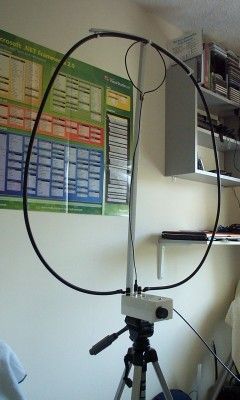
g4ilo-wonder-loop-1
The G4ILO Wonder Loop

The message to the KX3 Yahoo Group asked, “Has anyone used a Wonder Wand or Wonder Loop (I don’t know if there is a difference) with the KX3?” After a little Googling, I found The G4ILO Wonder Loop. G4ILO describes the Wonder Loop this way,

The G4ILO Wonder Loop is an inexpensive, easy to make magnetic loop antenna that covers five HF bands, 40m through 15m. It is designed for portability, and can be assembled or disassembled in about a minute. When disassembled the antenna easily fits in a suitcase or backpack.

The Wonder Loop is the perfect antenna for picnic table or hotel room operation, or for home station use where outside antennas are not permitted and attic antennas not possible. It needs no supporting mast, and no counterpoises or ground connections are required. Tuning is quick and easy.

What follows is a really great description of the antenna and how he built it. I have all the parts for this antenna, so I just might give it a go at some point. I don’t have a high-voltage capacitor, so I’d be restricted to QRP operation, but that’s OK.

k8nds-mag-loop
One of K8NDS’ helically-wound magnetic loops.

Helically-loaded magnetic loops

A couple of months ago, a guy I worked on 40m told me about the loop antennas designed by Rich, K8NDS. These are somewhat different than the typical magnetic loop antenna in that these typically consist of a flat, wide copper conductor, such as copper foil or copper flashing, helically wound over a PVC frame. According to  one of Rich’s websites, his design allows you to achieve a higher inductance in a small form factor. Another of Rich’s websites, http://www.hlmagneticloopantennas.com/, shows some of his designs and discusses some practical considerations.

Rich’s designs are made for high-power operation. As such, they use vacuum variable capacitors. The second website above gives a lot of useful advice for finding and buying such a capacitor.

I think a loop antenna may be a solution to getting on 80m. I don’t have enough space for an 80m dipole in my backyard, but I could set up a decent-sized loop in my backyard. Another solution I’m considering is one of those 43-ft. verticals, but they can be pricey, and need radials. Instead of buying one of these verticals, I could put the money towards a quality vacuum variable capacitor.

Other resources

There are a bunch of other resources on the web, including:

  • DIY Magnetic Loop Antennas by Owen, KF5CZO
  • Small Transmitting Loop Antennas (Magnetic Loop Antennas) by Steve, AA5TB
  • Magnetic Loop Antenna for 80 – 20 m by Frank, N4SPP

Related posts:

  1. Magnetic Loop Antenna at VE3SO
  2. Finally, a Loop for 10m.
  3. Got an indoor antenna? Help me out here.
  4. From my Twitter feed: loop antenna, 160m antenna, Japanese hams

Filed Under: Antennas Tagged With: magnetic loop

Reader Interactions

Comments

  1. Walter Underwood K6WRU says

    August 6, 2015 at 8:04 pm

    How often do you change frequency on 80m? If you stay in the CW or data segment, a loop might work. They are a hassle if you tune around.

    Here is one quick way to get into mag loops. Get one of the MFJ mag loop tuners. Get some flexible copper tubing, like used to connect water to refrigerator ice-makers. Hammer the ends flat, drill holes, and connect it to the MFJ.

    The MFJ instructions recommend loop circumferences. The best for 80m is 63 feet, but it probably works fine with 40 feet. That is about seven feet in diameter, so it might need some PVC support.

    http://www.mfjenterprises.com/Downloads/index.php?productid=MFJ-935B&filename=MFJ-935B.pdf&company=mfj

    Reply
  2. Chris Gerald Tucker KA7NIQ says

    August 13, 2015 at 8:07 am

    I am a Ham in Tampa. I own and operate a roof cleaning company here, so I see all the compromise antennas in our deed restricted communities.
    Of all the small compromise antennas, only the magnetic loop can approach the efficiency of a dipole. The problems have always been power handling and bandwidth.

    Reply

Leave a Reply Cancel reply

Your email address will not be published. Required fields are marked *

This site uses Akismet to reduce spam. Learn how your comment data is processed.

Primary Sidebar

No Nonsense Technician Class License Study Guide (for tests given between July 2026 and June 2030)

New No Nonsense Technican Class Study Guide now available!

The 2026 version of my Tech Class study guide is now available, and as always, the PDF version is FREE!. The ePub version costs $11.97, and a Kindle version and paperback version will be available on Amazon shortly.

Click here to get all of my "No Nonsense" study guides.

Also available: The CW Geek's Guide to Having Fun with Morse Code

W5SWL.Com
Retevis Ailunce H1 DMR Radio
DXpander: Cobweb antennas, Laser Cutting

You’ve got mail!

Enter your email address below and get an email every time I publish a new post.

Email


I frequently teach classes to help newcomers get their licenses. The next class will take place on Saturday, October 10, 2026 on the University of Michigan campus. Click here for more information.

If you can't make the class, subscribe to the mailing list to be notified of when the next class will be held.

You can always download my free study guide, and if you have any questions about the classes, or amateur radio in general, please feel free to email me directly.

Support KB6NU.Com

Donate $7.30 and get two of these cool stickers. Measuring 4.25-in. W by 2.75-in. H, it's perfect for your car, your shack, or wherever!

Contact me

If you have a question or comment about one of my blog posts, or a question about any of the material in my study guides, or just a question about ham radio in general, you can email me at [email protected].

Blogs You Should Also Read

  • AE5X: A CW-centric blog from Kingswood, Texas
  • K0LWC Blog
  • LA3ZA Ham Radio Blog
  • Little Radios, Big Fun – WB3GCK
  • Mr. Vacuum Tube's Blog
  • Radio Artisan – K3NG
  • The K0NR Weblog
  • VE3WDM's QRP Ham Radio Blog
  • W2LJ’s Blog

Ham Radio Websites

  • Dashtoons – The Hammin' Comedy by Jeff K1NSS

Podcasts

  • ICQ Podcast
  • Linux in the Ham Schack
  • No Nonsense Amateur Radio Podcast
  • Resonant Frequency Amateur Radio Podcast

Recent Comments

  • Frank on Make amateur radio club nets fun
  • Dan KB6NU on 2015 General Class study guide: Section G2E – Digital operating: procedures, procedural signals, and common abbreviations
  • Jimi on 2015 General Class study guide: Section G2E – Digital operating: procedures, procedural signals, and common abbreviations
  • Ali on Some Good Advice on Learning Morse Code
  • mike on Instant Character Recognition is the key to CW speed

Meta

  • Log in
  • Entries feed
  • Comments feed
  • WordPress.org

Footer

Copyright © 2026 Daniel M. Romanchik, KB6NU · Log in