
 When I was a kid, I used to watch Felix the Cat cartoons. One feature of those cartoons was Felix’s “magic bag of tricks.” Whenever he would get into a tight spot, he could make the bag into anything that he might need. For example, he might make it into an airplane and fly away from whatever trouble he had gotten himself into.
It’s even part of his theme song. One of the verses goes,
Felix the Cat,
The wonderful, wonderful cat,
Whenever he gets in a fix, he reaches into his bag of tricks.
When I started teaching one-day Tech classes, it became apparent to me that I needed my own “bag of tricks” to illustrate some of the concepts that I was trying to teach. For example, to illustrate question T6A05, “What type of electrical component consists of conductive surfaces separated by an insulator?” I pass around a ceramic capacitor from the bag of tricks to illustrate this point.
As I came across questions like these, I started throwing stuff from my junk box into a zip-lock bag. I’ve been carting this bag around for 20 years now, and it’s accompanied me all over the country from California to New England.
I’m continually adding items to the bag of tricks. The most recent addition is a short length of shielded cable (question T6D03). I rarely take things out of the bag, so it’s accumulated items that illustrated the answers to questions that are no longer in the question pool. More on that later.
What’s in my bag of tricks?
Yesterday, I got a text from a fellow who is teaching one-day Tech classes. He writes:
Can you kinda make an inventory of your bag of show-and-tell items for the HIAD (ham in a day) class?
Since this bag of tricks has always been sort of an ad-hoc thing, and it’s continually changing, I had never really created a list of items. I replied,
Hmmmm. Thanks for asking. I should probably re-think what’s in there. Give me a couple of days.
And so, that’s why I’m sitting at my desk, with the stuff from the bag of tricks not so neatly splayed out on the desk in front of me. Here’s what’s in there:
-
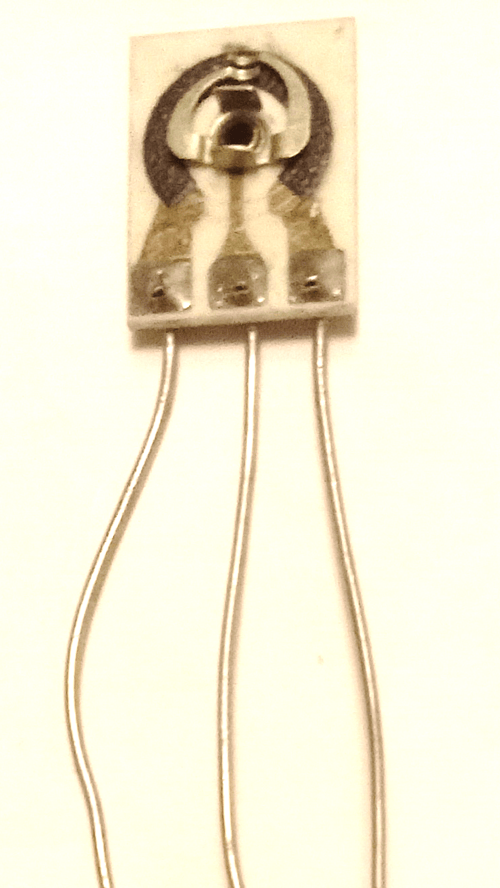
This potentiometer is one of the components in my one-day Tech class “bag of tricks.” A metal film resistor (T6A01).
- A 25 kΩ potentiometer (T6A03, T6A02)
- A potentiometer without the case (see right) that demonstrates how a pot works.
- A ceramic capacitor (T6A05)
- An electrolytic capacitor, in case anyone asks about them.
- A toroidal inductor (T6A06, T6A07)
- A rectifier diode (T6B02, T6B09, T6B06, T6D01). I’m also thinking about adding a small signal diode, such as a 1N4148 to the bag.
- Light-emitting diode (T6B06, T6D07)
- Transistors (T6B03, T6B10, T6B11). I have a couple of transistors in a plastic cases, a metal case 2N2222, and a larger power transistor.
- A PCB illustrating the circuit in Figure T-1 (T6C02, T6C03, T6D10, T6C04, T6C05). I designed this board specifically to explain these questions. I will happily send you one for a couple of bucks.
- 4001 integrated circuit (IC) in a 14-pin DIP package (T6D09). I keep thinking that I should get a big, honking processor IC to show as well.
- 78M05 voltage regulator (T6D05)
- A short length of shielded cable (T6D03)
- A dual-band HT. This can be used to illustrate lots of different questions. The most amusing to the class are when I use it to demonstrate antenna polarization (T9A03, T3B02) and cross-polarization (T3A04). To illustrate T3A04, I hold the radio so that the antenna is perpedicular to the ground and say, “It might look cool to hold the radio like this, but for best results, you really need to hold the radio so that the antenna is vertical.”
- A “rubber ducky” antenna (T9A04)
- Coax. I have three pieces of coax in the bag: RG-58, RG-213, and a piece of air-insulated coax. There are numerous questions about coax in the question pool.
- PL-259 (T9B07). The piece of RG-213 coax has a PL-259 attached.
- N connector (T9B06). What I had in the junk box was an N connector to BNC adapter.
- Length of “flat copper strap” (T4A08, T0A09)
- Clip-on ferrite choke (T7B11)
- Harbor Freight multimeter. I use this for all the multimeter questions, and I get a good laugh when I discuss T0A12 ”Which of the following precautions should be taken when measuring high voltages with a voltmeter?” The answer is, “Ensure that the voltmeter and leads are rated for use at the voltages being measured.” I say that the meter says it is rated up to 1,000 V, but you’ll probably melt the insulation on the test leads and blow up the meter if you do.
Finally, one thing I carry around with me is a vacuum tube. There are no questions on the test about tubes, but I show it to students who seem really interested in electronics. Once I explain how a tube works, they’re fascinated.
What am I missing?
There are probably a number of other things that I should have in the bag. Some that I could probably include kind of easily are:
- SPDT switch (T6A08). I probably could come up with a simple circuit board for this.
- Relay (T6D02). I’m sure that I have some of these in my junk box somewhere.
- Meter (T6D04). Ditto.
- Length of heavy-gauge DC power cable (T4A03)
There are undoubtedly others. Please, if you have something in your bag of tricks that I don’t have in min, or if you have an idea for something to include, let me know.
Leave a Reply