
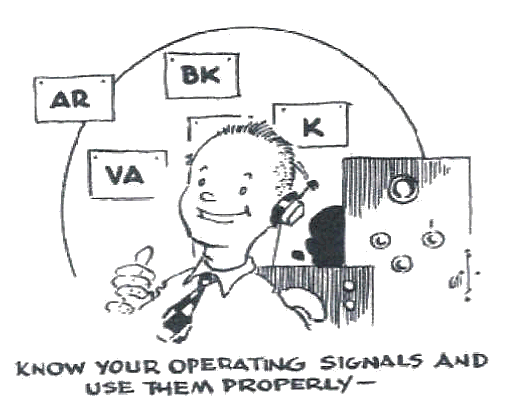
 The other day I called QRL? (“Is this frequency in use?” for you phone operators.) on 7028 kHz. The next thing I heard was a call sign.
This confused me. Was the guy telling me that the frequency was in use, or was he trying to establish contact with me? Discretion being the better part of valor, I decided to tune off frequency and call CQ elsewhere.
Everything that I’ve always read says that the correct response is either “C,” sometimes “R” or “YES,” if the frequency is in use or silence if the frequency is free. I would suggest that we stick to this protocol, although I’m perfectly willing to change, if others think there’s a better way.
What I really should have done is written down the callsign and emailed him to ask what his intention was. I could have used this occasion as an educational moment—for both of us!
Do you keep calling DX stations?
As I’ve said before, I’m not really much of a DXer. The other day, though, I got sucked into the pileup for 9LY1JM on 40m CW. I don’t really even know why I did it since I already have 9L confirmed.
Anyway, the operator at the key that day was often taking a very long time to respond to calls. Often more than a minute. Sometimes, up to two minutes. Sometimes, I’d call three or four times before he called another station.
That got me thinking about my calling strategy. Is the lack of activity on the part of the DX station an indication that he’s still listening or what? If he’s still listening, then I suppose it’s a good strategy to just keep calling until you hear the DX station call someone else. If not, then it really isn’t worth the bother.
Any thoughts?
Memorable NAQP QSO

On Saturday evening, I got sucked into the SSB version of the North American QSO Party. Again, I don’t really know why I did this because I’m not a big contester, and am definitely not a big phone operator. I didn’t even open up N1MM to log the contacts; I just entered them straight into my general QSO log.
Band conditions were decent, and making contacts was pretty easy. Pretty soon, I’d racked up nine contacts, then decided to make one more for an even ten, and call it a night.
My last contact was with W4AQL, the Georgia Tech Amateur Radio Club. After we’d exchanged info, the operator said, “Hey, you were my first QSL card!” How cool is that? I always make it a point to send someone a QSL card if they’re a new operator. It’s a great way get new hams engaged in the hobby.
Buzz is the mascot of the Georgia Institute of Technology. I’m radio is well within his grasp. https://en.wikipedia.org/wiki/Buzz_(mascot)
Hello Dan, I occasionally do some CW and am not aware of these protocols. Where can you find these? Is there a website that shows basic rules like the one you wrote about. Why responding with “C”?
I’ve been trying working 9X2AW on 60m for a few days now. He shows up every day at around the same time. But sometimes he’s just calling and not responding to the calling stations. I think it is just a matter of high noise/qrn, pulling out stations is difficult. In the end I made the contact yesterday evening but with very low report. Although I received him well. Could be the same for 9LY1JM.
73, Bas
The reason I heard for sending “C” is that it’s short for “si,” which is the Spanish word for “yes.” All of the recent books on CW operating procedure mention sending “C.” Earlier books, however, don’t mention this practice. Neither the 1991 edition of Morse Code: The Essential Language nor the 1997 edition of Morse Code: Breaking the Barrier mention a standard response to QRL?
An earlier book, the the 1973 edition of Operating an Amateur Radio Station from the ARRL, doesn’t mention sending QRL? at all. Instead, it says, “On cw, the [American] Morse letter C (didit dit) should bring a response if you are interfering with a station which you cannot hear.”
Technically, it could be argued that QRL is really not the appropriate Q-signal to use to check if the frequency is in use. Its “standard” meaning is “I am busy” or “Are you busy?”
I’m going to have to do some more research on when and how this operating practice has changed over the years.
Interesting story of how “C” means “Si” (yes). I’ve always thought it was “C” for “confirm”. I haven’t used “C” in years, though, preferring to use “R” (Roger) for confirmations, and actually trying to remember to use “Roger” instead of “QSL” on voice, as well.
I’m a fan of ON4UN and ON4WW’s “Ethics and Operating Procedures for the Radio Amateur” (http://www.hamradio-operating-ethics.org/versions-languages). The ARRL links to it from their “Operating Ethics” page (http://www.arrl.org/operating-ethics). The original version was much shorter, written by ON4WW, and was called, “Operating Practice” (http://www.on4ww.be/op.html). Both of these documents describe the responses to “QRL?” that Dan mentions above.
Although to purists, the protocols on phone and code may seem rigid, you have to kind of give a little leeway. Someone saying QTH or QRT on phone shouldn’t be ostracized. If I throw my call out on a local repeater, and then someone says their call sign, I’m thinking they are replying to me. I think in the situation you describe, I would of thought the same.
Operating practices are different on HF than they are on repeaters. You never ask if the frequency is in use on a a repeater, because if you don’t hear anyone talking, it’s either not in use or you are out of range. That’s not the case on HF.
Actually, I HAVE asked if a repeater was in use on several occasions when an in-progress QSO decided to move to another repeater, because one or more of the participants was getting out of range. The scenario is: “Hey, let’s move to 146.YY” and suddenly several operators end up on another machine. If I’m the first one over there, I’ll ask if the machine is in use, because I just plopped on the frequency and don’t know if there is a conversation going on there. It’s just polite to ask in situations like that. Of course, it would be even better if one of the group went there first and asked, before everyone just QSY’ed onto the new frequency.
I know of the response to “QRL?” Sending a few dits works too.
Though there have been a few (not that many) times where I was hanging out on a frequency while doing something else, reading a manual, checking my log, etc so I know the frequency is clear and hear a QRL? And would respond, but with a DE, “de N1XF”. Which has worked a few times for me, but I see the possible confusion now.
First of QRL? does not only mean “is this frequency occupied?” as it appears to do with open non circuit frequency working. More traditionally QRL? means “are you busy?” with regards to “point to point” working on a reserved circuit frequency.
Thus QRL? means different things to different people at different times that are sometimes almost the polar opposit of each other…
The problem with replying in any way to a QRL sent as an “is this frequency occupied” –on a non reserved circuit frequency– if “you” think the frequency is clear, is that “you” can get it wrong in terms of occupancy of the frequency, for whole heaps of reasons.
Even if “you” can not here anything on the frequency at your location it does in no way mean the frequency is unoccupied.
The only time “you” should respond to a QRL on an non circuit frequency is when you are one of the parties actively involved with communicating.
The opposit applies if you are on a reserved circuit frequency, that is you should always send a no if “your” status is that you are not busy.
But getting back to non reserved circuit frequency operating, it’s also polite to wait between overs to let the station making a QRL request hear if there may be others present when they may not be able to hear you for some reason (KWs-v-QRP etc).
That said there is no real way to resolve certain issues with a QSL request where “you” or others you can hear can not be heard by the QSL issuing station, that’s just the way it is sometimes.
When trying to work a CW pileup I sometimes try to find the last station who worked the DX station I want to call and call on that frequency when the QSO has finished. This isn’t possible, of course, if you can’t hear the station the DX station is working. I don’t keep calling every few seconds. I try to call if I can’t hear anyone else calling – not always possible either, HI!
What an excellent write up on QRL (and other things).
I recently posted a WQ6X Contest BLOG entry on this very subject:
http://wq6x.blogspot.com/2019/08/do-you-qrl.html
Hi. I was looking up an easy way to remember the QR’s for my exam- is it latin or ?… when I saw this post.
One of the questions on the exam is “ What is the proper Q signal to use if a frequency is in use before transmitting on CW? Answer QRL
We are studying from coaxpublications.ca
I am in Ontario Canada 🇨🇦 doing my exam next week.
Hope this helps