
I’ve decided that my next book is going to be about multimeters. Here’s a draft of the first chapter…Dan
Digital multimeters, or DMMs, are the most commonly-used test instruments by electronics engineers, technicians, and hobbyists to design, build, and troubleshoot electronic circuits. If you work with electronics or electrical circuits, either as a professional or as a hobbyist, you need a digital multimeter. Without one, it’s almost impossible to adjust or troubleshoot circuits.
Let me give you an example. About a year ago, my brother, Michael, decided that he was going to purchase a very-used shuffle bowling machine at an estate sale. This is the kind of coin-operated machine that you would often in bars. Put in a dime and it would allow you to “bowl” a game.
The unit he purchased was built in the late 1950s. Needless to say, it needed a lot of work. Before he actually paid for it, Michael asked me if I would help him fix it, and I said sure. It looked like it would be a lot of fun to get it running again.
The first thing that I advised him to do-once he got the machine home-was to buy a digital multimeter. With the digital multimeter, he was able to:
- Check the voltage across the transformer secondary windings to ensure that the transformer was still good.
- Check the continuity of the many solenoids in the machine to ensure that they were not shorted or open.
- Check the switches to make sure that they operated properly.
- Check the continuity of the wires in the cables connecting all the switches, solenoids, and indicators.
- And make many other measurements.
Without the digital multimeter, it would have been next to impossible to get the machine working again.
If you’re an amateur radio operator, you’ll need a multimeter to measure the output of your power supply and set it properly. You’ll need it to measure the resistance of the resistor that you’re going to insert in the printed circuit board of the kit you’re building. You’re going to need it to make sure that you haven’t shorted out your coax after you’ve installed a PL-259 connector on it. I have used mine for all of these measurements and more.
If you’re a homeowner, you can use a multimeter to check that the voltage present at an AC wall socket is really 117 VAC. You can also use it to make sure that the socket is wired properly. You can also use it to tell if a switch is working properly or if a circuit is wired properly.
What is a digital multimeter?
Simply put, a DMM is a test instrument that allows the user to measure voltage, current, and resistance, the three primary characteristics of an electrical circuit. While some DMMs may have other functions, measuring voltage–both direct current (DC) voltage and alternating current (AC) voltage, AC and DC current, and resistance are the most basic.
It’s called a “digital” multimeter because it uses digital electronics technology, rather than analog electronics technology to make measurements. Older “analog” multimeters used an electro-mechanical meter, like the one shown below, to indicate the value of the voltage, current, or resistance being measured. To make the measurement, you had to note how far the meter’s needle had deflected and then read the value from a scale printed on the face of the meter. A digital multimeter, on the other hand, displays a number on its LCD or LED display.
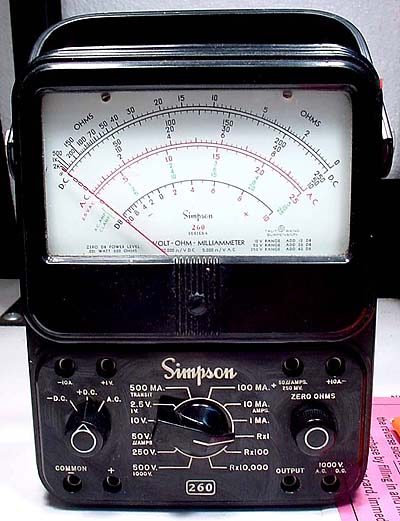
The difference between the two technologies is very similar to the difference between mechanical clocks and digital clocks. With a mechanical clock or watch, you have to note the positions of the two hands and then estimate the actual time. With a digital clock, you simply read the numbers. Both tell you the time, though.
While many old-timers swear by their analog meters, and while there are a few applications for which an analog meter is preferable to a digital meter, if you’re in the market for a multimeter, you want to buy a digital one. One reason for this is that most analog meters—at least ones that are any good—are really expensive. This generally makes instruments made with an analog meter more expensive than a digital multimeter that offers similar performance.
A digital multimeter will open up the world of electricity and electronics to you. With a digital multimeter, you’ll be able to make measurements that will show you how electrical and electronic circuits really work. And with that knowledge, you’ll save money as a homeowner and have more fun as an electronics hobbyist.