
• Skip to primary navigation
  • Skip to main content
  • Skip to primary sidebar
  • Skip to footer

KB6NU's Ham Radio Blog

KB6NU's Ham Radio Blog
  • HOME
  • Study Guides
  • Teach a One-Day Tech Class
  • W8SRC Repeater Guide
  • Advertise
  • Hire Me

VOX

Try FSQ for fast, simple QSOs

September 25, 2015 By Dan KB6NU 6 Comments

I’m an occasional user of digital modes, mostly PSK-31. Last night, though, I made my first FSQ QSO. What is FSQ? Well, ZL2AFP, one of the developers, describes it this way:

FSQ is a Fast Simple QSO mode designed specifically for HF. It works well under NVIS and sunrise/sunset conditions on the lower bands, and also works well for short skip and grey-line on higher bands. It can also be used on VHF FM, and clearly has a much wider useful range of operating conditions that other more conventional digital modes. FSQ transmission is also well within the capability of micro-controller based devices for low-power propagation transmissions (MEPT and telemetry). The FSQ modulation, coding and FSQCall protocol are publicly disclosed and described, and the software is open source.

I forget how I got interested in FSQ, but I probably heard about it sometime late August, and then there was an article about it in the September 2015 QST.

It has several features that really appeal to me:

  1. It’s a lot like chatting over the Internet. You simply type in a line, hit RETURN, and the software sends your callsign and the line you just typed.
  2. It has an image mode.
  3. You can selectively call a station.

That third feature would seem to be especially useful for use on VHF. I envision a “network” of stations here in Ann Arbor who are all running FSQ, monitoring the local repeater. I would use this network to send messages and images, maybe schematics, to those stations when I had something to send them. There’s also a relay feature that you could use to send messages to stations that perhaps cannot reach the repeater, but could reach a station not on the repeater.

Thom, W8TAM, and I are going to experiment a little with this mode of operation. One thing we found is that the VHF transceivers that we both have do not have VOX capability. So, as we also want to experiment with cheap sound cards other than the Signalink (like this Syba sound card), we’re also building the ZL1BPU VOX PTT circuit (see below). Depending on what you have in your junkbox, this circuit should cost you about ten bucks.
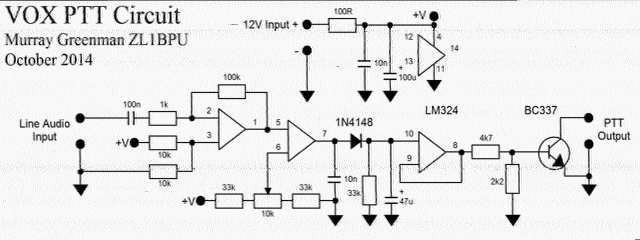
zl1bpu-vox-ptt

I was hoping that Thom and I would have had this all working on 2m by now, but circumstances have gotten in the way. I did, however, make my first FSQ QSOs on 40m last night.

My first FSQ actually started out as a CW QSO. I called CQ on 7026 kHz and got a call from Peter, VE3SO. During our QSO, I mentioned that I was going to try out FSQ later that evening. Peter said that he hadn’t heard about FSQ before, but it sounded interesting. I mentioned the article in the September QST.

After signing with Peter, I tuned up to 7104 kHz, the FSQ frequency on 40m. While playing around with the FLDIGI program, which now supports FSQ, I saw the callsign ve3so pop up on my screen. Peter went from just hearing about the mode to his first QSO in minutes! He was my first FSQ QSO as well.

So, I’m off and running with FSQ. If you already have a digital modes interface for your computer, give it a try. Listen for me on 7104 kHz.

Filed Under: Digital Communications Tagged With: FSQ, VOX

2015 General Class study guide – Section G2A – Phone operating procedures, USB/LSB utilization conventions, procedural signals, breaking into a QSO in progress, VOX operation

February 11, 2015 By Dan KB6NU Leave a Comment

In this section, the answer to G2A06 was changed slightly as was the wording of question G2A10.

Single sideband is the mode of voice communication most commonly used on the high frequency amateur bands. (G2A05) When using single sideband (SSB) voice mode, only one sideband is transmitted; the other sideband and carrier are suppressed. (G2A07) Because only one sideband is transmitted, less bandwidth used and greater power efficiency is an advantage when using single sideband as compared to other analog voice modes on the HF amateur bands. (G2A06)

Upper sideband is the sideband most commonly used for voice communications on frequencies of 14 MHz or higher. (G2A01) Accordingly, upper sideband is most commonly used for voice communications on the 17 and 12 meter bands (G2A04) and upper sideband is most commonly used for SSB voice communications in the VHF and UHF bands. (G2A03)

Lower sideband is the mode most commonly used for voice communications on the 160, 75, and 40 meter bands. (G2A02)The reason most amateur stations use lower sideband on the 160, 75 and 40 meter bands is that current amateur practice is to use lower sideband on these frequency bands. (G2A09)

To establish a contact on the HF bands, you can call CQ, reply to a CQ, or break into a conversation that’s already in progress. The recommended way to break into a conversation when using phone is to say your call sign during a break between transmissions from the other stations. (G2A08)

Sometimes you’ll hear stations calling “CQ DX” instead of simply CQ. The expression “CQ DX” usually indicates The caller is looking for any station outside their own country. (G2A11)

When operating SSB, many amateurs like to use the VOX, or voice-operated control, instead of push-to-talk, or PTT, operation . Why would amateurs use voice VOX operation versus PTT operation? VOX allows “hands free” operation. (G2A10)

Filed Under: Classes/Testing/Licensing Tagged With: SSB, VOX

Primary Sidebar

No Nonsense Technician Class License Study Guide (for tests given between July 2026 and June 2030)

New No Nonsense Technican Class Study Guide now available!

The 2026 version of my Tech Class study guide is now available, and as always, the PDF version is FREE!. The ePub version costs $11.97, and a Kindle version and paperback version will be available on Amazon shortly.

Click here to get all of my "No Nonsense" study guides.

Also available: The CW Geek's Guide to Having Fun with Morse Code

W5SWL.Com
Retevis Ailunce H1 DMR Radio
DXpander: Cobweb antennas, Laser Cutting

You’ve got mail!

Enter your email address below and get an email every time I publish a new post.

Email


I frequently teach classes to help newcomers get their licenses. The next class will take place on Saturday, October 10, 2026 on the University of Michigan campus. Click here for more information.

If you can't make the class, subscribe to the mailing list to be notified of when the next class will be held.

You can always download my free study guide, and if you have any questions about the classes, or amateur radio in general, please feel free to email me directly.

Support KB6NU.Com

Donate $7.30 and get two of these cool stickers. Measuring 4.25-in. W by 2.75-in. H, it's perfect for your car, your shack, or wherever!

Contact me

If you have a question or comment about one of my blog posts, or a question about any of the material in my study guides, or just a question about ham radio in general, you can email me at [email protected].

Blogs You Should Also Read

  • AE5X: A CW-centric blog from Kingswood, Texas
  • K0LWC Blog
  • LA3ZA Ham Radio Blog
  • Little Radios, Big Fun – WB3GCK
  • Mr. Vacuum Tube's Blog
  • Radio Artisan – K3NG
  • The K0NR Weblog
  • VE3WDM's QRP Ham Radio Blog
  • W2LJ’s Blog

Ham Radio Websites

  • Dashtoons – The Hammin' Comedy by Jeff K1NSS

Podcasts

  • ICQ Podcast
  • Linux in the Ham Schack
  • No Nonsense Amateur Radio Podcast
  • Resonant Frequency Amateur Radio Podcast

Recent Comments

  • Matt W1CDN on A completely different picture of Wayne Green, W2NSD (SK)
  • Chana Walsh on Rethinking ham radio education
  • Rob WfourZNG on Videos: What’s next for POTA, ham radio helps rescue man trapped in cave
  • Dan KB6NU on The EMF Explorer: A badge for ham radio?
  • Travis Good on The EMF Explorer: A badge for ham radio?

Meta

  • Log in
  • Entries feed
  • Comments feed
  • WordPress.org

Footer

Copyright © 2026 Daniel M. Romanchik, KB6NU · Log in