
• Skip to primary navigation
  • Skip to main content
  • Skip to primary sidebar
  • Skip to footer

KB6NU's Ham Radio Blog

KB6NU's Ham Radio Blog
  • HOME
  • Study Guides
  • Teach a One-Day Tech Class
  • W8SRC Repeater Guide
  • Advertise
  • Hire Me

First amateur radio geosynchronous satellite to launch in 2017

December 29, 2015 By Dan KB6NU 3 Comments

It was recently announced that researchers at the Ted and Karyn Hume Center for National Security and Technology, part of Virginia Tech University are preparing to send an amateur radio transponder into a geosynchronous orbit in 2017.
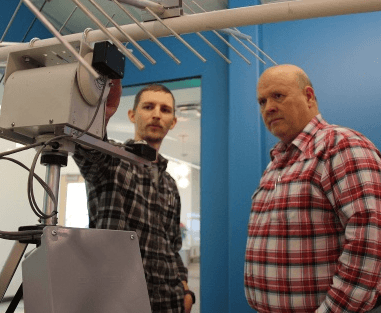
Bob McGwier, N4HY, and research associate Zachary Lefke discussing the antennas to be used for the geosynchronous satellite's ground station.
Bob McGwier, N4HY, and research associate Zachary Lefke discussing the antennas to be used for the geosynchronous satellite’s ground station.

“Seven days a week, 24 hours a day, 365 days a year, a new ham band will be available for the Americas,” said Robert McGwier, N4HY, a research professor in the Bradley Department of Electrical and Computer Engineering and the Hume Center’s director of research. This would be the first amateur radio payload in a geosynchronous orbit, and would significantly enhance communications capabilities for amateur radio operators, in particular following natural disasters or other emergency situations.

Amateurs have, of course, been communicating via satellite for decades. The first Orbiting Satellites Carrying Amateur Radio, or OSCAR, satellites were launched in the 1960s. Until now, however, these satellites have been in low Earth orbit (LEO), and were only available for short times when they happened to be overhead.

A geosynchronous satellite, however, would be accessible 24 hours a day, seven days a week. A geosynchronous orbit has the same period as the Earth’s rotation — just under 24 hours. That makes them easy to locate and access, as they are almost always in the same spot in the sky. In this case, the satellite will always be within a band of longitudes over the Americas, continually accessible to any amateur radio operator there, including the students and researchers at the Virginia Tech Ground Station.

One expected application is emergency communications. This satellite will allow amateur radio operators to help emergency personnel reliably access supplies, logistical support, and medical assistance. They key is to ensure that the satellite would always be accessible to the radio operators — which is why the geosynchronous orbit is critical.

The satellite itself will be operated by Millennium Space Systems on behalf of the United States Air Force; the Radio Amateur Satellite Corporation, also known as AMSAT, will operate the radio, which will be designed and built by Virginia Tech students — making this project a unique collaboration among the university, nonprofit organizations, private companies, and the federal government.

The Hume Center team is also engineering a ground terminal that emergency personnel could use to relay their own existing communications channels through the satellite. This setup could be deployed through the American Radio Relay League and the Radio Amateur Satellite Corporation as a key part of a robust national emergency response system, allowing trained operators to reliably mobilize to disaster areas in the first critical hours after a devastating event.

Questions. I have questions.

I’ve taken most of this information from a press release on the Virginia Tech website. The press release raises nearly as many questions as it answers. For example:

  • What can I and other amateur radio operators do to support this effort?
  • What frequencies will this satellite use?
  • Will amateurs like you and me be able to build their own equipment to access this satellite?
  • If so, what kind of equipment will amateur radio operators need to communicate via this satellite?

I’ve e-mailed N4HY with these questions. I’ll follow up on this story when I have the answers. This will be an amazing addition to amateur radio, and I’m looking forward to it.

UPDATE: There is more information in the QRZ.Com at http://forums.qrz.com/index.php?threads/first-amateur-radio-in-geosynchronous-orbit.505312/, if you want to wade through some the usual baloney that these threads contain. I’ll do that myself and update this post later.

Related posts:

  1. 2014 Tech study guide: satellite operation
  2. Amateur radio in the news: Ham finds long-lost satellite, LI hams to honor pandemic heroes
  3. 2020 Extra Class study guide: E2A – Amateur radio in space: amateur satellites; orbital mechanics; frequencies and modes; satellite hardware; satellite operations
  4. Amateur radio in the news, satellite edition: WA students reach for the stars, first Phillipines satellite

Filed Under: Everything Else

Reader Interactions

Comments

  1. Gary Pearce KN4AQ says

    October 14, 2016 at 5:32 am

    Here’s the presentation on the satellite from the 2016 ARRL/TAPR DCC. It’ll be a “Five & Dime” satellite (5 GHz up, 10 GHz down), with 1000 10 kHz wide all-digital channels.

    https://youtu.be/BE6ZZ3MQsNY

    Reply
    • Dan KB6NU says

      October 14, 2016 at 9:19 am

      Thanks, Gary!

      Reply
  2. Dan KB6NU says

    November 21, 2018 at 4:43 pm

    Anyone know whatever happened to this project? It obviously never was launched in 2017. Is it still in the cards?

    Reply

Leave a Reply Cancel reply

Your email address will not be published. Required fields are marked *

This site uses Akismet to reduce spam. Learn how your comment data is processed.

Primary Sidebar

No Nonsense Technician Class License Study Guide (for tests given between July 2026 and June 2030)

New No Nonsense Technican Class Study Guide now available!

The 2026 version of my Tech Class study guide is now available, and as always, the PDF version is FREE!. The ePub version costs $11.97, and a Kindle version and paperback version will be available on Amazon shortly.

Click here to get all of my "No Nonsense" study guides.

Also available: The CW Geek's Guide to Having Fun with Morse Code

W5SWL.Com
Retevis Ailunce H1 DMR Radio
DXpander: Cobweb antennas, Laser Cutting

You’ve got mail!

Enter your email address below and get an email every time I publish a new post.

Email


I frequently teach classes to help newcomers get their licenses. The next class will take place on Saturday, February 7, 2026 on the University of Michigan campus. Click here for more information.

If you can't make the class, subscribe to the mailing list to be notified of when the next class will be held.

You can always download my free study guide, and if you have any questions about the classes, or amateur radio in general, please feel free to email me directly.

Support KB6NU.Com

Donate $7.30 and get two of these cool stickers. Measuring 4.25-in. W by 2.75-in. H, it's perfect for your car, your shack, or wherever!

Contact me

If you have a question or comment about one of my blog posts, or a question about any of the material in my study guides, or just a question about ham radio in general, you can email me at [email protected].

Blogs You Should Also Read

  • AE5X: A CW-centric blog from Kingswood, Texas
  • K0LWC Blog
  • LA3ZA Ham Radio Blog
  • Little Radios, Big Fun – WB3GCK
  • Mr. Vacuum Tube's Blog
  • Radio Artisan – K3NG
  • The K0NR Weblog
  • VE3WDM's QRP Ham Radio Blog
  • W2LJ’s Blog

Ham Radio Websites

  • Dashtoons – The Hammin' Comedy by Jeff K1NSS

Podcasts

  • ICQ Podcast
  • Linux in the Ham Schack
  • No Nonsense Amateur Radio Podcast
  • Resonant Frequency Amateur Radio Podcast

Recent Comments

  • Steve KB3JC on How to “ragchew” on CW
  • Dan KB6NU on Yaesu FT-710: What’s the big deal?
  • Andrei on Yaesu FT-710: What’s the big deal?
  • Dan KB6NU on Finally, a Loop for 10m.
  • Dan KB6NU on 1930s cards for my collection of QSLs from stations whose callsigns spell words

Meta

  • Log in
  • Entries feed
  • Comments feed
  • WordPress.org

Footer

Copyright © 2026 Daniel M. Romanchik, KB6NU · Log in