Mac Logging Programs

Last October, I purchased a used, iBook G4 Mac laptop and promptly started looking for logging programs. I found one that was kind of expensive (MacLoggerDX); one that was free, but didn’t want to work so well (RUMLog); and one that worked OK and cost somewhere in between the first two (Aether).

I ended up purchasing Aether, but was never very happy with it. For one thing, it took forever to do any kind of sort or look up previous QSOs. Another pain was that it carried over none of the information from the previous contact, so you had to enter all of the information from scratch, even if you didn’t change frequencies or bands. It also had an odd way of doing notes about a contact, and I was disappointed to find out that it didn’t import the notes from the ADIF file I created from the N3FJP logging program I used previously. Since I had paid for it, though, I was reluctant to just dump it.

Well, a couple of weeks ago, I’d had enough and decided to start searching again. Since RUMLog was still free, I decided to give the new version (v 3.0, March 15, 2008) a go. I’m happy to report that this version likes my computer a lot better, and I like using it a lot!

One of the coolest things is that it did import the notes from my N3FJP ADIF file properly. So, now, when I type in a callsign, the program searches the database, finds all the previous contacts I’ve had with that station, and then displays them in spreadsheet style WITH the notes. If I’ve taken notes about a previous conversation, I can pick up right where I left off. Very cool.

It also has a very nice way of showing you what countries you’ve worked, on what bands you’ve worked them, and whether or not you’ve QSLed that country or not. Not only that, it shows what type of QSL you have, either a paper QSL or a Logbook of the World (LOTW) QSL. To get it to show LOTW QSLs, you have to somehow feed it information that you download from LOTW. I haven’t figured out how to do that yet.

According to RUMLog, I have 142 countries worked, but only 69 confirmed. After getting this report, I pawed through my QSL file and found cards from 18 countries that weren’t QSLed via LOTW, so I’m still 13 short for DXCC.  I guess I’m going to have to generate some more paper to get that certificate.

Don’t Throw Away Your Analog Cell Phone!

Dr. Arnie Coro, of Radio Havana’s DXers Unlimited, noted on his July 22/23, 2008 show:

The top quality microphones used by cellphone manufacturers are ideal for amateur radio use. A broken down, or an obsolete cellphone is a low cost source of two highly valuable devices… a nice high quality electret microphone element, and an also high quality optimized for voice communications earphone… So, follow your friend ARNIE CORO´S advice and don´t let your friends throw away the old analog cellphones before removing the microphone element and the earphone capsule…

For your information, my amateur radio two meters band handie talkie, a recycled unit itself, now has a much better microphone element than the original one, thanks to that simple surgical electronic transplant operation…The microphone from a Nokia analog cellphone has proven to receive much better audio reports than those that I got with my factory installed handy talkie built in microphone, an it took just about an hour to extract the analog Nokia cellphone microphone element and then install it on the old 1991 vintage YAESU FT 411 two meters band handie talkie… Reports received on the local 145.190 Havana Metropolitan Area repeater were very encouraging, with several of my friends telling me that the Nokia microphone element from the cellphone was sounding much better than the original element used by YAESU… And of course that as soon as I am able to get a hold of another broken down cellphone I will use it to replace the active element on an very old 6 meters band transceiver that has received some not very nice audio quality reports recently…

Not being a cellphone user myself, I don’t know how many of these are still available, but you might want to keep your eyes open for them.

Ads You May Have Missed in QST

I was looking through the ads in the back of the August QST, and I was reminded of how I used to do this as a kid. I would scour the ads, looking for some company or product I hadn’t seen before, then circling the appropriate number on the reader service card. Of course, now that we have the Web, there’s no need for reader service cards!

The first ad to catch my eye was a 1/16-page ad on page 144 for Liu & DB Enterprises, the “proud distributor of LDB brand electronics testing & measurement instruments.” They sell an eclectic mix of things including an analog audio generator, analog RF generator, five digital multimeters, a couple of frequency counters, and some soldering/desoldering stations. They even have a couple of ion air cleaners!

Just below the LDB ad, is an ad for Kintronics Labs, Inc. It’s a little bit unclear as to why they’re advertising in QST. Their ad shows a “49m, 10kW HF Balun” and their website notes, ” From concept to on air, Kintronic Labs, Inc. is ready to serve your AM/Medium Wave radio broadcast facility needs in a timely, efficient, and cost effective manner.” I suppose that if you have a lot of money, you could get them to design a custom antenna for you.

Finally, check out the ad on page 140 for Odyssey of an Eavesdropper. This book, written by Marty Kaiser, W3VCG, is subtitled “My life in electronics countermeasures and my battle against the FBI.” Check out his website to get an idea how an early interest in ham radio can get you in trouble. <grin>

Trunk-Fest

This morning, I drove over to Utica, MI to attend the General Motors ARC “Trunk Swap.” They charged $5/car, whether you were selling anything or not. They were also selling donuts for a buck apiece. the thing started at 7am and ended at 10am.

I didn’t count exactly, but I’m guessing that there were maybe 15 or 20 sellers and approximately 50 buyers. I’m also going to guess that they took in about $125. It wasn’t a big event, but it wasn’t hard to organize, and it was fun.

I liked it so much that I’m thinking of trying it here in Ann Arbor. We could commandeer part of a parking lot–perhaps the Pioneer High School lot or maybe a grocery store lot and run our own “trunk-fest.”

Have you attended one of these where you are? What did you like about it? What didn’t you like?

NASA to Hams: Hold Your Horses

As hams, we live and die with the sunspot cycle. (OK, OK, that’s being a bit drastic, but you get my point.) And, it’s no secret that we’re at that point in the cycle where sunspots are few and far between. It seems that it’s been so long since we’ve gotten any good news on this front, that some hams are speculating that we’re entering another Maunder Minimun, the years between 1645 and 1715 when there was virtually no sunspot activity.

Well, fret not says NASA solar physicist David Hathaway. In the article, “What’s Wrong with the Sun? (Nothing),” he notes:

“There have been some reports lately that Solar Minimum is lasting longer than it should. That’s not true. The ongoing lull in sunspot number is well within historic norms for the solar cycle.”

The article is chock full of data and charts, including the one below:


I won’t attempt to quote the whole thing, but the gist of it is that there’s nothing wrong with the sun, and we should start seeing more spots soon. I guess time will tell.

Monitor Your TX Output With This RF Sampler

I’ve always wanted a circuit for sampling the output of a transmitter. Well, today, I got the July 2008 issue of Feedback, the newsletter of the Southern Michigan ARS, which included the circuit below, courtesy of K6LS. I think I’d use a UHF T connector instead of a BNC connector, but otherwise it looks like a winner. (Click on the image to go to K6LS’s fine website and get a larger version of the diagram.)
RF Sampler

QSLs from Antarctica

Yesterday, a packet of QSLs arrived from ARRL QSL Bureau. I really haven’t been sending out many QSLs, and since the last couple of packets, hadn’t contained anything really exciting, I wasn’t expecting much this time. Well, I got a very pleasant surprise—two QSL cards from Antarctica.

VP8CMH QSLThis card is from the Royal Research Ship James Clark Ross. The card lists the ship’s location as 53S, 37W, which is about due east of the tip of South America.  That’s not quite Antarctica, but the ship does travel there frequently. The card notes, “The Royal Research Ship James Clark Ross was launched on the 1st December 1990 by Her Majesty Queen Elizabeth II and entered service with the British Antarctic Survey in September 1991.”

R1ANN QSL
This card is from R1ANN, which is most definitely located on the continent of Antarctica. The QTH is the Novolazarevskaya Base of the 50th Russian Antarctic Expedition. The card lists the station location as 70′49′26”S, 11′38′46”E.

Coincidentally, I made both of these contacts on 30m CW. I find 30m CW probably the best band for making contacts such as these. At any rate, both of these QSOs were very cool indeed (pun intended).

SuitSat 2 on the Way

EE Times has just published a very cool article with some history on SuitSat 1 and some design info on SuitSat 2. Unfortunately, they don’t give a date for the launch of the second SuitSat.  Here’s an excerpt from the article:

The experience proved so interesting that the engineers enthusiastically signed up for SuitSat-2. Leveraging their acquired knowledge, the team has already developed a new solar-conversion technique for the follow-on satellite that will extend system life to months instead of weeks. They have also crafted a software-defined, full-duplex radio with a better antenna for two-way communication and more-refined control.

For more information, go to the SuitSat website, which has links to a couple of ARRL articles on SuitSat 2.

Fun on the Fourth

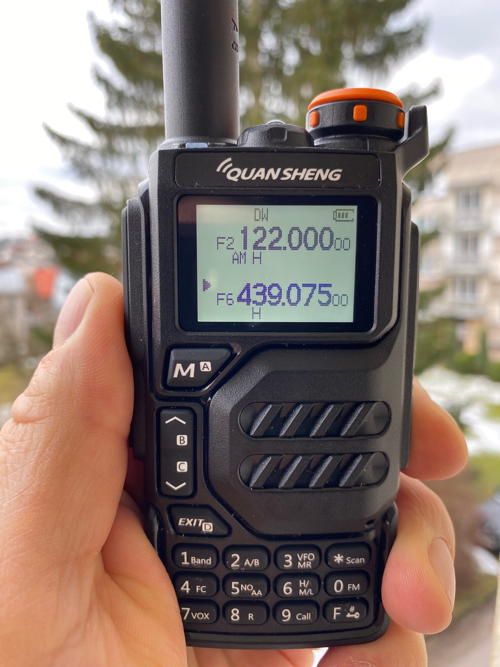
HT with flagThis year, as we have done for at least the last five years, our amateur radio club provided communications for the JayCee’s Ann Arbor Fourth of July Parade. Last year, I tried to get a small flag they were handing out to kids to mount on my HT antenna, but was rebuffed, the woman saying, “These are for kids.”

Well, this year, I brought my own.  Got a lot of great comments on it, too. :)

Great Lakes Division Has New Website

From Jim Weaver, K8JE:

The GLD web site is totally revised and updated!  You are invited to go to http://www.greatlakes.arrl.org to get a look at what webmeister Gary
Osborne, W8XS has done.

The web site and how we plan to use it will continue to evolve.  If you have suggestions of features you would like to see on the site, please
let me know.  Keep in mind that this is a Division site.  The three Section web sites will continue to provide most of the coverage of
Section information.

Thanks to W8XS for the fine work; work he has only just begun.

73, Jim