
• Skip to primary navigation
  • Skip to main content
  • Skip to primary sidebar
  • Skip to footer

KB6NU's Ham Radio Blog

KB6NU's Ham Radio Blog
  • HOME
  • Study Guides
  • Teach a One-Day Tech Class
  • W8SRC Repeater Guide
  • Advertise
  • Hire Me

2020 Extra Class study guide: E6B – Diodes

February 9, 2020 By Dan KB6NU 1 Comment

Diodes have two terminals and conduct current in only one direction, from the cathode to the anode. By manipulating the characteristics of the semiconductor material, manufacturers can make diodes useful in a wide variety of applications.

Take, for example, the Zener diode. Zener diodes actually allow current to flow in both directions, but only when the reverse bias voltage reaches a specific voltage, called the Zener voltage. When the voltage across the Zener diode reaches that point, it begins to conduct current in the reverse direction and maintains a constant voltage drop across the diode. This makes it useful in voltage regulator circuits.

QUESTION: What is the most useful characteristic of a Zener diode? (E6B01)
ANSWER: A constant voltage drop under conditions of varying current

Another example is the varactor diode. The capacitance of a varactor diodes changes as you change the voltage across it. This allows you to use it as a voltage-controlled capacitor in tuning circuits.

QUESTION: What type of semiconductor device is designed for use as a voltage-controlled capacitor? (E6B04)
ANSWER: Varactor diode

PIN diodes are diodes that operate as a variable resistor at RF and microwave frequencies. One common use for PIN diodes is as an RF switch. One characteristic of a PIN diode that makes it useful as an RF switch or attenuator is low junction capacitance. The forward DC bias current level is used to control the attenuation of RF signals by a PIN diode.

QUESTION: What characteristic of a PIN diode makes it useful as an RF switch? (E6B05)
ANSWER: Low junction capacitance

QUESTION: What is used to control the attenuation of RF signals by a PIN diode? (E6B11)
ANSWER: Forward DC bias current

Schottky diodes have a metal-semiconductor junction and have less forward voltage drop than other types of diodes. For this reason, are often used as a power supply rectifier. When used in digital ICs, the lower forward voltage drop allow the ICs to switch faster, and they are also often used as a VHF/UHF mixer or detector.

QUESTION: What is an important characteristic of a Schottky diode as compared to an ordinary silicon diode when used as a power supply rectifier? (E6B02)
ANSWER: Less forward voltage drop

QUESTION: Which of the following is a Schottky barrier diode? (E6B08)
ANSWER: Metal-semiconductor junction

QUESTION: Which of the following is a common use of a Schottky diode? (E6B06)
ANSWER: As a VHF/UHF mixer or detector

Point-contact diodes are also commonly used as RF detectors.

QUESTION: What is a common use for point-contact diodes? (E6B09)
ANSWER: As an RF detector

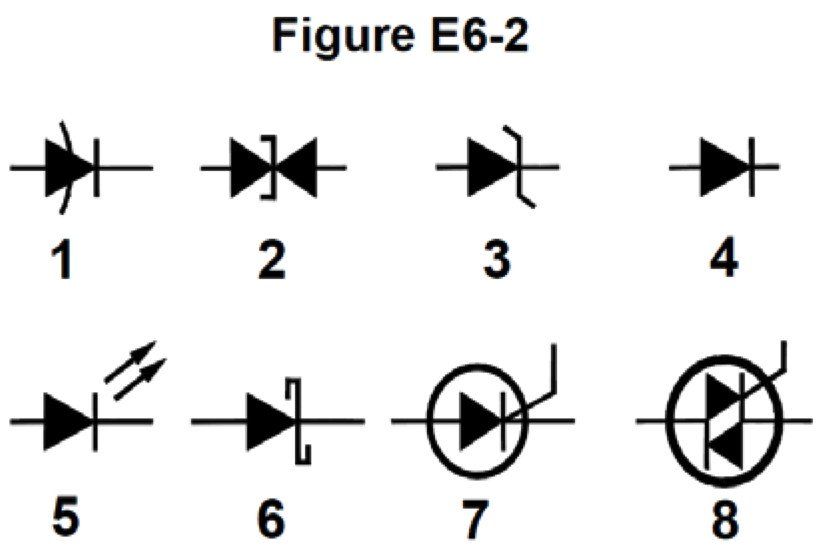
Light-emitting diodes, or LEDs, are widely used in amateur radio as visual indicators. When you forward bias an LED, current flows through the diode and it emits light. The schematic symbol for an LED is similar to the symbol for a signal diode, but has two arrows pointing away from the diode that are meant to show that it is emitting light.

QUESTION: What type of bias is required for an LED to emit light? (E6B03)
ANSWER: Forward bias

QUESTION: In Figure E6-2, what is the schematic symbol for a light-emitting diode? (E6B10)
ANSWER: 5
No matter what type of diode you are using, it’s very important to not exceed the forward current specification. Doing so, will cause the junction temperature to increase, and ultimately cause the diode to fail.

QUESTION: What is the failure mechanism when a junction diode fails due to excessive current? (E6B07)
ANSWER: Excessive junction temperature

Related posts:

  1. Extra Class question of the day: Semiconductor diodes
  2. 2020 Extra Class study guide: E6A – Semiconductor materials and devices: semiconductor materials; germanium, silicon, P-type, N-type; transistor types: NPN, PNP, junction, field-effect transistors: enhancement mode; depletion mode; MOS; CMOS; N-channel; P-channel
  3. 2016 Extra Class Study Guide: E6A – Semiconductor materials and devices
  4. 2016 Extra Class study guide: E6B – Diodes

Filed Under: Everything Else

Reader Interactions

Leave a Reply Cancel reply

Your email address will not be published. Required fields are marked *

This site uses Akismet to reduce spam. Learn how your comment data is processed.

Primary Sidebar

No Nonsense Technician Class License Study Guide (for tests given between July 2026 and June 2030)

New No Nonsense Technican Class Study Guide now available!

The 2026 version of my Tech Class study guide is now available, and as always, the PDF version is FREE!. The ePub version costs $11.97, and a Kindle version and paperback version will be available on Amazon shortly.

Click here to get all of my "No Nonsense" study guides.

Also available: The CW Geek's Guide to Having Fun with Morse Code

W5SWL.Com
Retevis Ailunce H1 DMR Radio
DXpander: Cobweb antennas, Laser Cutting

You’ve got mail!

Enter your email address below and get an email every time I publish a new post.

Email


I frequently teach classes to help newcomers get their licenses. The next class will take place on Saturday, October 10, 2026 on the University of Michigan campus. Click here for more information.

If you can't make the class, subscribe to the mailing list to be notified of when the next class will be held.

You can always download my free study guide, and if you have any questions about the classes, or amateur radio in general, please feel free to email me directly.

Support KB6NU.Com

Donate $7.30 and get two of these cool stickers. Measuring 4.25-in. W by 2.75-in. H, it's perfect for your car, your shack, or wherever!

Contact me

If you have a question or comment about one of my blog posts, or a question about any of the material in my study guides, or just a question about ham radio in general, you can email me at [email protected].

Blogs You Should Also Read

  • AE5X: A CW-centric blog from Kingswood, Texas
  • K0LWC Blog
  • LA3ZA Ham Radio Blog
  • Little Radios, Big Fun – WB3GCK
  • Mr. Vacuum Tube's Blog
  • Radio Artisan – K3NG
  • The K0NR Weblog
  • VE3WDM's QRP Ham Radio Blog
  • W2LJ’s Blog

Ham Radio Websites

  • Dashtoons – The Hammin' Comedy by Jeff K1NSS

Podcasts

  • ICQ Podcast
  • Linux in the Ham Schack
  • No Nonsense Amateur Radio Podcast
  • Resonant Frequency Amateur Radio Podcast

Recent Comments

  • Rob WfourZNG on Videos: What’s next for POTA, ham radio helps rescue man trapped in cave
  • Dan KB6NU on The EMF Explorer: A badge for ham radio?
  • Travis Good on The EMF Explorer: A badge for ham radio?
  • MARTIN ROBERT ROTHFIELD on The EMF Explorer: A badge for ham radio?
  • Mike Chen on Operating Notes, January 5, 2026

Meta

  • Log in
  • Entries feed
  • Comments feed
  • WordPress.org

Footer

Copyright © 2026 Daniel M. Romanchik, KB6NU · Log in