
• Skip to primary navigation
  • Skip to main content
  • Skip to primary sidebar
  • Skip to footer

KB6NU's Ham Radio Blog

KB6NU's Ham Radio Blog
  • HOME
  • Study Guides
  • Teach a One-Day Tech Class
  • W8SRC Repeater Guide
  • Advertise
  • Hire Me

A Field Guide to Simple HF Dipoles

July 25, 2018 By Dan KB6NU 3 Comments

A link to A Field Guide to Simple HF Dipoles was posted on reddit this morning, and I liked this document so much that I thought I would blog about it. The preface to this document reads:

Under project Agile, Stanford Research Institute has supplied several teams to assist operating personnel in improving the performance of field radio networks. In this work, it has been observed that U.S. military and civilian antenna manuals often contain misleading information regarding the operation of field antennas and tend to be overly complex. Consequently, this guide has been prepared to assist in training personnel concerned with the construction of simple HF antennas in the field.

I must say that A Field Guide to Simple HF Dipoles does this very well. It not only explains how dipole antennas work, it also does a very good job of describing the basics of radio waves and propagation. And it does this without getting overly technical.

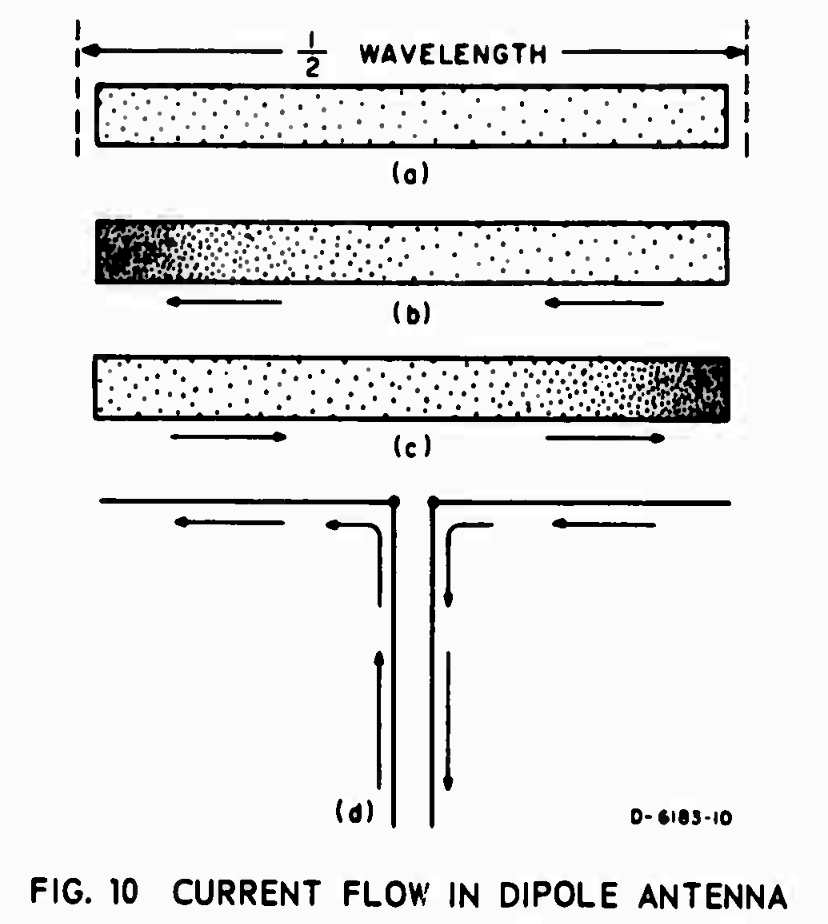
For example, below is Figure 10. It’s used to describe current flow in a dipole antenna.
The Field Guide reads:

Electric current in a conductor consists of the flow of small particles called electrons. Figure 10(a) represents a dipole with electrons in it. When the transmitter is turned off, the electrons distribute themselves evenly throughout the dipole, as shown. All electrons repel each other and try to get as far from each other as possible; that is how they achieve the uniform distribution show in Figure 10(a). When the transmitter is turned on, the electrons flow back and forth from end to end as shown in Figures 10(b) and 10(c). First the electrons flow to the left and crowded at one end as shown in Figure 10(b). Second, since the electrons repel each other, the push off to the right and get crowded together at the other end, as in Figure 10(c).

It then uses this description to talk about voltage and current distribution along a dipole antenna:

The difference between voltage (volts) and current (amperes) in a dipole is also illustrated by Figs. 10(b) and 10(c). You can see that the maximum flow of current is going to be in the middle of the dipole. An observer at the center of the dipole would see the electrons rush past, first one way and then the other. The center is the maximum current point. Very little current flows near the end of the dipole; in fact, at the extreme ends there is no current at all for there is no place for it to go. However, at the ends of the dipole, there is a great change of voltage; when the electrons are densely packed, this represents a negative voltages, and when there is a scarcity of electrons, it represents a positive voltage. Thus you can see that the voltage at each end swings alternately positive and and negative. An end of the dipole is a maximum voltage point.

A Field Guide to Simple HF Dipoles is packed with all kinds of goodies like this. Download it right now. This is just one of many fine military technical manuals that are now available for free from the Defense Technical Information Center.

Related posts:

  1. 2020 Extra Class study guide: E6A – Semiconductor materials and devices: semiconductor materials; germanium, silicon, P-type, N-type; transistor types: NPN, PNP, junction, field-effect transistors: enhancement mode; depletion mode; MOS; CMOS; N-channel; P-channel
  2. Antennas by the few, the proud, the Marines
  3. 2020 Extra Class study guide: E9C – Practical wire antennas; folded dipoles; phased arrays; effects of ground near antennas
  4. Make your own dipoles with these center insulators

Filed Under: Antennas

Reader Interactions

Comments

  1. Rob W4ZNG says

    July 25, 2018 at 9:13 pm

    Good stuff, Dan. Thanks for posting. Then I had to go look up Project Agile over at Wikipedia, and that was another education as well. From the intro: “Project AGILE was an Advanced Research Projects Agency (ARPA) project in the 1960s that investigated means for engaging in remote, limited warfare of an asymmetric type.”

    To quote another famous voice from the ’60s: “Fascinating.”

    Reply
  2. John KN4GUY says

    July 26, 2018 at 8:40 am

    Thanks Dan! I like these sorts of field guides.

    Reply
  3. John / N6VTS says

    July 26, 2018 at 1:19 pm

    Tnx! Great to pick up these guides!

    Reply

Leave a Reply Cancel reply

Your email address will not be published. Required fields are marked *

This site uses Akismet to reduce spam. Learn how your comment data is processed.

Primary Sidebar

No Nonsense Technician Class License Study Guide (for tests given between July 2026 and June 2030)

New No Nonsense Technican Class Study Guide now available!

The 2026 version of my Tech Class study guide is now available, and as always, the PDF version is FREE!. The ePub version costs $11.97, and a Kindle version and paperback version will be available on Amazon shortly.

Click here to get all of my "No Nonsense" study guides.

Also available: The CW Geek's Guide to Having Fun with Morse Code

W5SWL.Com
Retevis Ailunce H1 DMR Radio
DXpander: Cobweb antennas, Laser Cutting

You’ve got mail!

Enter your email address below and get an email every time I publish a new post.

Email


I frequently teach classes to help newcomers get their licenses. The next class will take place on Saturday, October 10, 2026 on the University of Michigan campus. Click here for more information.

If you can't make the class, subscribe to the mailing list to be notified of when the next class will be held.

You can always download my free study guide, and if you have any questions about the classes, or amateur radio in general, please feel free to email me directly.

Support KB6NU.Com

Donate $7.30 and get two of these cool stickers. Measuring 4.25-in. W by 2.75-in. H, it's perfect for your car, your shack, or wherever!

Contact me

If you have a question or comment about one of my blog posts, or a question about any of the material in my study guides, or just a question about ham radio in general, you can email me at [email protected].

Blogs You Should Also Read

  • AE5X: A CW-centric blog from Kingswood, Texas
  • K0LWC Blog
  • LA3ZA Ham Radio Blog
  • Little Radios, Big Fun – WB3GCK
  • Mr. Vacuum Tube's Blog
  • Radio Artisan – K3NG
  • The K0NR Weblog
  • VE3WDM's QRP Ham Radio Blog
  • W2LJ’s Blog

Ham Radio Websites

  • Dashtoons – The Hammin' Comedy by Jeff K1NSS

Podcasts

  • ICQ Podcast
  • Linux in the Ham Schack
  • No Nonsense Amateur Radio Podcast
  • Resonant Frequency Amateur Radio Podcast

Recent Comments

  • Walter Underwood on One lump or two (or three)?
  • Mike, KL7MJ on Question pools should make teaching classes easier
  • Karl Heinz - K5KHK on Question pools should make teaching classes easier
  • CD on Do these radios make ham radio better?
  • Wallace Barron KR4IAA on EchoLink or D-Star?

Meta

  • Log in
  • Entries feed
  • Comments feed
  • WordPress.org

Footer

Copyright © 2026 Daniel M. Romanchik, KB6NU · Log in