
• Skip to primary navigation
  • Skip to main content
  • Skip to primary sidebar
  • Skip to footer

KB6NU's Ham Radio Blog

KB6NU's Ham Radio Blog
  • HOME
  • Study Guides
  • Teach a One-Day Tech Class
  • W8SRC Repeater Guide
  • Advertise
  • Hire Me

Book for professional engineers helps amateurs be more successful, too

November 10, 2021 By Dan KB6NU Leave a Comment

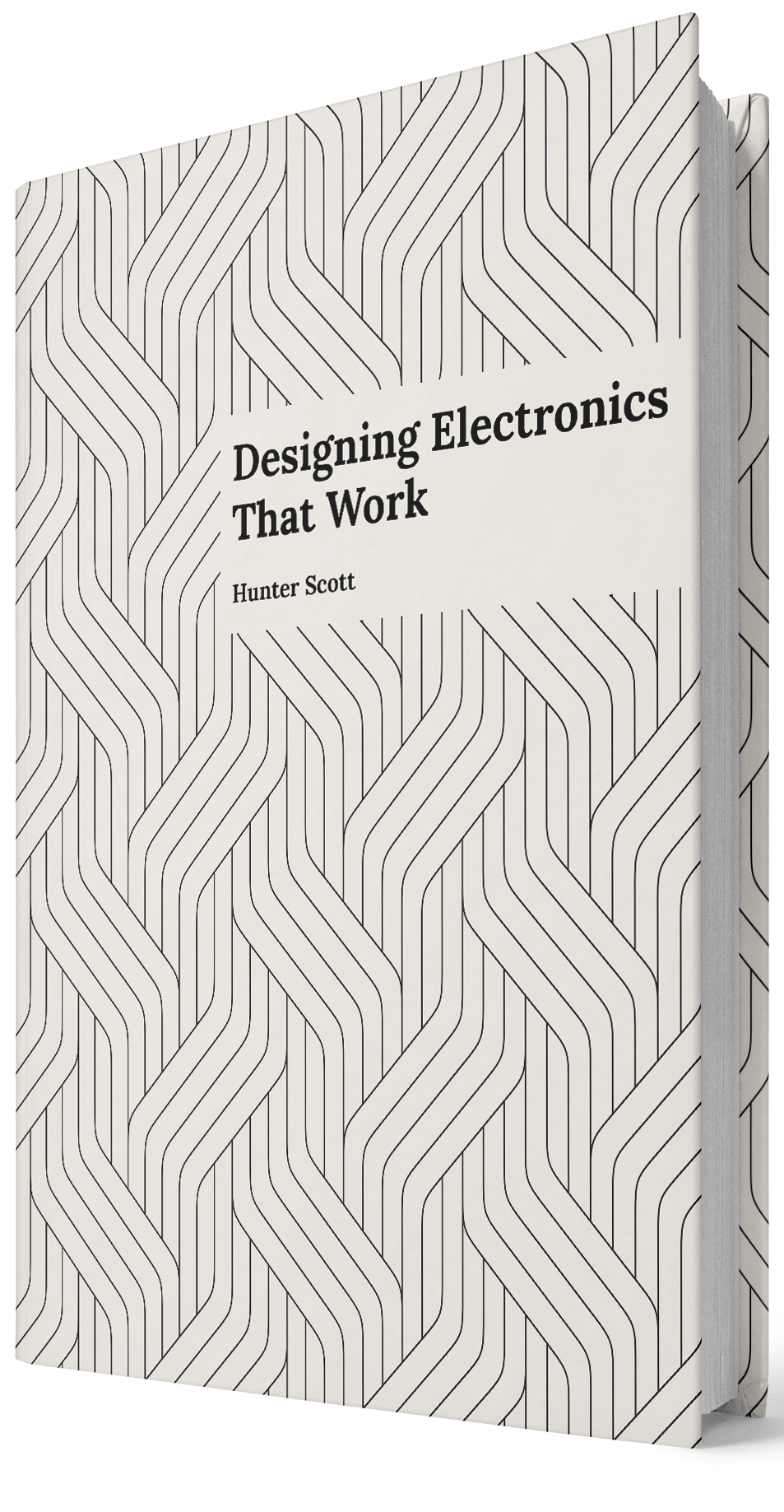
I’m going to steal an idea from my friend, Steve Leibson. He recently wrote a book review of Designing Electronics That Work by Hunter Scott, and I found the book so good that I thought I’d write a review of my own. TL;DR: This is a great book, and what makes it even greater is that the PDF version is free. (Print copies are available for $39.)

As Scott says in the preface, “This book is a collection of tips, techniques, and tricks that generally take a small amount of time and effort to implement, but have a disproportionate effect on the outcome of a design.”

Here’s an RF example:

High-speed and RF signals require high Q (quality factor) capacitors. Capacitor manufacturers have specific product lines for high frequency use. If you use a regular, non-high Q capacitor, bad things will happen: your filters won’t have the response you expect, your amplifiers will oscillate, and you’ll see very high insertion loss through your capacitors. It is critical that you choose capacitors that are rated for the frequency that you’re using. The GJM capacitor series by Murata (their high Q series) has a self-resonant frequency of 16 GHz. Johanson is another good manufacturer of high Q capacitors.

The book is chockfull of such examples on all phases of product design. He starts with how to set product requirements and specifications, how to specify and buy parts, how to build prototypes, keeping a lab notebook, how to design a schematic, how to layout a PC board, and how to test and troubleshoot designs.

There’s also a chapter on how to outfit an electronics lab. Here’s an excerpt from that chapter:

A lab needs excellent lighting. Get ring lights for your microscopes and very bright overhead lights for the lab bench. When you’re dealing with parts that are hundredths of an inch long, you don’t want any shadows. You also want the light to be as white as possible to make discolorations of parts easier to see.

Scott wrote this book for professional electronics design engineers, but nearly all of the advice is applicable to amateur radio. Amateurs may not have to be as rigorous as professional engineers, but adopting some of the practices described in this book will help hams be more successful when designing and building your own projects.

Related posts:

  1. This Weekend in Ham Radio at KB6NU
  2. What’s In an RF Front End?
  3. Random Links to Interesting Stuff
  4. Lady Ada’s getting a ham license!

Filed Under: Building/Homebrew Tagged With: electronic design

Reader Interactions

Leave a Reply Cancel reply

Your email address will not be published. Required fields are marked *

Primary Sidebar

No Nonsense Technician Class License Study Guide (for tests given between July 2026 and June 2030)

New No Nonsense Technican Class Study Guide now available!

The 2026 version of my Tech Class study guide is now available, and as always, the PDF version is FREE!. The ePub version costs $11.97, and a Kindle version and paperback version will be available on Amazon shortly.

Click here to get all of my "No Nonsense" study guides.

Also available: The CW Geek's Guide to Having Fun with Morse Code

W5SWL.Com
Retevis Ailunce H1 DMR Radio
DXpander: Cobweb antennas, Laser Cutting

You’ve got mail!

Enter your email address below and get an email every time I publish a new post.

Email


I frequently teach classes to help newcomers get their licenses. The next class will take place on Saturday, October 10, 2026 on the University of Michigan campus. Click here for more information.

If you can't make the class, subscribe to the mailing list to be notified of when the next class will be held.

You can always download my free study guide, and if you have any questions about the classes, or amateur radio in general, please feel free to email me directly.

Support KB6NU.Com

Donate $7.30 and get two of these cool stickers. Measuring 4.25-in. W by 2.75-in. H, it's perfect for your car, your shack, or wherever!

Contact me

If you have a question or comment about one of my blog posts, or a question about any of the material in my study guides, or just a question about ham radio in general, you can email me at [email protected].

Blogs You Should Also Read

  • AE5X: A CW-centric blog from Kingswood, Texas
  • K0LWC Blog
  • LA3ZA Ham Radio Blog
  • Little Radios, Big Fun – WB3GCK
  • Mr. Vacuum Tube's Blog
  • Radio Artisan – K3NG
  • The K0NR Weblog
  • VE3WDM's QRP Ham Radio Blog
  • W2LJ’s Blog

Ham Radio Websites

  • Dashtoons – The Hammin' Comedy by Jeff K1NSS

Podcasts

  • ICQ Podcast
  • Linux in the Ham Schack
  • No Nonsense Amateur Radio Podcast
  • Resonant Frequency Amateur Radio Podcast

Recent Comments

  • Mir Labs on Ten Steps to Mastering Morse Code
  • Skip K4EAK on Is the ARRL finally feeling the heat?
  • Victor on 468: Ham Radio’s Magic Number
  • Goody K3NG on Not1MM now working on my Linux box!
  • Mir Labs on JA1NUT: Two Issues in Morse Code Learning

Meta

  • Log in
  • Entries feed
  • Comments feed
  • WordPress.org

Footer

Copyright © 2026 Daniel M. Romanchik, KB6NU · Log in