• Skip to primary navigation
  • Skip to main content
  • Skip to primary sidebar
  • Skip to footer

KB6NU's Ham Radio Blog

KB6NU's Ham Radio Blog
  • HOME
  • Study Guides
  • Teach a One-Day Tech Class
  • W8SRC Repeater Guide
  • Advertise
  • Hire Me

Clubs

Newsletter of the month: LCARC’s Tuned Circuit

November 1, 2013 By Dan KB6NU Leave a Comment

Every month, I send out a column to more than 325 amateur radio club newsletter editors. It just occurred to me that I should feature some of there here on my blog. This month, I’ve stayed close to home (Ann Arbor, MI) and am featuring The Tuned Circuit of the L’Anse Creuse Amateur Radio Club.
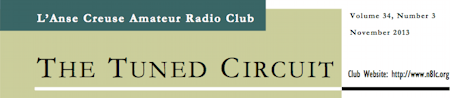
L'Anse Creuse Tuned Circuit

This sixteen-page newsletter features a lot of club news, including items on their upcoming swap on Sunday, December 8,  their Christmas party, recent repeater maintenance, and a schedule of club nets. The LCARC seems to be quite an active club!

There’s also news of other local amateur radio events. There’s a column listing test sessions around Southeast Michigan and another listing upcoming swaps in the area. That’s great news for LCARC members.

If you would like to get my column for your newsletter, simply click here and fill out the form. That will get you on my mailing list. I generally send out the column the last week of (almost) every month.

Filed Under: Clubs

The Logger’s Bark

September 29, 2013 By Dan KB6NU Leave a Comment

As many of you know, I write and send out a free monthly column for amateur radio club newsletters. One of fun things about doing this is that I get to read newsletters from all over the country, as many put me on their electronic mailing lists.

loggers-bark

This month, Mike, W7MWF, sent me the latest edition of The Logger’s Bark, the newsletter of the Radio Club of Tacoma (WA). In his “From the Editor” column, Mike explains how the newsletter got its name:

An interesting (to me, anyway) tidbit came along a few weeks ago. How did The Logger’s Bark get its name??

As it was explained to me, way back in the olden days before computer logging, contesting was a bit more different and hectic. A crew of folks were on duty supporting the operators by maintaining old- fashioned paper logs. Since during contests penalties were sometimes assessed for duplicate entries, an important function of the logger was to advise the operator when his or her contact was a “dupe.”

Upon hearing a call sign that had already been recorded, the Logger would bark out loudly “DUPE” to the operator, thereby passing on the information that the QSO could be curtailed. Thus arose the term “Logger’s Bark.”

Well, Mike, I found that tidbit interesting, too.

Mike also mentioned that his club is celebrating its 100th anniversary in October of 2016, and I gleaned from their newsletter that their membership is right around the 300 mark. Sounds like a great club to me!

Filed Under: Clubs

IRTS Promotes Clubs

September 26, 2013 By Dan KB6NU Leave a Comment

IRTSI forget exactly where I found out about the EI8IJ Fund, which promotes amateur radio clubs in Ireland, but when I did read about it, I thought, “What a great idea!” Here’s how the Irish Radio Transmitting Society (IRTS) website describes the EI6IJ Fund:

Each year, in order to promote Amateur Radio to the public, the Committee will consider the awarding of a number of grants to Affiliated Clubs. These grants will primarily be funded by a kind donation by the late John O’Riordan EI6IJ. The grants will be of around €300, usually not exceeding a total of €1000 in any one year, and are to assist with the mounting of public special event stations by clubs affiliated to IRTS. The stations should have significant public exposure with the specific intention of demonstrating Amateur Radio to members of the public. The funds may be allocated in one or more grants, or not at all, depending on the nature of applications received.

The ARRL continually pays lips service to clubs, but rarely do they ever put their money where their mouth is. Perhaps instead of spending so much time and effort to raise funds for W1AW, they should spend some of that loot on a program such as this which will reach many more people.

If your club could apply for such a grant, how would you use the money?

Filed Under: Clubs

Amateur radio in the news: VOIP, emcomm, clubs

September 19, 2013 By Dan KB6NU Leave a Comment

More kids should get the idea that amateur radio can still lead to a good career in tech…Dan

Vonage co-founder: VoIP came from ham radio, big bad telecoms At TwilioCon, Vonage co-founder Jeff Pulver gave a fascinating keynote about ham radio, getting fired, and a run-in with the FBI — and how all that gave birth to modern voice over Internet protocol technology. Pulver is widely recognized as a pioneer of VoIP technology and was the chief writer of the FCC’s first VoIP ruling.His current company is a Twilio-based iOS and Android app called Zula, created to enable better communication among teams. “It was amateur radio that unlocked my connection to voice over IP,” he said.

Ghostbusters-like crew of amateur radio operators help in emergency. When disaster strikes and traditional telecommunications services are curtailed, who do emergency responders call? A Ghostbusters-like crew of amateur radio operators.

This is a nice profile of a club in Maryland….Dan

Hamming it up on the air. For Rob Hoyt, president of the Charles County Amateur Radio Club, his interest in amateur radio started when he was a kid. But he credits his hobby for leading to a successful career.

Filed Under: Amateur Radio in the News, Clubs, Emergency Communications / Public Service

Activity Report: Dayton, General class, Mini Maker Faire, Monroe hamfest

June 17, 2013 By Dan KB6NU Leave a Comment

I realized the other day that I haven’t really been reporting on my own amateur radio activities lately. At first, I thought it was because I hadn’t really done much lately, but that’s not really true. So, here’s a report of some recent activity.

U-M ARC celebrates 100 years. The University of Michigan Amateur Radio Club recently celebrated it’s 100th anniversary. I helped them celebrate by operating during their special event on April 14th, 2013. The event was held on the  Central Campus Diag, and recognized the University’s first licensing as station 8XA in June of 1913. It was really cold and rainy that day, and the bands were pretty bad, but they had some hot coffee and donuts, and we had fun anyway.

Dayton 2013

In some ways, Dayton was kind of a washout for me. I came down with some  kind of stomach flu a couple of days before Dayton, and was even considering not going at all, but since I enjoy FDIM, and I was scheduled to speak at the  instructor’s forum on Friday morning, I decided to go.

As usual, FDIM was a blast. There were lots of good ideas being thrown around. I especially enjoyed the talk on receiver design by Rick, KK7B, and the talk on baluns by Rick, W7EL. They were all very good, though. The QRP-ARCI does a very good job lining up speakers.

I even participated in Vendor Night. Between talks, they had asked for volunteers to help set up tables for the vendors. It occurred to me that, if it didn’t cost much, I could show the CD-ROMs that I’d brought with me and pass the word about my free downloads. Well, it turned out that it didn’t cost a thing, so I asked for and they gave me a table.

I didn’t really expect to sell anything, as most of the folks there I’m sure had Extra Class licenses, but I did manage to sell one, and to talk to a lot of people about the study guides. So, overall, it worked out great.

On Friday, the entire morning was taken up, getting my speaker badge and then participating in the instructor’s forum. My talk about conducting one-day Tech classes went pretty well, but the forum didn’t end until noon, leaving me only five hours to peruse the flea market. That’s a fair amount of time, but I still wasn’t 100%, and my heart wasn’t really in it. I ended up buying not a single thing.

Saturday morning, I decided not to go to the Hamvention and just to pack it up and head home. I guess thinking about it, it wasn’t a complete washout, but I certainly didn’t get as much out of Dayton as I have in years past.

General class
I started a teaching a General Class course on Thursday evenings at the Hands-On Museum a couple of weeks ago. It’s a small class, but they’re enthusiastic. I am, of course, using my study guide as the text. Doing this has shown me how I can improve the next edition. I’ll be beefing up the explanations in a few spots and moving some things around.

Mini Maker Faire 2013 a success. This year’s Ann Arbor Mini Maker Faire was held about a month ago, and if you ask me, it was a great success. As we have done for the past several years, Dave N8SBE and I anchored the station, and Prem KD8SVR, one of my recent Tech students joined us.

The table they first assigned us was inside, with no clear path for our coax to get outside to the antennas. After some negotiation, we found ourselves relocated outside. Then, once Dave had gotten his K3 gear all set up, they decided to move us again! We finally got settled about 10:45 am.

We got the usual type of visitors:

  • Those who were already hams. They stopped by to ragchew a little.
  • Inactive hams. We tried to get them energized to get back on the air. One of these was KA8ODD. What a great call!
  • Interested people. I passed out my card liberally, pointing them to my free study guide.
  • Not-so-interested people. I at least tried to get them and/or their kids to send their name in Morse Code.

One thing that I found interesting is how some people seem to naturally take to Morse Code while others do not. For those who have a natural fist, I can easily make out their names when they send it by looking up the characters on the code chart. When I do copy a name, I reach out my hand and say, “Hi, John (or Mary or whomever). Nice to meet you.” They seem to be amused that I was able to figure out their name from their sending.

Unfortunately, not everyone is a natural. If I can’t make out the name, I smile and say, “Good job!”

Monroe hamfest
Yesterday morning, I drove town to Monroe for a hamfest. It’s a small hamfest, but fun. Every time I’ve gone, the weather’s cooperated, and this is important because most of the sellers are outside. Yesterday, the temperature was in the upper 60s, and the sky started out overcast, but as the morning progressed, the sky cleared, and it was just beautiful.

I almost bought a Jones paddle for $75, but since I really don’t need another paddle, I put off the purchase until I was about ready to leave. By the time I got back to that seller, he’d already sold it to someone else. I’m more than OK with this. I saved 75 bucks! I did end up buying some PL-259s and some 3.5mm stereo plugs. As Ralph would say, this was the “requisite handful of connectors.”

Filed Under: Classes/Testing/Licensing, Clubs, Just for Fun

From my Twitter feed: Field Day, HackRF, intruders

May 12, 2013 By Dan KB6NU Leave a Comment

N5NTG
AMATEUR RADIO FIELD DAY – GET OUT AND OPERATE: Field Day Is Just Around The Corner – Plan Now …http://t.co/crdHOFKEno

Chris_Diemoz
Who’s intruding #hamradio bands (and how)? The answer is blowing in the April @IARU_R1Monitoring System newsletter!http://t.co/Afp6XUScxH

n0rc
Giving Away HackRF #sdrhttp://t.co/zxXnOyg4q2 #hamr #diy#electronics

Filed Under: Clubs, Contests, Gear/Gadgets

Amateur radio in the news: Purdue club

April 16, 2013 By Dan KB6NU 6 Comments

Geoffrey Stewart, son of Andy Stewart of Chelmsford, operates his ham radio. His call sign is KB1USE. COURTESY PHOTO

Ham radio: the original social network
Andy Stewart and his friends could be considered revolutionary. “The jokes that I hear are that ham radio was the original social network,” he said.

Purdue’s ham radio club turns 100.
During open house, members can spend their time however they want. Most of the time, members learn more about ham radio, make new contacts from around the world and fix radios. One time, a few members even made a credit card scanner just for fun.

Volunteers vital to Weather Service during severe storms
With the forecast calling for possible severe weather Thursday, the National Weather Service expects to call on its team of weather spotters. They include Roane County ham radio operator Phil Newman. For 16 years, Newman has communicated to fellow operators around the region and the world….

Filed Under: Clubs, Emergency Communications / Public Service, The Service

Upcoming amateur radio events

April 12, 2013 By Dan KB6NU Leave a Comment

KB6NU teaching the Jan. 14, 2012 One-Day Tech Class
Me making a point (apparently about SWR) at a recent One-Day Tech Class

Here are some upcoming amateur radio events here in Ann Arbor, MI:

  1. VE Testing. ARROW, the club here in Ann Arbor, conducts an amateur radio license test session ever second Saturday of the month at the Washtenaw County Red Cross, 4624 Packard Rd., Ann Arbor (map).

    Preregistration is recommended but walkins are welcome. Contact Mark Goodwin – W8FSA (734-944-0730) [email protected], Beverley Stoner – K8ZJU (734-424-9446), or Ralph Katz – AA8RK (734-663-1288) [email protected], for more information, and to register for the test.

  2. University of Michigan Amateur Radio Club’s 100th Anniversary Special Event Station. The University of Michigan Amateur Radio Club is celebrating its 100th anniversary by operating a special event station on Sunday, April 14 on the Diag on central campus. Setup is going to start around 1300Z. We’re hoping to start operating around 1400Z and continue until around 2200Z. If you’re in or near Ann Arbor, please come down and operate with us. If not, listen for us on the bands.
  3. One-Day Tech Class, Saturday, April 27. I’ll be conducting the next one-day Tech Class on Saturday, April 27, at the Ann Arbor Hands-On Museum. Go to wa2hom.org for more details.

Filed Under: Classes/Testing/Licensing, Clubs, Everything Else

U-M ARC needs antenna ideas

March 18, 2013 By Dan KB6NU 17 Comments

W8UM
The University of Michigan Amateur Radio Club is celebrating their 100th anniversary this year. The recently reinvigorated club has a great station, W8UM, in the Electrical Engineering and Computer Science (EECS) Building on U-M’s North Campus.

The University of Michigan Amateur Radio Club is celebrating their 100th anniversary this year. To celebrate, they’re planning to operate a special event station from the Diag, an open space in the heart of the campus.

The problem they’re having are all the rules for such an event. For example, the event can’t be too noisy, even though it’s outside.

The biggest problem they’re having though is trying to come up with an antenna setup that the powers that be will approve. They can’t, for example, drive any stakes into the ground. Supposedly, that will damage the lawns. That rules out the 40m/20m inverted-V setup supported by the surplus fiberglass masts that we often use for these kind of temporary operations.

There’s also a rule that whatever structure is erected be no higher than eight feet tall. That also rules out the use of the fiberglass mast.

There are some trees near where they want to set up the station, but the grounds department have concerns about ropes in trees. That kind of rules out dipoles.

This morning, it occurred to me that we probably could use BuddiPoles and/or BuddiSticks. We could easily keep them under eight feet, and if operated vertically, they could be decent antennas. Using an insulated wire for the counterpoise should be safe enough.

I’d like to hear what you think, though. What kind of antennas have you used for this type of operation? Do they meet the restrictions these guys must meet?

Filed Under: Antennas, Clubs

How well is your amateur radio club’s website working?

March 17, 2013 By Dan KB6NU 7 Comments

When I stepped down as our club’s president a couple of years ago, I also gave up responsibility for the club website. At that time, it was decided to move the website from the web hosting company I was using to a server connected to the network at a local community college, where one of our members taught part-time. The rationale was that since there would be no web hosting fees, the club would save money.

Unfortunately, this has proven to be a case of being “penny wise, but pound foolish.” About every six months, the site seems to go down for a week or so. The first time this happened, there was a problem was with the community college’s network, and because this use of the network wasn’t a high priority for the college’s IT staff, the site was down for quite a while.

The most recent outage was due to memory failure. The failure was first reported a week ago, and as I’m writing this, the site has yet to be fully restored. The timing of this was unfortunate, as our monthly meeting was held on Wednesday, March 13, and since the website was down, there was really no way for anyone to get details.

My intent here is not to disparage the volunteers running the website. Having done it myself for a couple of years, I know it’s a thankless job, and I thank them for their service. Even so, I think website hosting is one of those things best not left volunteers, especially when suitable web hosting services can be had for less than $100/year.

The website is, after all, your club’s biggest PR piece, and if it’s not working, or if the information is out of date, or if the design is lousy, you’re not making a very good good case for your club. Seriously, would you consider patronizing a business whose website was out of date or that you couldn’t access at all?

Several members got their hackles up over this last outage, and it’s looking like we’ll be moving the site back to a web hosting service again. Not only that, several members, including me, have offered to help out in some way with the website. So, over all, I think this latest outage has proven to be a good thing. If we do it right, we might even have several people submitting content.

I’ll update this post in about six months and keep you apprised of our progress. Of course, you could just go to the website and see for yourself.

HamRadioWebsites.Net
Coincidentally, a fellow posted a link to HamRadioWebsites.Net in a message to the AmateurRadioLeadership Yahoo Group. This looks like a relatively new service that helps clubs set up websites and produces e-mail newsletters for clubs.

While I think this is an interesting idea, I have several questions about taking this approach:

  1. Can a service like this really be effective if those that are creating the website and newsletter are not part of the club? After all, someone still has to come up with the club-related content.
  2. If there aren’t some members engaged enough to do these kinds of things (we call them “club service” in Rotary), are they going to be engaged enough to do anything at all?

What do you think? Will HamRadioWebsites.Net be successful? How does your club handle its website and newsletter needs?

Filed Under: Clubs

  • « Go to Previous Page
  • Page 1
  • Interim pages omitted …
  • Page 16
  • Page 17
  • Page 18
  • Page 19
  • Page 20
  • Interim pages omitted …
  • Page 26
  • Go to Next Page »

Primary Sidebar

No Nonsense Technician Class License Study Guide (for tests given between July 2026 and June 2030)

New No Nonsense Technican Class Study Guide now available!

The 2026 version of my Tech Class study guide is now available, and as always, the PDF version is FREE!. The ePub version costs $11.97, and a Kindle version and paperback version will be available on Amazon shortly.

Click here to get all of my "No Nonsense" study guides.

Also available: The CW Geek's Guide to Having Fun with Morse Code

W5SWL.Com
Retevis Ailunce H1 DMR Radio
DXpander: Cobweb antennas, Laser Cutting

You’ve got mail!

Enter your email address below and get an email every time I publish a new post.

Email


I frequently teach classes to help newcomers get their licenses. The next class will take place on Saturday, October 10, 2026 on the University of Michigan campus. Click here for more information.

If you can't make the class, subscribe to the mailing list to be notified of when the next class will be held.

You can always download my free study guide, and if you have any questions about the classes, or amateur radio in general, please feel free to email me directly.

Support KB6NU.Com

Donate $7.30 and get two of these cool stickers. Measuring 4.25-in. W by 2.75-in. H, it's perfect for your car, your shack, or wherever!

Contact me

If you have a question or comment about one of my blog posts, or a question about any of the material in my study guides, or just a question about ham radio in general, you can email me at [email protected].

Blogs You Should Also Read

  • AE5X: A CW-centric blog from Kingswood, Texas
  • K0LWC Blog
  • LA3ZA Ham Radio Blog
  • Little Radios, Big Fun – WB3GCK
  • Mr. Vacuum Tube's Blog
  • Radio Artisan – K3NG
  • The K0NR Weblog
  • VE3WDM's QRP Ham Radio Blog
  • W2LJ’s Blog

Ham Radio Websites

  • Dashtoons – The Hammin' Comedy by Jeff K1NSS

Podcasts

  • ICQ Podcast
  • Linux in the Ham Schack
  • No Nonsense Amateur Radio Podcast
  • Resonant Frequency Amateur Radio Podcast

Recent Comments

  • Dan KB6NU on The EMF Explorer: A badge for ham radio?
  • Travis Good on The EMF Explorer: A badge for ham radio?
  • MARTIN ROBERT ROTHFIELD on The EMF Explorer: A badge for ham radio?
  • Mike Chen on Operating Notes, January 5, 2026
  • Rob W4ZNG on The EMF Explorer: A badge for ham radio?

Meta

  • Log in
  • Entries feed
  • Comments feed
  • WordPress.org

Footer

Copyright © 2026 Daniel M. Romanchik, KB6NU · Log in