

• Skip to primary navigation
  • Skip to main content
  • Skip to primary sidebar
  • Skip to footer

KB6NU's Ham Radio Blog

KB6NU's Ham Radio Blog
  • HOME
  • Study Guides
  • Teach a One-Day Tech Class
  • W8SRC Repeater Guide
  • Advertise
  • Hire Me

Copy CW signals more easily with two tones

January 22, 2021 By Dan KB6NU 1 Comment

A couple of days ago, someone posted the article, “A novel way to hear weak CW signals” (CQ, January 2018) to the Long Island CW Club mailing list.

In the article, the author, Pete,, N8PR (SK) writes that you should set up your receiver to produce two tones 65 to 80 Hz apart to make copying weak CW signals more easily. The theory behind this is that the dissonance between the two tones makes copying a CW signal more copyable than just a single tone. I like this  idea. I played around a little bit last night with this technique, and it did indeed seem to work better than using just a single tone.

The problem, as I see it, is that even if this works, it only works if your radio has two receivers. I can do this with my Flex 6400 because it has two receivers, but most radios, such as the IC-7300 have only a single receiver, making this impossible. I’m also not sure this is the best use of the second receiver should your transceiver have one. For example, if you’re working a pileup, then you may not want to use the second receiver to generate the second tone, but rather use it to listen to the pileup to more easily find the frequency of the station that the DX station just worked.
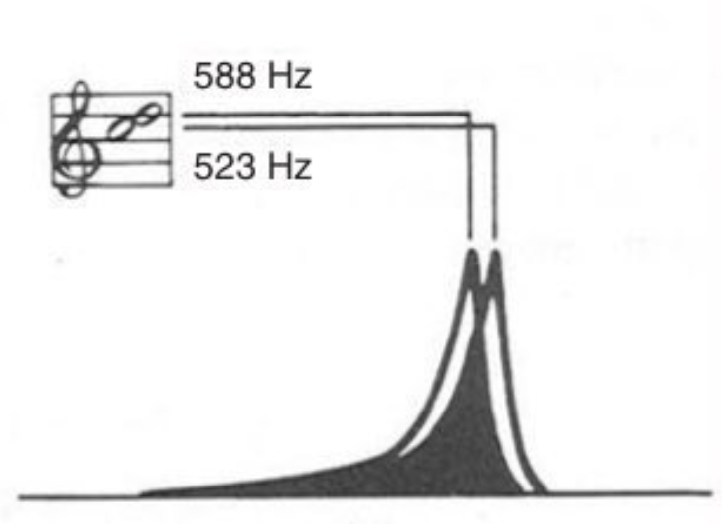
N8PR suggests that two tones spaced 65 Hz to 80 Hz apart make weak CW signals easier to copy.

So, what’s the solution? It seems to me that one should be able to devise a DSP algorithm to take a tone and then generate the second tone from the first, and then mix the two to get the final output. Ideally, this would be done in the receiver, but failing that, it seems to me that one could do this externally.

I’m even thinking that one could use GNURadio to do this. At the very least, you could use GNURadio to develop a prototype. I’ll have to do some research and see what kind of modules that GNURadio has that can accomplish this.

I just searched for “dsp audio frequency shift algorithm” and came up with the post, “Shift frequency of an audio signal” on the website DSPRelated.Com. The replies list several ways as to how this might be accomplished. With this algorithm, you could shift the frequency of an incoming signal, then mix it with the original signal to get the two tones.

I also suppose that this could be done in analog, just as audio peak filtering was done at first. The input signal could be mixed with a beat signal to produce the second tone, which would then be re-mixed with the original tone. I’m not really an analog guy, but it might be fun to try and design a circuit that would do that.

The nice thing about an external solution—either digital or analog—is that it wouldn’t require continual retuning. Using two receivers, you’d have to continually be tuning both to give you the proper two tones. In any event, I”m going to continue to play around with this technique some more and see what I can do with it.

Related posts:

  1. Operating note: Don’t bail on weak signals
  2. 2015 General Class study guide: Section G2C – CW operating procedures and procedural signals, Q signals and common abbreviations, full break in
  3. Extra Class question of the day: Modulation and demodulation
  4. 2015 General Class study guide: Section G7C – Receivers and transmitters; filters, oscillators

Filed Under: CW

Reader Interactions

Comments

  1. Paul says

    January 23, 2021 at 9:06 am

    I posted a similar question on the FTDX-101 groups.io.
    The FTDX-101 has a sync option
    Offset VFO B by 50hz then set VFO B to follow VFO A with the SYNC button to the top left of the VFO dial. When you tune up and down on VFO A, the other VFO will follow at the same rate but at your specified offset.
    from post of ki5o joe

    Interesting to see if your comprehension improves with this method.
    Copy W1AW code practice using this method and see if your comprehension increases (error count goes down).

    Paul kw1L

    Reply

Leave a Reply Cancel reply

Your email address will not be published. Required fields are marked *

This site uses Akismet to reduce spam. Learn how your comment data is processed.

Primary Sidebar

No Nonsense Technician Class License Study Guide (for tests given between July 2026 and June 2030)

New No Nonsense Technican Class Study Guide now available!

The 2026 version of my Tech Class study guide is now available, and as always, the PDF version is FREE!. The ePub version costs $11.97, and a Kindle version and paperback version will be available on Amazon shortly.

Click here to get all of my "No Nonsense" study guides.

Also available: The CW Geek's Guide to Having Fun with Morse Code

W5SWL.Com
Retevis Ailunce H1 DMR Radio
DXpander: Cobweb antennas, Laser Cutting

You’ve got mail!

Enter your email address below and get an email every time I publish a new post.

Email


I frequently teach classes to help newcomers get their licenses. The next class will take place on Saturday, February 7, 2026 on the University of Michigan campus. Click here for more information.

If you can't make the class, subscribe to the mailing list to be notified of when the next class will be held.

You can always download my free study guide, and if you have any questions about the classes, or amateur radio in general, please feel free to email me directly.

Support KB6NU.Com

Donate $7.30 and get two of these cool stickers. Measuring 4.25-in. W by 2.75-in. H, it's perfect for your car, your shack, or wherever!

Contact me

If you have a question or comment about one of my blog posts, or a question about any of the material in my study guides, or just a question about ham radio in general, you can email me at [email protected].

Blogs You Should Also Read

  • AE5X: A CW-centric blog from Kingswood, Texas
  • K0LWC Blog
  • LA3ZA Ham Radio Blog
  • Little Radios, Big Fun – WB3GCK
  • Mr. Vacuum Tube's Blog
  • Radio Artisan – K3NG
  • The K0NR Weblog
  • VE3WDM's QRP Ham Radio Blog
  • W2LJ’s Blog

Ham Radio Websites

  • Dashtoons – The Hammin' Comedy by Jeff K1NSS

Podcasts

  • ICQ Podcast
  • Linux in the Ham Schack
  • No Nonsense Amateur Radio Podcast
  • Resonant Frequency Amateur Radio Podcast

Recent Comments

  • Dan KB6NU on Yaesu FT-710: What’s the big deal?
  • Andrei on Yaesu FT-710: What’s the big deal?
  • Dan KB6NU on Finally, a Loop for 10m.
  • Dan KB6NU on 1930s cards for my collection of QSLs from stations whose callsigns spell words
  • Sean on Finally, a Loop for 10m.

Meta

  • Log in
  • Entries feed
  • Comments feed
  • WordPress.org

Footer

Copyright © 2026 Daniel M. Romanchik, KB6NU · Log in