

• Skip to primary navigation
  • Skip to main content
  • Skip to primary sidebar
  • Skip to footer

KB6NU's Ham Radio Blog

KB6NU's Ham Radio Blog
  • HOME
  • Study Guides
  • Teach a One-Day Tech Class
  • W8SRC Repeater Guide
  • Advertise
  • Hire Me

How to measure wire length

March 11, 2021 By Dan KB6NU 3 Comments

A recent post on the reddit /r/amateurradio, got me to thinking about a better way to measure wire length here in my shack. I’ve been using one of two methods:

  1. Laying the wire on my basement floor, where I’ve marked off different lengths.
  2. Going out into the backyard and measuring the length using a 100-ft. measuring reel.

These two methods work OK because I don’t do it that often, but recently a friend wanted 100-ft. of RG-8X off the 1000-ft spool I purchased from DX Engineering a couple years ago. It was too cold and snowy out in the backyard, so I had to measure multiple short lengths down in my basement. That was a real pain in the butt. It took me more than a half hour to measure the coax and then coil it up for my friend.

That reddit post stirred up that bad memory, so I decided to see if there was something out there that could make my life easier. Of course, the first thing I did was to search on Amazon.
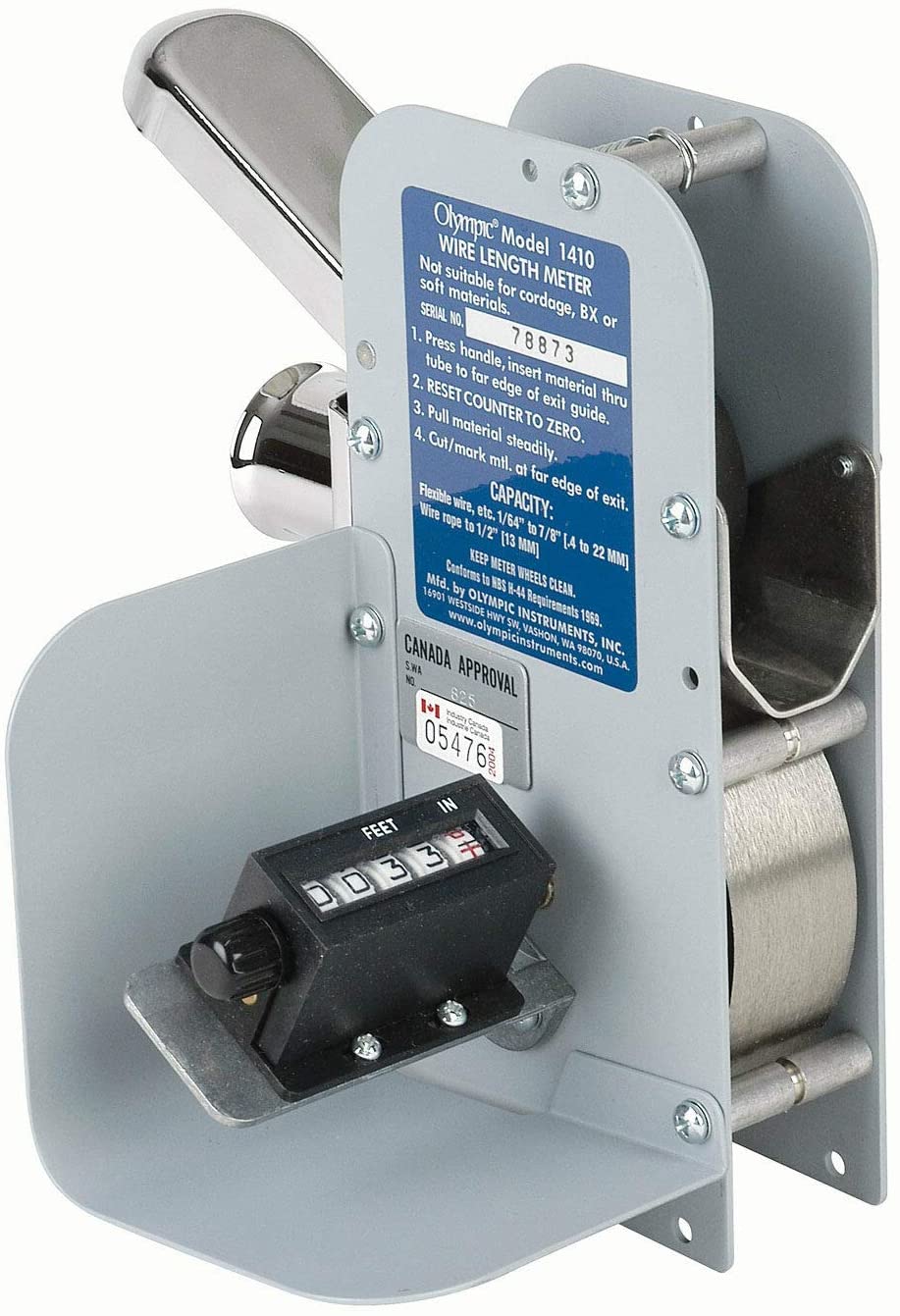
Olympic 1410

The first thing that I found was the Olympic 1410 Cordage Measurer. This is what the pros use. If you’ve ever purchased wire or rope at a hardware store, chances are this is what they used to measure your purchase. This is a great device, but it costs $450!
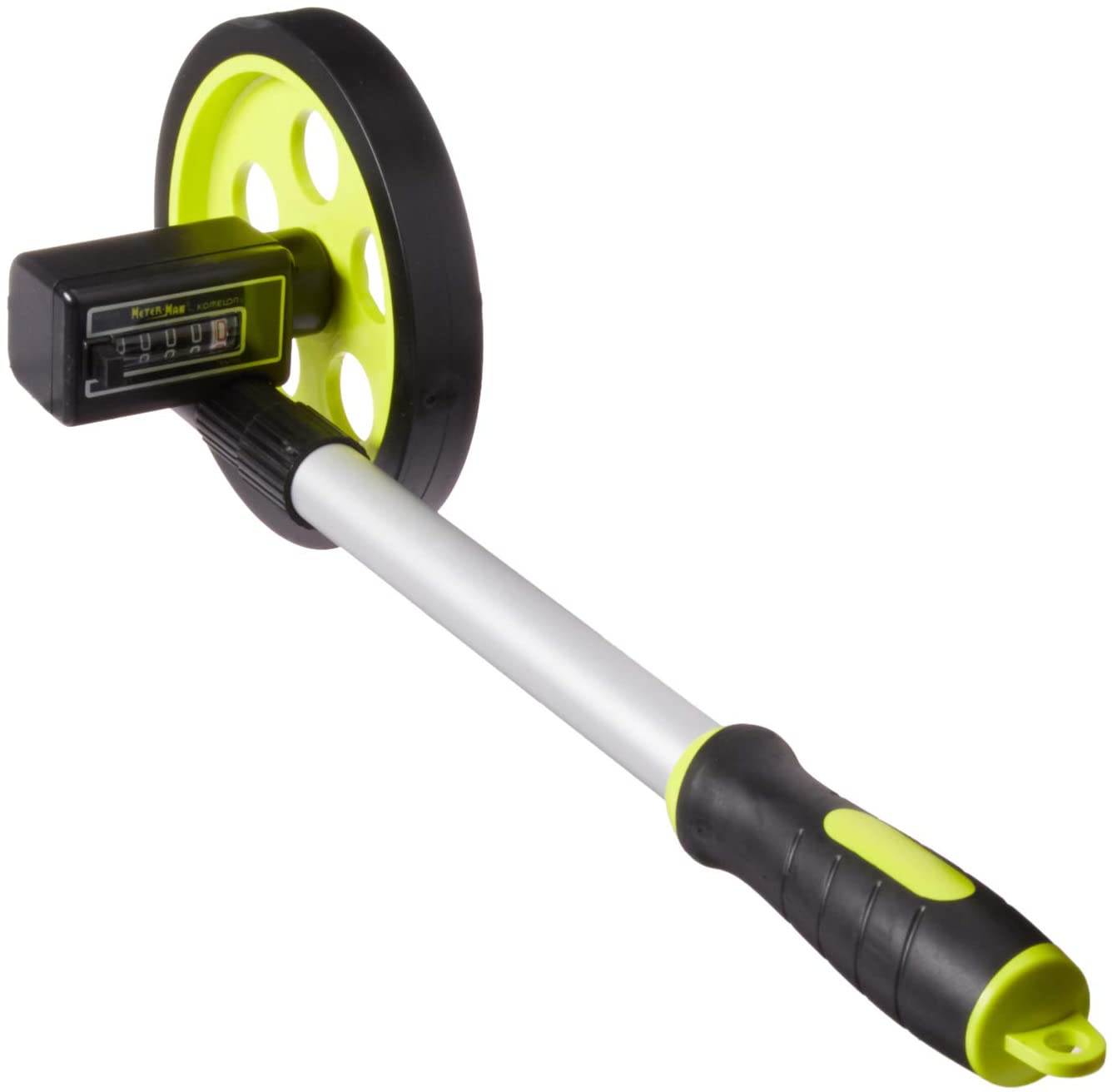
Komelon ML1810

Fortunately, there are less-expensive options. For example, you could purchase a measuring wheel, like the Komelon ML1810 Measuring Wheel. This device costs less than $30. The downside to this is that you’d have to build some kind of fixture to hold the wire tight to the wheel while you’re measuring the wire. That doesn’t seem like it would be too difficult to do, though. The upside is that you could then use it to measure other things around the house, like your lot size or the length of your driveway.

Amazon also sells other types of meters with rollers and two wheels, but it looks like these meters were designed to measure material. As such, they’re calibrated in yards. I think that those would be more difficult to use.

A couple of the respondents mentioned that they had made marks on their driveways and used those marks to measure wire lengths when they needed to. Another mentioned that he used a laser distance measurer. Those seem like good options, too, but I think I’d still like to have something like the cordage measurer. Maybe I’ll buy the measuring wheel and play around with it.

Related posts:

  1. 2020 Extra Class study guide: E9F – Transmission lines: characteristics of open and shorted feed lines; coax versus open-wire; velocity factor; electrical length; coaxial cable dielectrics
  2. The “Almost Random” Wire Antenna
  3. The Vagaries of My Random Wire
  4. A reader asks about end-fed antennas

Filed Under: Building/Homebrew Tagged With: wire

Reader Interactions

Comments

  1. David KJ4CMY says

    March 12, 2021 at 11:00 am

    The measuring wheel is much easier. I had one of the other devices, but never used it.

    Reply
  2. Dave New, N8SBE says

    March 12, 2021 at 11:59 am

    I have a 300 ft. measuring tape which we use every year at Field Day, to work out how far apart to put our wire antenna poles. Not too expensive, and works for measuring long antennas (160 meters, anyone?), but of course, not too useful when up to your knees in snow.

    I originally got one of these for use at work, because we needed to measure out 300 ft. around a vehicle, to test remote start range for our key fobs.

    Reply
  3. Mike G3JKX says

    March 21, 2021 at 11:19 am

    For measuring thin wire, cut a stiff piece of cardboard so that 2 opposite edges are 1ft apart..
    Wind the wire onto that and count carefully as each turn goes on. It helps if you cut slits at one edge to keep the wire end in place.

    Reply

Leave a Reply Cancel reply

Your email address will not be published. Required fields are marked *

This site uses Akismet to reduce spam. Learn how your comment data is processed.

Primary Sidebar

No Nonsense Technician Class License Study Guide (for tests given between July 2026 and June 2030)

New No Nonsense Technican Class Study Guide now available!

The 2026 version of my Tech Class study guide is now available, and as always, the PDF version is FREE!. The ePub version costs $11.97, and a Kindle version and paperback version will be available on Amazon shortly.

Click here to get all of my "No Nonsense" study guides.

Also available: The CW Geek's Guide to Having Fun with Morse Code

W5SWL.Com
Retevis Ailunce H1 DMR Radio
DXpander: Cobweb antennas, Laser Cutting

You’ve got mail!

Enter your email address below and get an email every time I publish a new post.

Email


I frequently teach classes to help newcomers get their licenses. The next class will take place on Saturday, October 10, 2026 on the University of Michigan campus. Click here for more information.

If you can't make the class, subscribe to the mailing list to be notified of when the next class will be held.

You can always download my free study guide, and if you have any questions about the classes, or amateur radio in general, please feel free to email me directly.

Support KB6NU.Com

Donate $7.30 and get two of these cool stickers. Measuring 4.25-in. W by 2.75-in. H, it's perfect for your car, your shack, or wherever!

Contact me

If you have a question or comment about one of my blog posts, or a question about any of the material in my study guides, or just a question about ham radio in general, you can email me at [email protected].

Blogs You Should Also Read

  • AE5X: A CW-centric blog from Kingswood, Texas
  • K0LWC Blog
  • LA3ZA Ham Radio Blog
  • Little Radios, Big Fun – WB3GCK
  • Mr. Vacuum Tube's Blog
  • Radio Artisan – K3NG
  • The K0NR Weblog
  • VE3WDM's QRP Ham Radio Blog
  • W2LJ’s Blog

Ham Radio Websites

  • Dashtoons – The Hammin' Comedy by Jeff K1NSS

Podcasts

  • ICQ Podcast
  • Linux in the Ham Schack
  • No Nonsense Amateur Radio Podcast
  • Resonant Frequency Amateur Radio Podcast

Recent Comments

  • Matt W1CDN on A completely different picture of Wayne Green, W2NSD (SK)
  • Chana Walsh on Rethinking ham radio education
  • Rob WfourZNG on Videos: What’s next for POTA, ham radio helps rescue man trapped in cave
  • Dan KB6NU on The EMF Explorer: A badge for ham radio?
  • Travis Good on The EMF Explorer: A badge for ham radio?

Meta

  • Log in
  • Entries feed
  • Comments feed
  • WordPress.org

Footer

Copyright © 2026 Daniel M. Romanchik, KB6NU · Log in