
If you’re like me, you have a lot of browser tabs open. These tabs have web pages that you keep meaning to get around to reading, but often do not. You could bookmark them, but bookmarking those pages just puts them out of sight, and they shortly become out of mind.
Right now, I have four different amateur radio-related tabs open. Since I think that many of you will also be interested in reading them, I’ll do a short review of each one here.
G7FEK antenna: 80 meters in a limited space
Before I found and put up my Cobra antenna, I did a little research and found several possibilities, including a loaded dipole and a 43-ft. vertical. Another good option that I recently came across is the G7FEK antenna. G7FEK describes his antenna as “a 46-ft., multi-band antenna for small gardens that works well on 80 meters.” And, according to G7FEK, its impedance is nearly 50 Ω on 40 meters, 30 meters, 17 meters, 15 meters, and 12 meters, and it can be used with a tuner on 20 meters and 10 meters.
Here’s what it looks like:
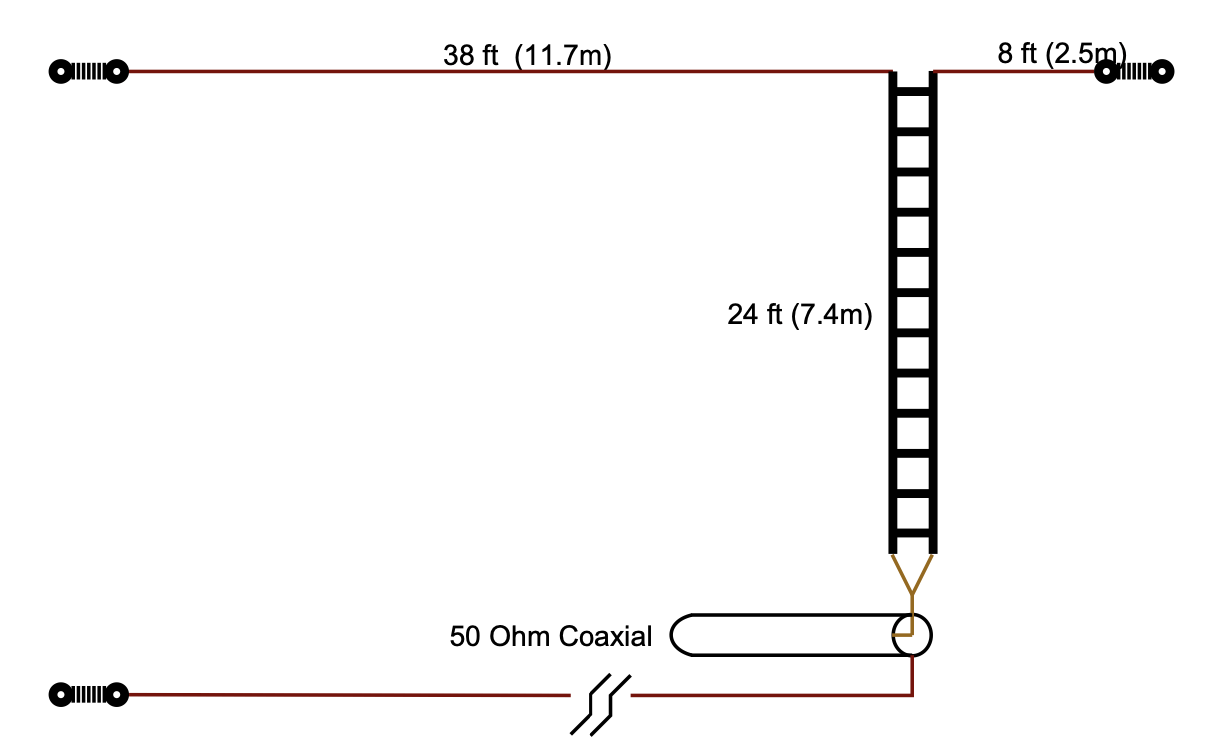
If any of you are using this antenna, please let me know. I’d like to hear your thoughts.
The REAL SWR page
As I’ve often noted, I’m not an antenna guru. I know enough to get something in the air and working well enough to make contacts, but not a heckuva lot more. I know that low SWR at the transmitter is a good thing, but that it’s not really necessary that the antenna itself have a low SWR. The REAL SWR page backs me up on this.
Here are the 7 points that WC7I makes on this page:
- Reflections happen at the coax – antenna connection and they also happen at the coax – tuner connection. The last part of this statement seems to be missing from most discussions of SWR and mis-matched conditions.
This is why a lot of people think that reflected power gets into the radio and does damage. That does not happen! - These reflections do not cause energy loss. All losses are due to the coax itself.
- Energy moving backwards in the coax is subject to the exact same losses as energy moving in the forward direction.
- The amount of energy reflected at the coax – antenna connection depends on the amount of impedance mis-match (read SWR) between the antenna and the coax. The greater the mis-match, the greater the reflection.
- The amount of energy re-reflected at the coax – tuner connection is 100% of the energy that gets there, but not all the energy that was originally reflected gets back to the coax – tuner connection. There will be losses in the coax. All the reflected energy that reaches the coax – tuner connection is re-reflected back into the coax headed for the antenna. (Yup, another lossy trip in the coax.)
- The re-reflected energy will be in phase with the generator so the two signals will add. This can create more forward power in the coax than the transmitter is actually producing. It is possible to measure 125 Watts forward power from a 100 Watt transmitter because the re-reflected power adds to the transmitter power.
- Coax losses are the only losses in the whole system. These losses can be significant, but they are the ONLY losses in the antenna system. If you have been paying attention, you know that this last step is just a re-statement of other steps above.
He goes into much more detail on why this is so, so read the web page. Two things pop out from this discussion:
- WC7I says, “You should always use an antenna tuner. It goes near your rig, in the shack. Its duty is to match your antenna and coax to the impedance of your rig, not to change the SWR in the coax that goes from the antenna down to the antenna tuner.”
- Electrical energy moves forward and backward in a coaxial cable and in ladder line. (Everything I tell you about coax is also true for ladder line, except that ladder line has far less loss.)
How to activate your local repeater
 A frequent lament is that repeaters these days are quiet most of the time. In an attempt to get more people on their local repeater, a Reddit user asked for suggestions on how to increase activity. Here are some of the ideas that you might want to try:
- Throw out your call sign and let people know you’re listening. It won’t change it overnight, but I think you, plus a few others, could make a world of difference.
- We have a daily net, round table style. It is open from 5 to a minimum of 5:30. longer if we are having discussions. If we run out of check ins or things to say, the net control remains on frequency and makes a call every few minutes until 5:30. Encourage discussions and conversations. Some net controls do words of the day, finding odd words and asking if folks know their meaning. I do trivia, sometimes ham related, sometimes not. As a NC, engage with people, ask questions, ask how that thing they were doing last week went or whatever. The point is to make it more than a simple check in and personal, not just some call sign checking in.
- Does the repeater have a website? Make sure any regular nets are published there, and promote it in clubs, newsletters, etc.
The post also has some good ideas about how to make nets more interesting and get more check-ins.
Leave a Reply