
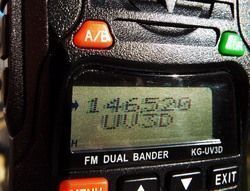
I saw this post on reddit yesterday and liked it so much that I asked James, N4EGA, if I could post it here. He’s also posted it to his website, AxlesandAntennas.com. I now have the radio in my shack tuned to 146.52 MHz…..Dan
 I recently made a trip out to Montana for an overland rally and to teach a class in Mobile Communication basics. I had two primary radios with me: a 2 meter mobile (50 watts) and a CB.
For my bumper, I made a vinyl graphic that read, “N4EGA 146.52.” Additionally, about every 30 minutes (more frequently though cities) I would put out my call several times and ask for a reply.
Only twice during the 2000 mile one way trip did I get a response.
My CB was by far more active.
So what am I bitching about? After the class I gave, I had a couple of hams asking me about my thoughts about the calling frequency in regards to establishing a QSO and then moving off. For as long as I have been active in ham radio, I told them as I have always said “BS”.
Since ’93 I have never heard a QSO on .52 last long enough to be an issue. For a traveler, hearing a QSO on “the calling frequency” means you know there are at least two hams talking and you can jump in and talk as well.
I used to have a buddy here in Knoxville that I would talk with a few nights a week on .52. I live next to two major interstates and had several hams jump at the chance to talk with us, even for just a few minutes! It was always fun.
One more than one occasion, someone would break in and tell us to move as .52 was the calling frequency by law, which is utter nonsense.
Guys and girls, I’m pleading with you: Make 146.52 part of your channel list. Use it. Talk on it. Don’t just call your buddy and slide down a few kHz. Let others know that you are talking and willing to talk to mobiles passing though. If some OF tells you to move off frequency, ignore them and keep the QSO going. A passerby will be delighted to chat!
I’ll echo Greg’s comment and add that if some OF objects to your using .52 for your contact, ask them to join you!
It’s the same with 145.5 in Europe. There seems to be a little more in England, though.
I’ve done the same with some window (bumper) stickers that I had made up from an online build a sign company. Sadly, my results are about the same as reported above.
This article brought to mind a recent article I read on APRS voice alert: http://www.aprs.org/VoiceAlert3.html
One of the problems with ham radio in general is the amount of dead air. Every ham should try to use every resource at their disposal to get the most out of their radio privileges, and I realize those people who work for a living don’t have all day for getting on the air, but since I am a stay at home caregiver I have noticed the near radio silence on repeaters in the area. There are a few exceptions that are getting use without scheduled nets, but these are rare.
Regarding the calling frequency, I have also made a lot of calls on 2 meters on this frequency in the past couple of months at almost every time of day, with up to 75 watts of output power and have not had one response here. That does not mean I will quit, but it says something about the use of the simplex calling frequency in the time I’ve been calling CQ on it. I can understand how that discourages people who are new to try simplex use of the 2 meter band, but since it is so simple to use I don’t see why more people are not monitoring and using it. It isn’t the overuse of a frequency that will cause ham radio to decline, it is the lack of use. There is always some entity attempting to claim rights to frequencies not in use, and the best way to lose the ones allocated to us is to stop providing traffic on them.
Of course, simplex isn’t the sexiest digital mode on radio, and 2 meter communications are limited in range, but almost every ham has a 2 meter transceiver of some type, so we need to all dust off the simplex frequency and get on the air. If we don’t, I feel someone or some entity in politics and lobbying will persuade the FCC to give that part of the band away. Let’s not allow that to happen.
73!
Steve – W8SFC
I’m glad that you posted the 146.52 suggestion on your blog. I’ve tried the same thing, using some stickers that I had made from an online company. The results were disappointing, however I’m still trying.
The cause of a lot of inactivity and missed contacts on 52 is possibly the operating procedures of the hams. I notice guys popping on 52 saying “W6XXX mobile,” but by the time I get up and over to the rig they are gone.
If I am scanning I don’t even know what frequency they are/were on.
That procedure is OK for a popular repeater but for simplex where mobile flutter exists (possibly on both ends), you have to make a little more noise than that to get a contact.
The way to make a contact is to call several times using phonetics, especially if you are not in your home town and few will recognize your out-of-town call. For example, try calling like this:
This is W0RW, Whisky Zero Radio Whiskey, mobile on 52″, is the frequency clear?
This is W0RW mobile, Whisky Zero Radio Whiskey, mobile on 52. Can anyone copy? Or tell me where the best Mexican restaurant in town is? over.
If you just want to test your rig and never talk to anyone, just say “W6XXX mobile”.
Good point, Paul! I’m going to start using a more “complete” call even, even when calling via a repeater. You’re right that if people are scanning several repeaters, they may not know what repeater you’re calling on. And, if you’re calling on .52, you should let people know that you’re operating simplex.
About 30 minutes ago, (at 2:00PM, August 25th, 2018), I called CQ on 52, and after two attempts I was shocked to find someone heard me and responded. I was only testing so I didn’t expect anything to happen, but a ham in Clinton returned my call and we spoke for about 5 minutes. I did not write his call sign down, but at least I know my radio will work for the 2 meter simplex event tomorrow evening and I can be heard loud and clear at least 23 miles or so from here.
I just wanted to tell someone about my contact. I am starting a log book for 2 meter simplex now and I will definitely continue to pursue this “new” way to use the rig. (New to me – but actually the oldest type of QSO).
I’ve actually managed to start .52 simplex conversations while in traffic, if I spot a ham call plate, or something else that makes it clear that I’ve spotted a ham in his vehicle, with what looks like a VHF or VHF/UHF whip, I’ll sign to him five fingers, then two fingers, a few times, i.e. 52, 52, 52.
Believe it or not, it has netted me some pretty interesting QSO’s. Sometimes they’ll tell me that they had the volume down on some popular drive-time repeater, because they either had gotten bored with talking to the same folks all the time, or they had had too much difficultly breaking into a fast-turnover roundtable.
On the other hand, I’ve passed some guys with a ‘monitoring .52’ sticker, and couldn’t raise them. Go figure.
VHF operating tends to be local, so your experience will vary by location. I normally monitor five two while mobile, usually by leaving one of my dualband receivers sitting on that frequency.
Lately, I’ve had many contacts on 146.52 MHz while doing Summits On The Air activations. Quite a few operators monitor the frequency in Colorado. It is the default hiking, fishing, camping, 4WD frequency on 2m fm.
Paul/W0RW’s point is important…make a long call on 146.52 MHz as it is may be part of a scan list. Also, try to act like you are having fun.
I was stuck in crawling traffic on northbound Interstate 5 above Shasta Lake. No place to get off, no repeaters, and certainly no traffic reporters, so I got on 146.52. I had a nice chat with a trucker going from LA to Seattle. He had just gotten past the accident. No injuries, but semi loaded with plate glass had turned over on a curve. The large amount of broken glass plus the diesel fuel kept traffic creeping by. He began to get out of range, so I said thanks and 73.
Out in Minnesota we have activity there (146.52) each night usually from 8:30pm to 10:00pm
CB radio was more active on your route because there are more people using CB radios and there are less people willing to get a ham license so they can talk to you on your 2000 mile trip.
I definitely hope more people decide to use 146.52 instead
In central Florida, with the flat land, the frequent tropospheric ducting and (did I mention I live on a large lake?), I work lot of DX on .52. Just talked to a Port St. Lucie station – 135 miles away. 60 to 80 mile QSOs are commonplace. The thing that causes a lot of experienced hams to turn the volume down on .52 is the constant drone of conversations that would be right at home on the CB channels. Quick QSOs are fine, but there are 12 other channels in the 146 MHz. band, plus 11 on 147. QSY and yack your head off. Actually the incessant yacking would be somewhat acceptable on .52 if hams: 1/ left a bit of extra time between transmissions and 2/ went to another channel to continue their QSOs if there was any DX coming in. I’ve met some great hams while driving cross country – I have a “QRZ .52” rear window sign.
As for Colorado, the receiver at our little summer place sits on .52 24/7. I’ve had some great QSOs with hams on Mount Evans or Pike’s Peak. I even have a large mirror – if they’re on a mountain top I can see, I’ll flash them from the back porch!