
• Skip to primary navigation
  • Skip to main content
  • Skip to primary sidebar
  • Skip to footer

KB6NU's Ham Radio Blog

KB6NU's Ham Radio Blog
  • HOME
  • Study Guides
  • Teach a One-Day Tech Class
  • W8SRC Repeater Guide
  • Advertise
  • Hire Me

Presentation explains latest RF exposure regulations

April 29, 2021 By Dan KB6NU Leave a Comment

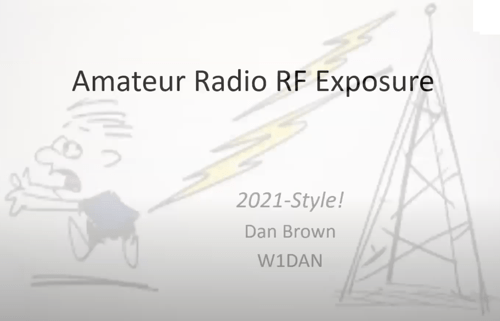
On Tuesday, April 27, Dan, W1DAN, ARRL Eastern Massachusetts Section Technical Coordinator, gave a Zoom presentation on the latest FCC regulations on RF exposure evaluation. These are spelled out in FCC-1926A1, “Proposed Changes in the Commission’s Rules Regarding Human Exposure to Radiofrequency Electromagnetic Fields; Reassessment of Federal Communications Commission Radiofrequency Exposure Limits and Policies.” The document is as long as the title might suggest—159 pages—but W1DAN boiled it down, focusing on what these changes mean for radio amateurs.

A recording of the presentation can be viewed by going to https://drive.google.com/drive/folders/1_qIGZhHyMrha-axJt87Dcu0UZuJO0t8F.

After explaining how RF exposure can be harmful, Dan explained how the rules are changing: The biggest change, he notes, is that amateur radio’s categorical exclusion has been eliminated. What this means is that now every radio amateur will have to perform an RF exposure evaluation of their stations. This now includes mobile and portable stations, including HTs, SOTA/POTA stations, and Field Day and special event stations.

He noted that you must be able to prove that your station is safe. This includes not only performing the evaluation, but also documenting these evaluations, should this data be requested by FCC personnel.

One thing that’s not changing are the maximum permissible exposure (MPE) limits. These are spelled out in FCC OET Bulletin 65, “Evaluating Compliance with FCC Guidelines for Human Exposure to Radiofrequency Electromagnetic Fields.” The FCC published this document in August 1997, but it’s still the Bible when it comes to RF exposure. If you don’t have a copy, or have never taken a look at it, you really should do so.

Be careful, though, when reading it. It contains a table (Table 1 on p. 21) that contains a list of output powers at various frequencies. If your station exceeded those limits, then you were required to perform an RF evaluation. Now, however, all amateurs (and other radio services, for that matter) must perform RF exposure evaluations if their output power exceeds 1 mW. We are no longer categorically excluded from performing these evaluations.

OET Bulletin 65 goes on to give guidance on how to calculate or measure exposure levels. Explaining how to do this is outside the scope of this article, but again, you’ll want to refer to the bulletin for more information.

Besides the elimination of the categorical exclusion for amateur radio stations, what else is new is the dates on which amateur radio stations must perform evaluations. They are:

  • May 3, 2021(!!) for new and modified stations
  • May 3, 2023 for stations that complied under the old rules.

Having said all that, the ARRL’s RF Exposure page has a lot of resources to help you understand this topic and perform your own RF exposure evaluations:

  • An RF-exposure FAQ to help hams understand the new rules.
  • “Learning to Live with RF Safety,” QST March 2009 pp. 70-71.
  • RF Safety at Field Day QST June 1999, pp. 48-51. A case study of Field Day with NSRC in a public park
  •  RF Exposure Station Evaluation and Exemption Worksheets
  • RF Exposure and You. This 8 Mbyte PDF file contains the text of the entire book by Ed Hare, W1RFI.
  • Chapter 5 References needed for filling out worksheet.

The page also has links to FCC web pages with information on RF exposure.

I’m sure we’ll all be hearing more about this in the days ahead. Hopefully, someone will come out with a simple way to do the modeling or make the calculations. As always, play safe.


Related posts:

  1. 60m band rule changes coming
  2. Did the FCC just make Baofengs illegal? Short answer: NO!
  3. IARU Region 3 tackles spectrum management issues
  4. Random stuff: HamAlert, fuse replacements, FCC in action

Filed Under: Rules, Regulations, Enforcement, Safety Tagged With: RF exposure

Reader Interactions

Leave a Reply Cancel reply

Your email address will not be published. Required fields are marked *

This site uses Akismet to reduce spam. Learn how your comment data is processed.

Primary Sidebar

No Nonsense Technician Class License Study Guide (for tests given between July 2026 and June 2030)

New No Nonsense Technican Class Study Guide now available!

The 2026 version of my Tech Class study guide is now available, and as always, the PDF version is FREE!. The ePub version costs $9.97, and a Kindle version and paperback version will be available on Amazon shortly.

Click here to get all of my "No Nonsense" study guides.

Also available: The CW Geek's Guide to Having Fun with Morse Code

W5SWL.Com
Retevis Ailunce H1 DMR Radio
DXpander: Cobweb antennas, Laser Cutting

You’ve got mail!

Enter your email address below and get an email every time I publish a new post.

Email


I frequently teach classes to help newcomers get their licenses. The next class will take place on Saturday, February 7, 2026 on the University of Michigan campus. Click here for more information.

If you can't make the class, subscribe to the mailing list to be notified of when the next class will be held.

You can always download my free study guide, and if you have any questions about the classes, or amateur radio in general, please feel free to email me directly.

Support KB6NU.Com

Donate $7.30 and get two of these cool stickers. Measuring 4.25-in. W by 2.75-in. H, it's perfect for your car, your shack, or wherever!

Contact me

If you have a question or comment about one of my blog posts, or a question about any of the material in my study guides, or just a question about ham radio in general, you can email me at [email protected].

Blogs You Should Also Read

  • AE5X: A CW-centric blog from Kingswood, Texas
  • K0LWC Blog
  • LA3ZA Ham Radio Blog
  • Little Radios, Big Fun – WB3GCK
  • Mr. Vacuum Tube's Blog
  • Radio Artisan – K3NG
  • The K0NR Weblog
  • VE3WDM's QRP Ham Radio Blog
  • W2LJ’s Blog

Ham Radio Websites

  • Dashtoons – The Hammin' Comedy by Jeff K1NSS

Podcasts

  • ICQ Podcast
  • Linux in the Ham Schack
  • No Nonsense Amateur Radio Podcast
  • Resonant Frequency Amateur Radio Podcast

Recent Comments

  • Skip K4EAK on Button, button. Who’s got the button?
  • Ed K8MEJ on Is anyone running for the board this year in the Great Lakes Division?
  • Skip Behnke on 2020 Extra Class study guide: E9F – Transmission lines: characteristics of open and shorted feed lines; coax versus open-wire; velocity factor; electrical length; coaxial cable dielectrics
  • Mike on Map your contest QSOs
  • Phillip Cardwell on J-Poles

Meta

  • Log in
  • Entries feed
  • Comments feed
  • WordPress.org

Footer

Copyright © 2026 Daniel M. Romanchik, KB6NU · Log in