
• Skip to primary navigation
  • Skip to main content
  • Skip to primary sidebar
  • Skip to footer

KB6NU's Ham Radio Blog

KB6NU's Ham Radio Blog
  • HOME
  • Study Guides
  • Teach a One-Day Tech Class
  • W8SRC Repeater Guide
  • Advertise
  • Hire Me

Field Day

A different kind of Field Day, but still a lot of fun

June 29, 2020 By Dan KB6NU 2 Comments

Field Day was a lot different here in Ann Arbor than in years past. Our club, ARROW, cancelled the big event (we have been running Class 4A with a GOTA station), and instead, encouraged everyone to operate in some way from their homes. I certainly missed hanging out with old friends—and meeting new ones—but this new format gave me a chance to try some things that I probably would not have otherwise, including running QRP. And, I still had a lot of fun.

The setup

First of all, I decided to operate Class 1B-Battery. The rules say, “All contacts must be made using an output power of 5 Watts or less and the power source must be something other than commercial mains or motor-driven generator.” To meet these requirements, I used my Elecraft KX3, set to 5 W output and a 9 Ah BioEnno battery. Here’s a photo of the station:
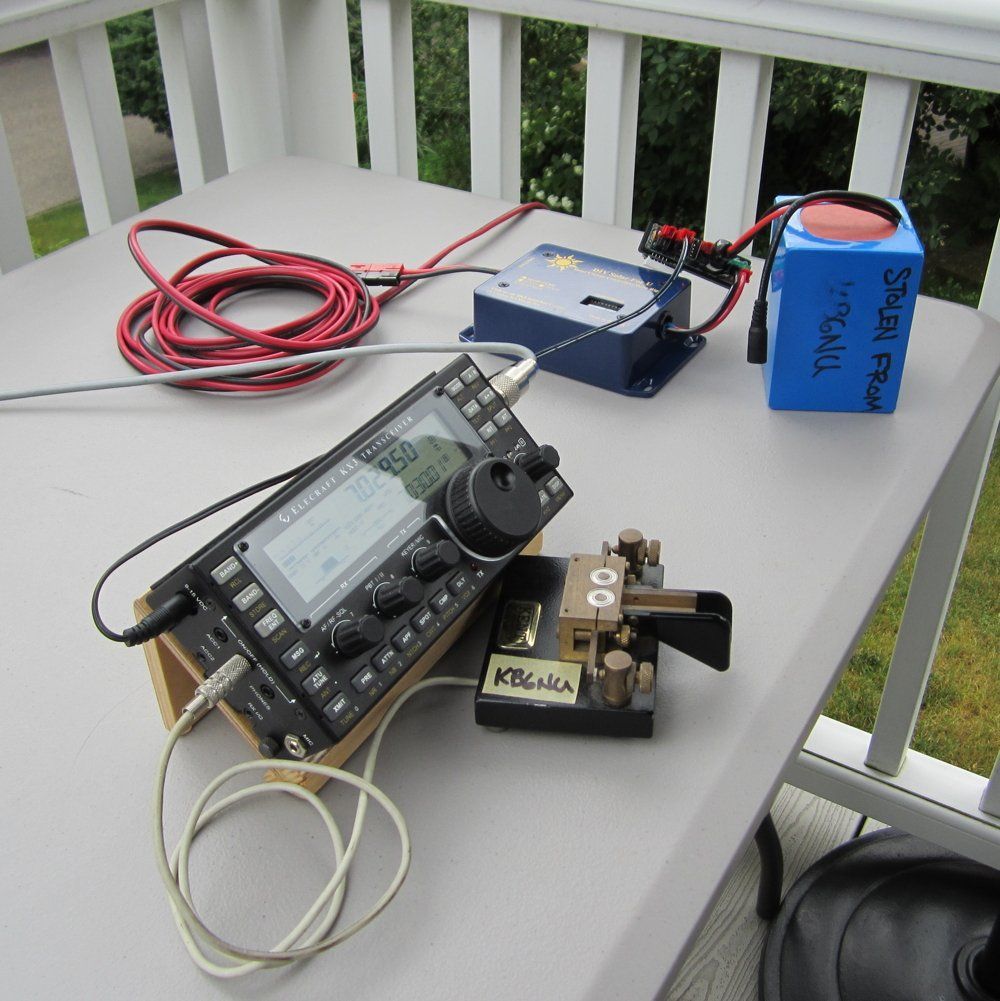

Not only did I power the station with a battery, I charged the battery and operated from solar power. That box next to the battery is an DIYSolar4u Apollo MPPT solar charge controller. The solar panel (shown below) I used was also manufactured by a company here in Michigan called Uni-Solar, which was a subsidiary of Energy Conversion Devices. Unfortunately, this company went out of business eight years ago, but before they closed up shop, our club made a big purchase of these panels at liquidation prices.
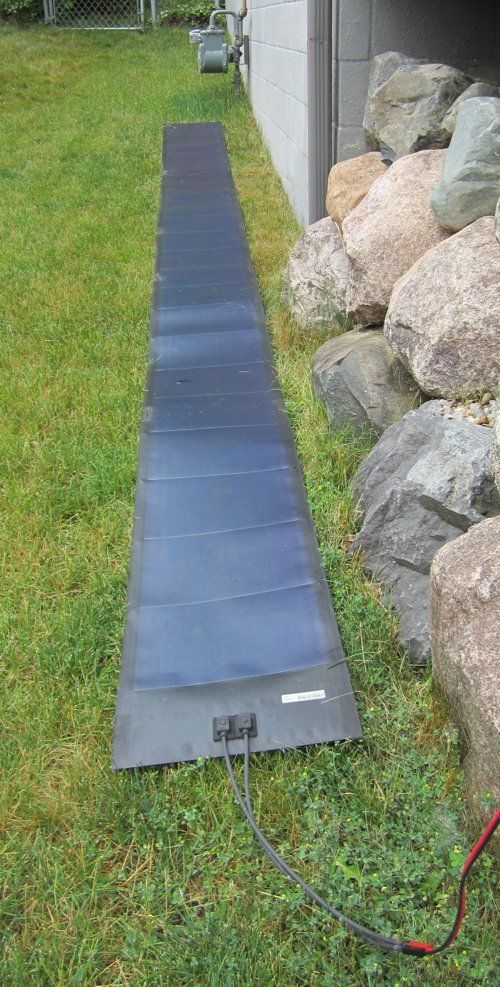
The solar panel and charge controller worked like a charm. In fact, I’d say that running on solar power was perhaps my biggest success of the weekend. I learned a lot about solar panels and charge controllers. For example, while the sun was shining, the solar panel provided more than enough power to power the KX3 on its own. Of course, I was running only 5W, but it would be interesting to see how much power I could run without starting to deplete the battery.

I probably paid a little more than I had to for the solar charge controller, but it is a quality product and can handle a lot more power than I was using on Field Day. Now, I’m thinking that it might be an interesting project to power my entire station from batteries charged by solar panels year-round. I’d certainly need a bigger battery and a couple more solar panels, but this solar charge controller should be able to handle it.

For an antenna, I used the antenna that we normally use at our GOTA station, a 40-meter/20-meter fan dipole in an inverted-V configuration, supported in the center by a mast built from military-surplus fiberglass poles. I set this up in the flower bed in front of my house (see below). I was mostly successful in my efforts to avoid trampling the flowers and plants, but I’m afraid that one of the hostas lost a few leaves. The good news is that you almost can’t kill hostas, and I’m sure it will recover.
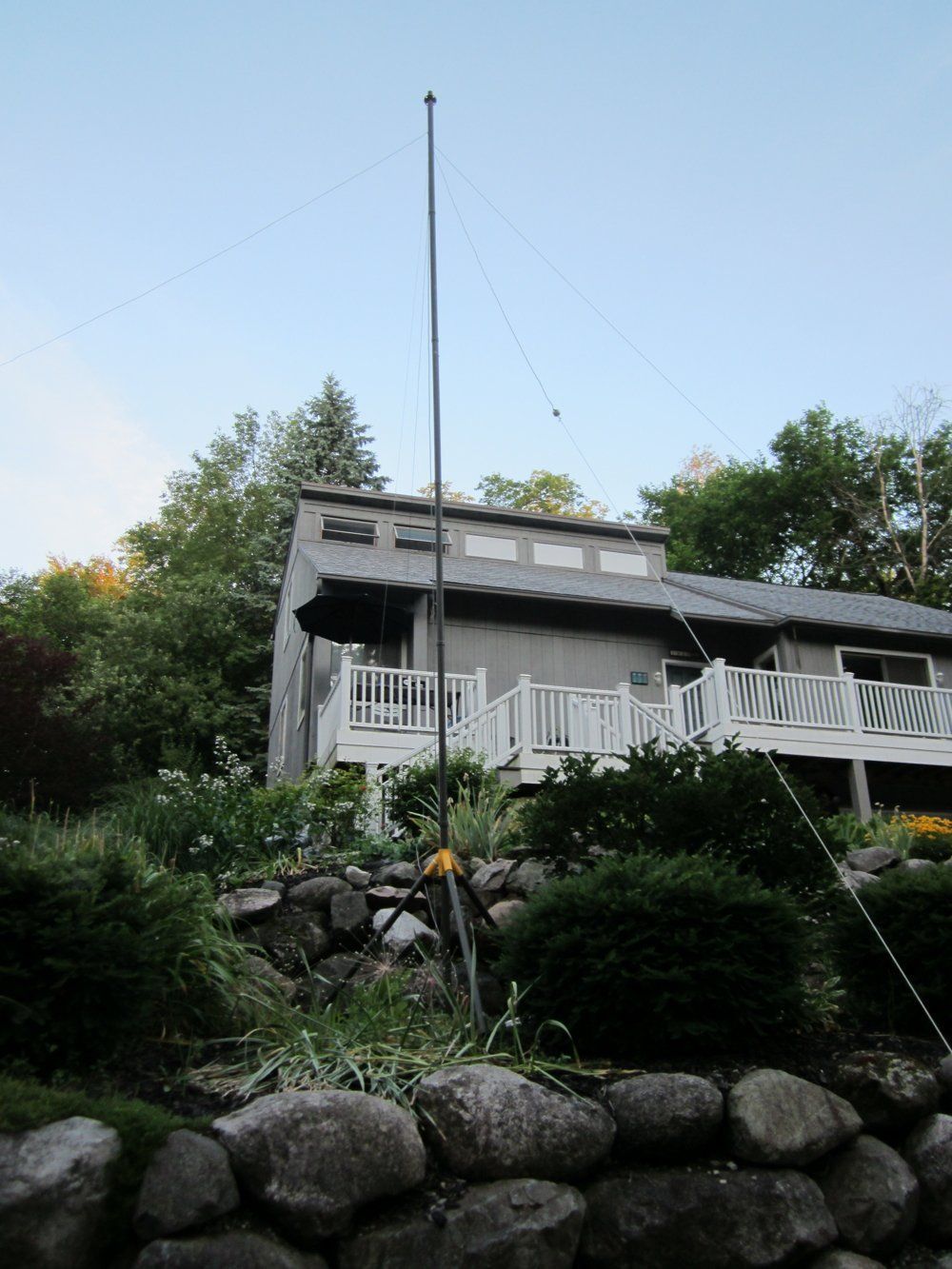
If you haven’t worked with these masts before, let me tell you that putting one up can be kind of tricky. The poles are about four feet long, and you stack them one on top of each other to get the height you want. I have a set of 10 poles. Three are used for the tripod base, leaving seven for the vertical section. That gets the antenna up close to 30 feet.

During a normal Field Day, there are lots of people around to help. This year, though, I had to do it on my own—well, almost all on my own. I decided to quit after stacking six of the poles, and at that point, I asked my wife, Silvia, to hold the mast while I staked down the guy wires. All told, it took me a little less than an hour to untangle the antennas, hoist the mast, and get it all staked down. Not too bad.

How did I do?

I think that I did pretty well. In about 12 hours of operating, I managed to make 225 QSOs, 216 on 40-meter CW and 9 on 20-meter CW. I did try a bit on 15 meters, but no one could hear my 5 W. I worked 20 meters for about an hour and a half on Saturday afternoon, but the band just wasn’t that open, so I gave up and went back to 40 meters..

One mistake that I made was to go to bed early Saturday night, so that I could get up early Sunday morning. I went to sleep at 10 pm and got up at 4 am. I think that in doing this, I missed some prime operating time. I should have tried to stay up till 2 am and then get up around 8 am. I did get to see the sun come up, though, and that was pleasant.

Another pleasant thing was that even though I was running only 5 W, I was able to “run” a frequency a couple of times before a higher power station chased me off. I’m guessing that I made about a dozen contacts during those two periods.

About 10:30 am or so, I had just over 200 contacts, and I was thinking that maybe I could hit 250. Right about that time, though, the activity just tanked. I stuck it out until just before 1 pm, when I hit 225.

Funny story: Sunday evening, some club members got on 2m to share our Field Day experiences. One guy mentioned that he operated FT8 and FT4, and after deleting dupes, he had 226! That kind of frosted me. I probably could have pounded out two more had I known he was at 226.

Bonus points

In addition to trying a different setup, I did get to score bonus points that I wouldn’t normally at our club Field Day operation. It’s not that I don’t want to do them, but they’re normally assigned to other members. For example, Jay, WB8TKL, normally does the traffic handling. Well, this year, I originated some traffic of my own. Of course, Jay is the one who took the traffic from me. Thanks, Jay!

I also set up a public information table (shown below) down by the street so that folks walking by could take one of the flyers underneath the plastic cover. A couple of people did, too, although one of them was my next-door neighbor, and I kind of coerced her into taking it. As she was walking by on Sunday morning, I noticed that she was eying my antenna. I called down to her, “Don’t worry. This is coming down this afternoon.” I also explained a little bit about what I was doing and then got her to take a flyer.

In addition to scoring 100 points each for sending traffic and having a public information table, I scored 450 more bonus points for the following:

  • Operated on 100% emergency power (100 points).
  • Copied the bulletin (100 points).
  • Tweeted while I was operating for the social media bonus (100 points).
  • Sent out a press release before the event (100 points).
  • Submit my logs electronically (50 points).

So, my total score was 225 QSOs x 10 points/QSO, plus 650 bonus points for a total of 2,900 points!

What did I miss?

I did, of course, miss some of the regular Field Day happenings:

  • The food, of course. Every year, someone seems to step up and put on a nice Saturday evening dinner.
  • Hanging out with my friends, swapping stories about past Field Days.
  • Helping newcomers and non-hams make contacts at the GOTA station. Every year, we get one or two folks who just take to it, and introducing them to the fun of ham radio is just a blast for me.
  • Did I mention the food?

Overall, this was a great Field Day, but let’s hope that next year we can return to a more traditional Field Day next year.
Filed Under: Everything Else Tagged With: Field Day

Operating notes: Field Day 2020 prep – the chicks have flown the nest!

June 21, 2020 By Dan KB6NU 8 Comments

The chicks have flown the nest!

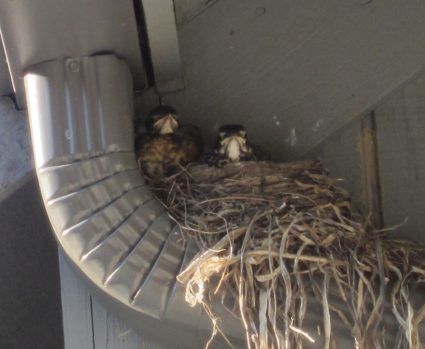
I took this photo on Friday, not more than 36 hours before the chicks flew the nest.

For the past several weeks, we’ve been hosting a robin family in the crook of a downspout just above our front deck. This really is a perfect spot for a nest. It’s protected from the rain, and any four-legged predators would have to climb up the downspout somehow to get to the eggs or chicks. I like hosting the robins, but we also enjoy eating dinner there, reading, and just generally enjoying the summer.

Anyway, what does this have to do with Field Day? Well, this is also the spot where I intend to set up my Field Day station. I was hoping that the chicks would be gone by then, and now it appears that they have flown the nest, and I’ll be able to operate Field Day without disturbing the care and feeding of robin chicks.

Giving my KX3 a workout

Since our club has cancelled its big operation, I’ve decided to operate 1B-Battery this year. I’ll be running my KX3 from a BioEnno battery. The KX3 is a great radio, but I haven’t used it since last August, so I thought I better get it out of the tool box where I keep it and log a few hours on it before Field Day.

So far, so good. There have been a couple of DX stations that couldn’t hear me when I called that probably would have heard me had I been running 100 W, but overall, I’ve had some pretty decent QSOs so far.

I do miss not having a panadapter, though. It’s one of those things that you really get used to having.

Solar power

To qualify for the 1B-Battery class—and the 5x QSO multiplier—the battery has to be charged from some kind of alternate power. To meet this requirement, I obtained a used solar panel from a friend in our club, purchased an MPPT charge controller he recommended, and built up a bunch of cables to connect everything together.

This evening, I’ll be testing that setup with an old gel cell battery that I’ve had around the shack for several years. If that goes OK, I’ll connect up the BioEnno battery and be ready to roll for Field Day.

If any of you have operated Class 1B-Battery, I’d love to hear about your experience, and what to watch out for.


Filed Under: Operating Tagged With: Field Day

Get 100 Field Day bonus points even if you’re operating solo

June 11, 2020 By Dan KB6NU 3 Comments

Yesterday, on our club’s Zoom meeting we discussed Field Day. This year, we’ve opted to all operate and submit our scores separately. It may not be as much fun, but it will give our club an opportunity to score more bonus points. One way to do this is to have each member send out a press release. I volunteered to write a sample press release that could then be adapted by other club members for their own operations. Here’s what I came up with:
FOR IMMEDIATE RELEASE
Contact: Dan Romanchik, KB6NU
734-930-6564
[email protected]

Amateur Radio Operators Adapt to COVID-19 Crisis

Ann Arbor, Michigan – June 12, 2020 – The last full weekend in June is a big one for tens of thousands of amateur radio operators all over North America. It’s Field Day weekend, a combination emergency-preparedness exercise, public relations event, and club picnic. Clubs and individuals tune up their power generators and charge their batteries and get on the air to make radio contacts with other participants. It’s normally a pretty big deal for the ARROW Communications Association, the amateur radio club in Ann Arbor, MI. The club sets up five separate stations in the park just north of the Ann Arbor Municipal Airport and draws well over 100 participants.

This year’s club event is yet another casualty of the COVID-19 crisis, but that’s not deterring ARROW members from participating in this year’s Field Day. Many are planning to set up and operate emergency-power and alternate-power stations from their homes.

For example, Dan Romanchik, amateur radio callsign KB6NU, plans on setting up a temporary station on his front deck on Orkney Drive in Water Hill. The station will include a low-power (5 W) transceiver (transmitter/receiver combination) and a temporary antenna that he’ll set up in the flower bed in front of his house. To power the transceiver, he plans to use batteries that he charged using a solar panel.

To make contacts, Romanchik plans to use a variety of different modes, including voice and digital communications. He’ll also be using Morse Code. “Morse Code is a very efficient way to communicate,” he says, “especially when you’re using such low power.”

Romanchik notes that one of his objectives is to ensure that his equipment will be operational, and should a real emergency occur, that he can send and receive messages. “Even if the power goes out,” he says, “I should be able to keep in touch using batteries charged with my solar panel.”

2020 marks the 82nd annual Field Day event. It was started in 1933 by the ARRL, the national association for radio amateurs, and has been held every year since then, except for the years 1942 – 1946, when amateur radio was suspended during WW II. There are currently more than 750,000 licensed radio amateurs in the U.S., who donate the equivalent of millions of dollars per year providing emergency and public service communications.

For more information about Field Day, the ARROW Communications Association, or amateur radio in general, contact Dan Romanchik, KB6NU, email: [email protected], phone: 734-930-6564.

Now, all our club members have to do is to replace my contact info with theirs and replace the three paragraphs in which I describe what I plan to do with what they plan to do.

Feel free to use this for your own Field Day press release, and have fun and be safe!

Filed Under: Operating, Promotion & PR Tagged With: Field Day, press release

ARRL changes rules for 2020 Field Day

May 29, 2020 By Dan KB6NU Leave a Comment

Since many of us are still hunkering down, and that doesn’t look like it’s going to change much by the end of June, the ARRL has modified the Field Day rules for this year. The biggest change is that Class D stations, that is home stations using commercial power, can now work other Class D stations for points. Previously, this wasn’t allowed.

The second change is that the ARRL will publish aggregate club scores this year. In previous years, this was only done for Class A and Class F entries. Remember, though, Field Day isn’t a contest (yeah, right!).

Here’s the official announcement:

Temporary Rule Waivers for ARRL Field Day 2020

5/28/2020

With one month to go before 2020 ARRL Field Day, June 27-28, the ARRL Programs and Services Committee (PSC) has adopted two temporary rule waivers for the event:

1) For Field Day 2020 only, Class D stations may work all other Field Day stations, including other Class D stations, for points.

Field Day rule 4.6 defines Class D stations as “Home stations,” including stations operating from permanent or licensed station locations using commercial power. Class D stations ordinarily may only count contacts made with Class A, B, C, E, and F Field Day stations, but the temporary rule waiver for 2020 allows Class D stations to count contacts with other Class D stations for QSO credit.

2) In addition, for 2020 only, an aggregate club score will be published, which will be the sum of all individual entries indicating a specific club (similar to the aggregate score totals used in ARRL affiliated club competitions).

Ordinarily, club names are only published in the results for Class A and Class F entries, but the temporary rule waiver for 2020 allows participants from any Class to optionally include a single club name with their submitted results following Field Day.

For example, if Podunk Hollow Radio Club members Becky, W1BXY, and Hiram, W1AW, both participate in 2020 Field Day — Hiram from his Class D home station, and Becky from her Class C mobile station — both can include the radio club’s name when reporting their individual results. The published results listing will include individual scores for Hiram and Becky, plus a combined score for all entries identified as Podunk Hollow Radio Club.

The temporary rule waivers were adopted by the PSC on May 27, 2020.

ARRL Field Day is one of the biggest events on the amateur radio calendar, with over 36,000 participants in 2019, including entries from 3,113 radio clubs and emergency operations centers. In most years, Field Day is also the largest annual demonstration of ham radio, because many radio clubs organize their participation in public places such as parks and schools.

Due to the COVID-19 pandemic, many radio clubs have made decisions to cancel their group participation in ARRL Field Day this year due to public health recommendations and/or requirements, or to significantly modify their participation for safe social distancing practices. The temporary rule waivers allow greater flexibility in recognizing the value of individual and club participation regardless of entry class.

ARRL is contacting logging program developers about the temporary rule waivers so developers can release updated versions of their software prior to Field Day weekend. Participants are reminded that the preferred method of submitting entries after Field Day is via the web applet. The ARRL Field Day rules include instructions for submitting entries after the event. Entries must be submitted or postmarked by Tuesday, July 28, 2020.

Personally, I plan to operate 1B-Battery. I’m going to set up my KX3 on the deck and my 20m/40m fan inverted-V antenna in the yard. I’ve just acquired a couple of solar panels, too, and plan to get the 100 point bonus for alternate power. In addition, I’m going to shoot for other bonus points, too:

  • copy the bulletin—no brainer
  • promote my location on social media—I am going to get on NextDoor and invite neighbors over to watch from an acceptable “social distance.”
  • put some literature down at the bottom of the hill near the street and claim a public information table.
  • send a press release to the local online paper and claim a media publicity credit.
  • perhaps get someone under 20 to come and operate while I coach from an acceptable “social distance.”

For more ideas on what you can do for Field Day, take a look at this presentation by Anthony, K8ZT. It has a lot of great ideas.

I’m really going to miss helping newcomers operate the GOTA station,  the food, and all the camaraderie, but this should be fun, too.

Filed Under: ARRL, Contests, Operating Tagged With: Field Day

Operating Notes: 20m open, random Field Day notes

July 4, 2019 By Dan KB6NU Leave a Comment

In case you haven’t been paying attention, 20m has been open more in the past couple of days. Today, for example, I made 7 20m contacts, including several in Europe. I don’t think this is a long-term trend, but it’s nice to make some contacts on 20m.


I copied the special bulletin for Field Day this year. My original plan was to copy the first Friday evening CW transmission at 20 wpm. So, just before the transmission was to begin, I tuned to 7047.5 kHz (I wonder how they chose that particular frequency?) and set up my digital recorder.

It’s a good thing that I set up the recorder because I found that I couldn’t actually write that fast. I quickly fell behind and then just gave up. I could copy the message easily enough in my head. I just couldn’t get it down on paper.

After the bulletin ended, I played it back and copied using a text editor. That was very easy. I should have started off doing that. In any case, I scored 100 points Friday evening before making a single QSO.


Saturday night while operating 40m CW, I worked VE7SAR. The very next contact was K5SAR.


And, finally, another operating oddity. On June 20, 2019, I worked VE3 BXG. My previous QSO with Mark was on June 20, 2018.

Filed Under: Operating Tagged With: Field Day

Amateur radio in the news: Field Day 2019 video edition

July 3, 2019 By Dan KB6NU 1 Comment

Ham radio operators prepare for the worst


Lake Oswego Amateur Emergency Radio Service


Conejo Valley group shows ham radio’s essential purpose in 24-hour race to connect

Filed Under: Clubs, Operating Tagged With: Field Day

Some Field Day 2019 thoughts

June 25, 2019 By Dan KB6NU 9 Comments

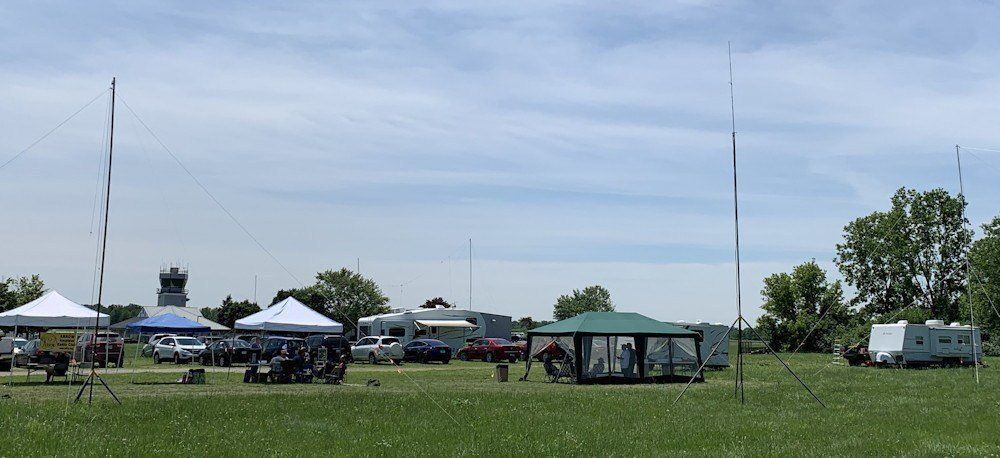
We ran four HF stations this year, including two CW and two SSB stations. Also shown in this photo are the GOTA station, the public information table, and the food tent. Photo: Larry Works, KD8MDM.

Well, Field Day 2019 has come and gone. We didn’t do quite as well as we did last year. This year, we made just short of 2,100 QSOs, compared to 2,245 in 2018. We also missed some bonus points that we scored last year, so our overall score is going to be lower this year.

I had a good time, as usual, as did everyone that attended, but I’m a bit disappointed that our score is going to be lower. So, it got me to thinking about how we could do better next year.  Here are a few thoughts:

  1. Schedule operators. I think that we should set up a written schedule so that we’re sure that the stations are in operation for all 24 hours. There were some times, especially late at night/early in the morning, when they weren’t being operated. You can’t make Qs if stations don’t have operators.
  2. Train operators beforehand. I think it would be helpful to give the operators some training before Field Day, so that when they do sit down in front of a radio, they know what to do .
  3. Better antennas. Steve, K8QKY, one of our CW operators, made this point. Even though there are no multipliers on Field Day, louder stations get more attention, and therefore, make more contacts. We’ve been using a series of dipoles held up by 40-ft. masts, and they work well, but if we want to take our operation to the next level, we need to think about directional antennas.

Of course, doing these things takes a lot of work, so, the question is whether it’s worth it or not. Scoring more points is more fun than scoring fewer points, so perhaps it is.

Tell me about your Field Day experience? Did you make any changes to your operation that helped you score more points or made Field Day more fun? Do you have any thoughts about how to improve your operations next year?

Filed Under: Clubs, Operating Tagged With: Field Day

Field Day 2019 makes the news

June 18, 2019 By Dan KB6NU 1 Comment

As I’m sure most of you know, Field Day is this coming weekend. I often describe Field Day as a combination emergency preparedness exercise/club event/PR opportunity. Indeed, you score points by sending out a press release to local news outlets.

Increasingly, I find that many of these press releases are being picked up and reported on. Here’s a sampling of the stories I’ve found over the last week or so:

  • Ham Radio takes the spotlight with Field Day, June 22-23
  • Amateur Radio Field Day to be marked in Huntsburg Township
  • Local Ham Radio Operators to Participate in Nationwide Emergency Preparation Event on June 22-23
  • See how ham radio works at the Amateur Radio Field Day exercise June 22-23 in Riverside
  • Proclamation passed by commissioners
  • Tune In To Ham Radio Field Day In Lancaster
  • Locals taking part in ham radio exercise
  • Fair Lawn Amateur Radio Club Celebrates A Weekend Of Radio Science With Field Day
  • Amateur radio Field Day event set in Seven Hills
  • Ham Radio Club to host annual Field Day

Sending out a press release is a relatively easy way to score points on Field Day. If your club hasn’t done this yet, there’s still time. And, for sure, make it a point to do it next year.

Filed Under: Amateur Radio in the News, Operating, Promotion & PR Tagged With: Field Day

Amateur radio in the news: Field Day 2018 edition

July 9, 2018 By Dan KB6NU 3 Comments

Here are some news stories from around the country about Field Day 2018. I don’t know if I’m just more connected this year, but there seemed to be more stories this year than in previous years. I think that the Public Information Officers around the country are doing a great job, though, of getting publicity for amateur radio.

Radio Enthusiasts Gather for Field Day

Local amateur radio enthusiasts gather for annual Field Day

Orange Radio Club Holds Field Day

Ham Radio Operators Demonstrate Their Skills

Field Day demonstrates the critical need for emergency communication through amateur radio

Amateur radio is alive and well in Pontotoc County

Filed Under: Everything Else Tagged With: Field Day

Amateur radio videos: satellites for new operators, project-to-kits, Field Day

July 2, 2018 By Dan KB6NU Leave a Comment

Here are some cool YouTube videos that I’ve come across. The first one is a YouTube channel for beginning satellite operators.

A friend of mine and I once made a kit from a project. We did OK with it, but only OK. Here’s a video from Jenny List, G7CKF, a Hackaday contributing editor. While she admits that she makes more money writing for Hackaday than selling kits, she still has some kits available for sale.

Here’s a video of the South Lyon ARC Field Day operation. They’re just up the road from us here in Ann Arbor. I think that next year we need to find someone with the video skills to capture our Field Day.

And, finally, here’s a Field Day video of the N5OAK club in Dripping Springs, TX. My No Nonsense Amateur Radio Podcast co-host, Tom, KB5RF, belongs to this club. He makes a short appearance towards the end of the video.

Who says there are no young guys in amateur radio?

Filed Under: Amateur radio business, Kits, Operating, Satellites Tagged With: Field Day

  • « Go to Previous Page
  • Page 1
  • Page 2
  • Page 3
  • Page 4
  • Page 5
  • Interim pages omitted …
  • Page 7
  • Go to Next Page »

Primary Sidebar

No Nonsense Technician Class License Study Guide (for tests given between July 2026 and June 2030)

New No Nonsense Technican Class Study Guide now available!

The 2026 version of my Tech Class study guide is now available, and as always, the PDF version is FREE!. The ePub version costs $11.97, and a Kindle version and paperback version will be available on Amazon shortly.

Click here to get all of my "No Nonsense" study guides.

Also available: The CW Geek's Guide to Having Fun with Morse Code

W5SWL.Com
Retevis Ailunce H1 DMR Radio
DXpander: Cobweb antennas, Laser Cutting

You’ve got mail!

Enter your email address below and get an email every time I publish a new post.

Email


I frequently teach classes to help newcomers get their licenses. The next class will take place on Saturday, February 7, 2026 on the University of Michigan campus. Click here for more information.

If you can't make the class, subscribe to the mailing list to be notified of when the next class will be held.

You can always download my free study guide, and if you have any questions about the classes, or amateur radio in general, please feel free to email me directly.

Support KB6NU.Com

Donate $7.30 and get two of these cool stickers. Measuring 4.25-in. W by 2.75-in. H, it's perfect for your car, your shack, or wherever!

Contact me

If you have a question or comment about one of my blog posts, or a question about any of the material in my study guides, or just a question about ham radio in general, you can email me at [email protected].

Blogs You Should Also Read

  • AE5X: A CW-centric blog from Kingswood, Texas
  • K0LWC Blog
  • LA3ZA Ham Radio Blog
  • Little Radios, Big Fun – WB3GCK
  • Mr. Vacuum Tube's Blog
  • Radio Artisan – K3NG
  • The K0NR Weblog
  • VE3WDM's QRP Ham Radio Blog
  • W2LJ’s Blog

Ham Radio Websites

  • Dashtoons – The Hammin' Comedy by Jeff K1NSS

Podcasts

  • ICQ Podcast
  • Linux in the Ham Schack
  • No Nonsense Amateur Radio Podcast
  • Resonant Frequency Amateur Radio Podcast

Recent Comments

  • Dan KB6NU on Finally, a Loop for 10m.
  • Dan KB6NU on 1930s cards for my collection of QSLs from stations whose callsigns spell words
  • Sean on Finally, a Loop for 10m.
  • Bill Waslo on 1930s cards for my collection of QSLs from stations whose callsigns spell words
  • C M Wetzel KD8TNF on The Wesco BN-1

Meta

  • Log in
  • Entries feed
  • Comments feed
  • WordPress.org

Footer

Copyright © 2026 Daniel M. Romanchik, KB6NU · Log in