
• Skip to primary navigation
  • Skip to main content
  • Skip to primary sidebar
  • Skip to footer

KB6NU's Ham Radio Blog

KB6NU's Ham Radio Blog
  • HOME
  • Study Guides
  • Teach a One-Day Tech Class
  • W8SRC Repeater Guide
  • Advertise
  • Hire Me

Tropospheric propagation extends VHF/UHF signals

October 11, 2013 By Dan KB6NU 2 Comments

When I’m down at the Hands-On Museum, talking to the visitors there, I frequently get asked if the weather affects radio propagation. I normally respond that the weather has no effect on propagation at all. That’s true, of course, for HF radio propagation, but I now know that’s most definitely not true for VHF, UHF, and even microwave propagation.

Above 30 MHz, the troposphere, the lowest layer of the Earth’s atmosphere refracts and scatters radio waves. This effect occurs every day and can allow amateurs to make contacts of up to 500 miles, although typically the distance is about half that.
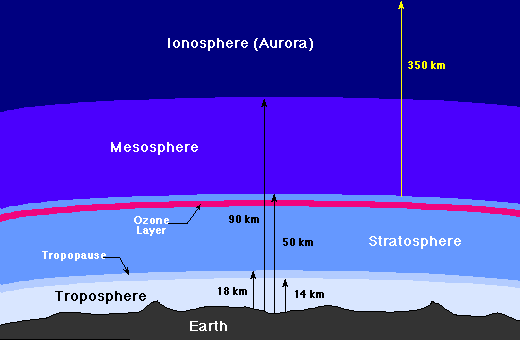
Atmosphere

Normally, air temperatures are warmest near the Earth’s surface and decrease as you go up. Sometimes, though, weather conditions are such that a temperature inversion forms and the atmospheric temperature increase with altitude. When this occurs, a phenomenon called ducting can take place. The duct can act like a waveguide and propagate radio waves for long distances with relatively low losses. If a radio wave of the right frequency enters such a duct, it can propagate up to 900 miles. Sometimes these ducts can exist for days.

For more information on tropospheric scattering, you can read up on it in the ARRL Handbook, or go to the Web page, “Tropospheric DX Modes.” On that website, you’ll also find tropospheric ducting forecasts produced from weather forecasts.

Being an HF guy, I blew off learning about this phenomena. Even when teaching my Tech classes, I wouldn’t attempt to discuss this much. Instead, I’d just recite the answers to the questions and plead ignorance. Now that I understand this more—thanks to a great presentation by Russ, KB8U, at our club meeting on Wednesday—I actually find it kind of interesting.

As if on cue, yesterday while I was fiddling around with the Baofeng UV-5RA that I just purchased (more on that later), I heard a couple of guys from Buffalo, NY access the W8UM repeater EchoLink node. They’d access the link, then identify every minute or so. I thought that was kind of odd, so I called one of them directly. As it turns out, what they were doing is keying repeaters in areas where they thought a ducting path to Buffalo might exist. They would key the repeater via EchoLink and then listen for the repeater with their radios. They weren’t successful with W8UM, but they had been successful with other repeaters that they’d accessed. Very cool stuff.

Related posts:

  1. 2016 Extra Class Study Guide: E3A – electromagnetic waves, propagation
  2. 2020 Extra Class study guide: E3B – Transequatorial propagation; long-path; ordinary and extraordinary waves; chordal hop; sporadic E mechanisms
  3. 2020 Extra Class study guide: E3A – Electromagnetic waves; Earth-Moon-Earth communications; meteor scatter; microwave tropospheric and scatter propagation; aurora propagation; ionospheric propagation changes over the day; circular polarization
  4. Extra Class question of the day: Aurora propagation, selective fading; radio-path horizon; take-off angle over flat or sloping terrain; effects of ground on propagation; less common propagation modes

Filed Under: Propagation, VHF/FM/Repeaters

Reader Interactions

Comments

  1. Edward Vielmetti says

    October 11, 2013 at 8:16 pm

    Huh, that might explain why I was able to tune in a Cleveland FM station last night? I had a drive back and forth to Toledo, and the signal was strong in Toledo and then gradually faded in and out as I got closer to Ann Arbor.

    Reply
  2. k8gu says

    October 16, 2013 at 7:45 am

    Tropo is a lot of fun, especially if you have one of those newer DC-daylight radios. Put up a small beam in a high location. We’re getting toward the end of tropo season, though. I heard a 2m repeater about 250 mi away on the way into work this morning and there was a lot of co-channel interference on the NPR affiliate I listen to as well. One of the really fun things about tropo is that the duct usually gets better as you go up in frequency, making “impossible” QSOs happen at UHF and microwave.

    Reply

Leave a Reply Cancel reply

Your email address will not be published. Required fields are marked *

This site uses Akismet to reduce spam. Learn how your comment data is processed.

Primary Sidebar

No Nonsense Technician Class License Study Guide (for tests given between July 2026 and June 2030)

New No Nonsense Technican Class Study Guide now available!

The 2026 version of my Tech Class study guide is now available, and as always, the PDF version is FREE!. The ePub version costs $11.97, and a Kindle version and paperback version will be available on Amazon shortly.

Click here to get all of my "No Nonsense" study guides.

Also available: The CW Geek's Guide to Having Fun with Morse Code

W5SWL.Com
Retevis Ailunce H1 DMR Radio
DXpander: Cobweb antennas, Laser Cutting

You’ve got mail!

Enter your email address below and get an email every time I publish a new post.

Email


I frequently teach classes to help newcomers get their licenses. The next class will take place on Saturday, October 10, 2026 on the University of Michigan campus. Click here for more information.

If you can't make the class, subscribe to the mailing list to be notified of when the next class will be held.

You can always download my free study guide, and if you have any questions about the classes, or amateur radio in general, please feel free to email me directly.

Support KB6NU.Com

Donate $7.30 and get two of these cool stickers. Measuring 4.25-in. W by 2.75-in. H, it's perfect for your car, your shack, or wherever!

Contact me

If you have a question or comment about one of my blog posts, or a question about any of the material in my study guides, or just a question about ham radio in general, you can email me at [email protected].

Blogs You Should Also Read

  • AE5X: A CW-centric blog from Kingswood, Texas
  • K0LWC Blog
  • LA3ZA Ham Radio Blog
  • Little Radios, Big Fun – WB3GCK
  • Mr. Vacuum Tube's Blog
  • Radio Artisan – K3NG
  • The K0NR Weblog
  • VE3WDM's QRP Ham Radio Blog
  • W2LJ’s Blog

Ham Radio Websites

  • Dashtoons – The Hammin' Comedy by Jeff K1NSS

Podcasts

  • ICQ Podcast
  • Linux in the Ham Schack
  • No Nonsense Amateur Radio Podcast
  • Resonant Frequency Amateur Radio Podcast

Recent Comments

  • Rob WfourZNG on Videos: What’s next for POTA, ham radio helps rescue man trapped in cave
  • Dan KB6NU on The EMF Explorer: A badge for ham radio?
  • Travis Good on The EMF Explorer: A badge for ham radio?
  • MARTIN ROBERT ROTHFIELD on The EMF Explorer: A badge for ham radio?
  • Mike Chen on Operating Notes, January 5, 2026

Meta

  • Log in
  • Entries feed
  • Comments feed
  • WordPress.org

Footer

Copyright © 2026 Daniel M. Romanchik, KB6NU · Log in