
• Skip to primary navigation
  • Skip to main content
  • Skip to primary sidebar
  • Skip to footer

KB6NU's Ham Radio Blog

KB6NU's Ham Radio Blog
  • HOME
  • Study Guides
  • Teach a One-Day Tech Class
  • W8SRC Repeater Guide
  • Advertise
  • Hire Me

Auroral flutter an interesting phenomenon

October 25, 2011 By Dan KB6NU 3 Comments

Aurora
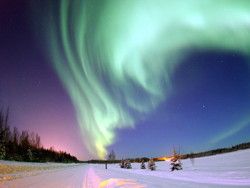
An aurora over Alaska. Source: NASA

Last night, it was reported that there was a coronal mass ejection (CME) that resulted in an aurora being seen as far south as Atlanta, GA. The aurora, more commonly known as the Northern Lights, are usually only visible as far south as the northern tier of the United States.

I knew something was up as soon as I turned on my rig last night. Nearly every signal had some auroral flutter on it. Auroral flutter is caused by radio waves bouncing off the ever-changing aurora or passing through it. When severe, auroral flutter can make a signal nearly unreadable.

Auroral flutter is usually limited to signals that pass over the North Pole. I first became aware of this phenomenon when I worked several stations in Northern Russia. Last night, though, even U.S. stations had this characteristic flutter. I was a little flummoxed by this. I’d never heard this on domestic QSOs.

I got to talking about this with Steve, N4LQ. He said that he was at first a little taken aback by the auroral flutter, because he had been fooling around with the receiver section of the HW-16 he was using and didn’t know if the odd sound he was hearing was the result of his experiments or band conditions. I assured him that it wasn’t the receiver. :)

Related posts:

  1. Operating Notes: auroral flutter, 40m propagation, more
  2. An Interesting Phenomenon
  3. Extra Class question of the day: Aurora propagation, selective fading; radio-path horizon; take-off angle over flat or sloping terrain; effects of ground on propagation; less common propagation modes
  4. 30m: An Interesting Little Band

Filed Under: Operating, Propagation

Reader Interactions

Comments

  1. PAUL, AA1LL says

    October 29, 2011 at 7:24 pm

    Auroral flutter can be heard via back scatter (reflection from it) as well as forward scatter (transmission through it). If two stations are in the skip zone on a frequency above the MUF for their path, their signals will pass through the ionosphere without reflecting. It is possible they would only be able to hear each other via reflection off the ionized region of the auroral zone, which would have that characteristic flutter (which is variable doppler modulation due to the varying properties of the aurora). Below 10MHz most of us don’t have beams so our antennas usually radiate pretty much in all directions. During these periods of increased K index, effective MUF is also lowered which could also explain how this is often heard. HF is interesting as a hobby– a much more challenging medium than VHF for communications. I would hate to have to design a comm link depending on it!!

    Reply
  2. Joe W1FYL says

    April 24, 2012 at 7:58 am

    Similar conditions observed here in MA on 30M last night: very deep and rapid flutter on signals from 1s, 2s, 3s and 4s, which aren’t usually heard at night. There were media reports of auroras and meteor showers last night. Also, little European DX heard, making me wonder if auroras might’ve been reflecting their signals as well.

    Reply
  3. Harry Seyfert says

    July 19, 2016 at 2:33 pm

    I have worked / attempted to work Project Deep Freeze stations with the frustration of auroral flutter via Antarctica. We were experimentally attempting to pass SSTV images back and forth in hopes of being able to send pictures of new born babies to the sailors “on the ice”, or family pictures of special events. It was most interesting how some pictures would pass when listening to the signals said NO! Likewise, when the signals sounded good, the images might be terrible.

    Reply

Leave a Reply Cancel reply

Your email address will not be published. Required fields are marked *

This site uses Akismet to reduce spam. Learn how your comment data is processed.

Primary Sidebar

No Nonsense Technician Class License Study Guide (for tests given between July 2026 and June 2030)

New No Nonsense Technican Class Study Guide now available!

The 2026 version of my Tech Class study guide is now available, and as always, the PDF version is FREE!. The ePub version costs $11.97, and a Kindle version and paperback version will be available on Amazon shortly.

Click here to get all of my "No Nonsense" study guides.

Also available: The CW Geek's Guide to Having Fun with Morse Code

W5SWL.Com
Retevis Ailunce H1 DMR Radio
DXpander: Cobweb antennas, Laser Cutting

You’ve got mail!

Enter your email address below and get an email every time I publish a new post.

Email


I frequently teach classes to help newcomers get their licenses. The next class will take place on Saturday, October 10, 2026 on the University of Michigan campus. Click here for more information.

If you can't make the class, subscribe to the mailing list to be notified of when the next class will be held.

You can always download my free study guide, and if you have any questions about the classes, or amateur radio in general, please feel free to email me directly.

Support KB6NU.Com

Donate $7.30 and get two of these cool stickers. Measuring 4.25-in. W by 2.75-in. H, it's perfect for your car, your shack, or wherever!

Contact me

If you have a question or comment about one of my blog posts, or a question about any of the material in my study guides, or just a question about ham radio in general, you can email me at [email protected].

Blogs You Should Also Read

  • AE5X: A CW-centric blog from Kingswood, Texas
  • K0LWC Blog
  • LA3ZA Ham Radio Blog
  • Little Radios, Big Fun – WB3GCK
  • Mr. Vacuum Tube's Blog
  • Radio Artisan – K3NG
  • The K0NR Weblog
  • VE3WDM's QRP Ham Radio Blog
  • W2LJ’s Blog

Ham Radio Websites

  • Dashtoons – The Hammin' Comedy by Jeff K1NSS

Podcasts

  • ICQ Podcast
  • Linux in the Ham Schack
  • No Nonsense Amateur Radio Podcast
  • Resonant Frequency Amateur Radio Podcast

Recent Comments

  • Dan KB6NU on Some Ham-Vention History
  • David Pompea on Some Ham-Vention History
  • Walter Underwood on One lump or two (or three)?
  • Mike, KL7MJ on Question pools should make teaching classes easier
  • Karl Heinz - K5KHK on Question pools should make teaching classes easier

Meta

  • Log in
  • Entries feed
  • Comments feed
  • WordPress.org

Footer

Copyright © 2026 Daniel M. Romanchik, KB6NU · Log in