
A reader recently e-mailed me:
In the past you told me you started with the Autek RF-1, and later moved to the Palstar ZM-30. I am finally getting around to thinking about purchasing an antenna analyzer, but I am stumped by the choices. In order of increasing purchase price this is what I’ve turned up:
- Autek RF-1 – $139.95
- Autek RF-5 – $229.95
- Rig Expert AA-54 – $340.00
- Palstar ZM-30 $399.99
- W4RT Electronics MiniVNA $399.99
- Rig Expert AA-230PRO $690.00
- Timewave Technology TZ-900S $899.99
How does one decide? Where does one go to find out the differences? Other than asking a fellow ham, how does one find out which one is the best antenna analyzer without paying an arm and a leg (unless the feature(s) so purchased are deemed worth the cost)?
Thanks! 73
He actually missed several other good choices:
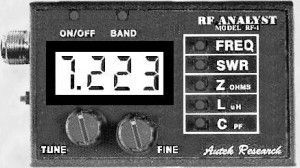
- Autek VA1 – $199. This is actually the antenna analyzer that I first purchased.
- MFJ 259B – $240. This is arguably the most popular antenna analyzer on the market. MFJ has several other models with different feature sets.
- YouKits FG-01 – $250. This is a very cute, little analyzer with a small graphical display. It seems kind of expensive, but the graphical display might be worth it.
- Comet CAA500 – $450.
So, how do you choose just one from this list? Well, I think the first thing that you have to ask yourself is how you’re going to use the analyzer. If all you’re going to do is to check the SWR of your HF dipoles, then buy the Autek RF-1. It’s the least expensive unit, is reasonably accurate, and is small and lightweight, making it easy to use outside where your antennas are located.
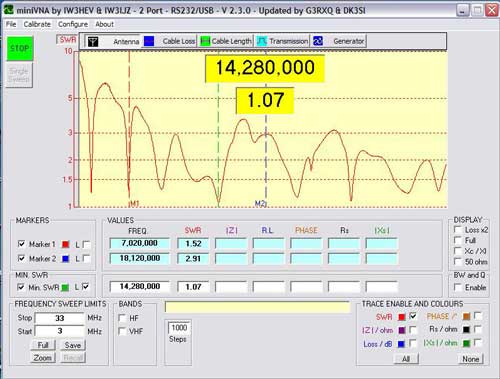
If you want to do some more serious frequency analysis, then you should be looking at the W4RT miniVNA or, if you have more cash, the Timewave TZ-900s. These instruments can help you do a lot more in-depth analysis of your antenna system. The figure below, for example, shows a plot generated by the miniVNA software. It shows the SWR of a multi-band vertical antenna from 3 – 33 MHz.
Some antenna analyzers do more than just SWR. For example, what sold me first on the Autek VA1 and then on the Palstar was that they also measured reactance. So, you can use the antenna analyzer as an LC meter as well. Palstar also says that you can use the ZM-3 as a low-level signal source.
Next, you need to consider what bands you’ll be using it on. Many antenna analyzers only cover the HF bands. That’s a bummer if you like operating 6m, or like to experiment with VHF/UHF antennas. A friend of mine bought the Palstar antenna analyzer after talking to the company at Dayton. At the time, they said that they were planning to come out with a model that covered 6m, as well as the HF bands.
Unfortunately, they never did come out with a 6m version, and he was sorely disappointed. He ended up buying a miniVNA instead.
Asking your fellow hams about the antenna analyzers they have is actually a good way to figure out what’s best for you. If you ask nicely, they might even let you borrow their analyzers or come over and show you how it works on your antennas.
Reading the reviews on eHam is also a good way to gather information before making a purchase like this. You certainly have to take the reviews there with a grain of salt, but if several reviewers mention a particularly good or particularly bad feature of a product, then it’s certainly something worth taking a hard look at.
If you’re new to the hobby, starting out small and working your way up might be a good strategy. You could buy one of the less expensive models and get used to how they work, then sell it and make the leap to a more sophisticated unit. The way things are going, you should be able to sell your first antenna analyzer for at least 80% of what you paid for it.
Whatever you do, don’t fall victim to “paralysis by analysis.” Go ahead and buy one and start using it. This is a learn by doing hobby after all.
Dan,
Don’t forget to mention the DG8SAQ Network analyzer which is IHMO the best device out here these days. 80dB dynamic range is more than you probably ever need.
Thanks for mentioning that, Tobias. I’d never heard of this analyzer before.
Good job summarizing a difficult topic. I had a VA-1 for a while then sprung for a AA-230PRO and found it to be quite a bit more accurate. But occasionally I do miss the direct LC measurement feature of the VA-1. I use the AA stand-alone in the field or with AAPlot software (http://www.w7ay.net/site/Applications/AAplot) if I want to do some more detailed analysis with my Mac Air. One nice feature of AAPlot is you can calibrate out the effects of your connecting cable so you can effectively measure right at the antenna without being there.
Can you elaborate on how you determined that the AA-230PRO is more accurate than the VA-1?
I think it would be really interesting to do a head-to-head comparison of all of these units.
I have an Autek VA-1 that I bought second-hand for about $150 shipped. I think it’s hard to argue with that price and the results are good enough for what I use it for. I’ve never run it head-to-head with a real lab-grade VNA on standard loads. I seem to recall that the ARRL Lab did that and all of the basic analyzers did pretty well close to 50 ohms and deteriorated (as expected) as you got farther away. I have unlimited access to a portable Agilent VNA with 2-port test set at work, so I’m happy with a basic analyzer for routine tinkering, testing, and tuning, at HF.
The ARRL did an in-depth review of four analyzers in the March, 2012 QST (available online to ARRL members). The reviewed the Comet CAA-500, MFJ-266, RigExpert AA-54, and the Youkits FG-01. Each analyzer reviewed had various plusses and minuses, and of course, depending on what purpose you wish to put them to, personal preference will also play into your decision. Even if the unit you are considering was not reveiewed, the article provides a guide to the kinds of questions you should be asking yourself, as you determine your best choice.
I own a Bird wattmeter with various RF/power slugs, a Daiwa cross-needle wattmeter/SWR meter, an MFJ-259B, and a MiniVNAPro, with the 1.5 GHz extender. They each tend to be best suited for various things I do when working with transmitters and antennas. There doesn’t seem to be a substitute, for instance, for a decent wattmeter, which can also display reverse power or SWR. Units like the MFJ-259B are portable, have their own low power signal source, and can be used to tune antennas without causing a bunch of interference on the ham bands by incessent ‘tuning up’ using your transmitter.
Finally, if you want to really see what is going on, a VNA-like instrument, like the MiniVNAPro is really helpful. The Pro version includes a remote Bluetooth interface, which lets you do cool things like hanging the unit right off the center insulator, and take remote readings. And after a long wait, the 1.5 GHz extender unit finally came out last year, so now the MiniVNAPro can cover higher frequencies than the original 170 MHz.
If 170 MHz seems like an odd place to stop, it seems that a number of low-cost VNA units all used the same/similar chipset in the front end, that quits at 170 MHz. It’s frustrating for those of us that operate 430 MHz and/or 900 MHz or 1.2 GHz, but now there are units or extenders that cover those bands.
I chose my antenna analyzer quite a few years ago when the MFJ 259 was probably the only model in existence. I’ve gotten my money’s worth out of it several times over. I also have friends (some friends, huh?) who like my analyzer better than they do me. When I’m invited to a ham’s house for antenna work, I’m often quoted an expression coined by a large company in a TV ad: “Don’t leave home without it!”
I should probably send it to MFJ for servicing, but I can’t part with it!!
Getting back into hamming it up after many years away and looking for equipment for my station an analyzer is near the top of my list. This is to help ensure that what I use for antenna and feed lines and such are properly sized and tuned. As a ham who is also a boater, I am desirous of being able to test Marine VHS as well as Ham HF. I find it interesting that some analyzers such as MFJ 259B do HF thru 170mhz since Marine VHS (including weather stations) are in the 156-162mhz band. See http://www.navcen.uscg.gov/?pageName=mtvhf It is a curiousity that many analyzers cover a more restricted range of freq. I have watched youtube video, read vendor sites, and read unit manuals and I still haven’t decided. When I meet my fellow hams the question I ask is “What do you own that you would buy again?” Responses so far are “interesting”. On YouTube search for “Martin F Jue” and watch his demo to the radio club at the Univ of Georgia. It is very educational. (I am not paid for saying this).
I think the reason that many manufacturers don’t include VHF coverage is that it adds cost to the unit and most hams that operate VHF don’t really tweak their antennas as they do on HF. I know that’s basically what I do. A simple SWR meter is good enough for me on VHF.
I’m not a big fan of MFJ equipment, but I know many guys who have the MFJ antenna analyzers and like them. And, like you say, the MFJ analyzer is one of the few that actually covers up through 170 MHz. Do you have a link for that video? Did you perhaps mean his demo at GA Tech?
These reviews are old, there are newer antenna analyzer out there now that are a lot cheaper than presently described.
Yes, there are some other good choices out there now, even some that you can build yourself. Glen, do you have a favorite? Please add a review here, if you do. Thanks!
Here’s a helpful comparison table of RigExpert Antenna Analysers (bottom of the page).
I have had very good luck with the mfj-259b and more recently the rig expert aa-30.