
• Skip to primary navigation
  • Skip to main content
  • Skip to primary sidebar
  • Skip to footer

KB6NU's Ham Radio Blog

KB6NU's Ham Radio Blog
  • HOME
  • Study Guides
  • Teach a One-Day Tech Class
  • W8SRC Repeater Guide
  • Advertise
  • Hire Me

It’s not a Begali, but….

February 7, 2021 By Dan KB6NU Leave a Comment

One of the questions I’m most frequently asked is, “What is a good paddle for a beginner?” My usual answer to this question is to look for a used Bencher BY-1 at a hamfest or on one of the online venues. You used to be able to get them for $60 or less. Now, however, there are few hamfests and the price has gone up. Now, used Benchers are close to $80.

Another option that newcomers might consider is the CW Morse paddle (shown in photo below). They cost $60 with a steel base ($43 without), and are available from 3rd Planet Solar and Gigaparts. I purchased one recently, and used it for a couple of days. To be honest, I was prepared to hate it, but it actually works pretty well. It’s not a Begali, but it’s good enough that I’d recommend it as a starter key.
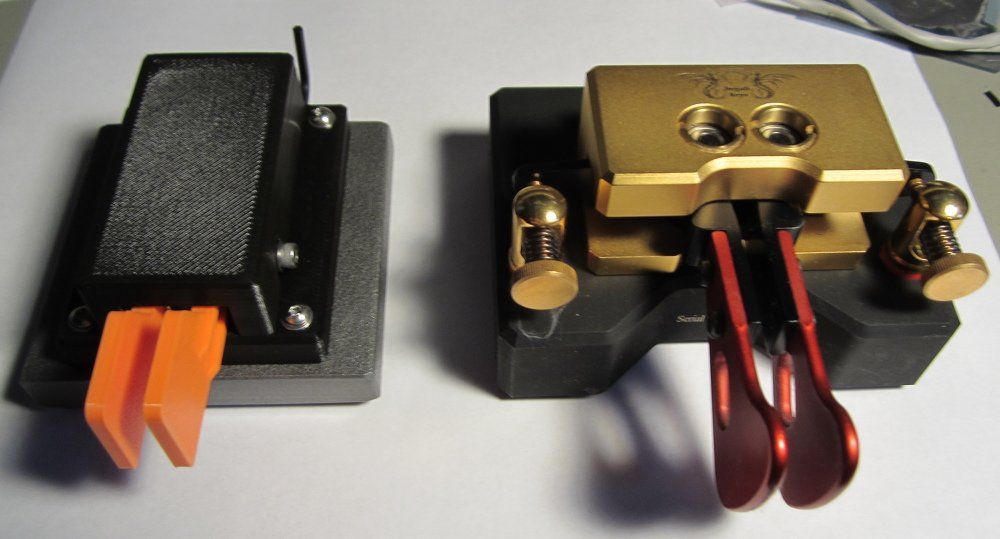
It’s not a Begali Magnetic Pro (right), but the CW Morse dual-lever paddle (right) is worth considering as a first key.

These keys are mostly made from 3D-printed plastic parts. You can tell this from the finish. While not as bad as some 3D-printed parts, they do look a little rough. I wouldn’t be surprised if they go to molded parts, though, at some point. In high volumes, it has to be cheaper to mold the parts rather than print them.
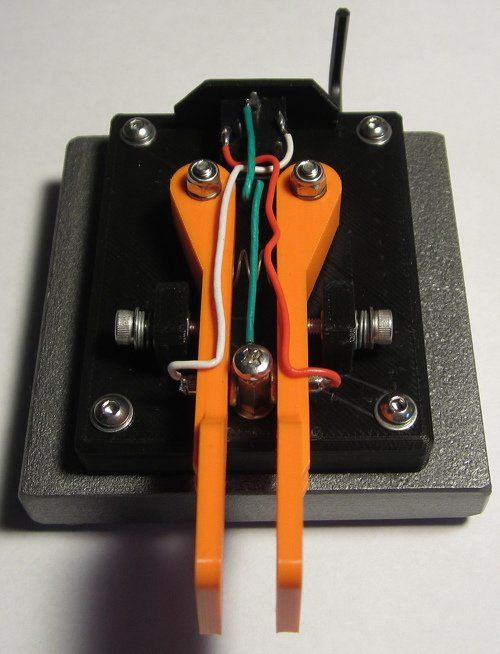
The CW Morse key is mostly plastic, but uses metal where it counts.

The key does have metal parts where it counts, though. The contacts are all brass, the base is made from 1/2-in. cold-rolled steel, and the levers pivot on sealed ball bearings. My key weighed 22.5 oz (1.4 lbs.), and was quite stationary on the silicone mat that I use for my keys. The Begali is, of course, a lot heavier at nearly 60 oz. (3.75 lbs.).

A spring between the levers provides the tension. Two screws allow you to adjust the contact spacing. Unlike the Begali, whose adjustment screws have a very fine thread to give you plenty of adjustability, these screws are standard thread screws. What this means is that it can be a bit tricky to set the contact spacing. The screws are spring-loaded to prevent the adjustment from changing, but the springs don’t seem to be very beefy, and I can see where the adjustment might change after a lot of use.

The ball bearings give the key a nice action. During my tests, I had the speed cranked up to 23 wpm, and this key performed well at that speed. One thing I didn’t like very much is that the arms tend to flex more than I like, but I actually have the same problem with the plastic Begali finger pieces. That’s why I use the aluminum finger pieces on the Begali.

Overall, though, I’m quite happy with this key. And, for sixty bucks, which is about one-fifth of the price of a new Begali Magnetic Pro, I can certainly recommend this key to newcomers getting started in CW.

Related posts:

  1. My new (to me) key
  2. Operating Notes: My CW Technician
  3. My First Vibroplex
  4. CW Geek’s Guide to Having Fun With Morse Code: Choosing a key

Filed Under: CW Tagged With: Begali, CW Morse

Reader Interactions

Leave a Reply Cancel reply

Your email address will not be published. Required fields are marked *

This site uses Akismet to reduce spam. Learn how your comment data is processed.

Primary Sidebar

No Nonsense Technician Class License Study Guide (for tests given between July 2026 and June 2030)

New No Nonsense Technican Class Study Guide now available!

The 2026 version of my Tech Class study guide is now available, and as always, the PDF version is FREE!. The ePub version costs $9.97, and a Kindle version and paperback version will be available on Amazon shortly.

Click here to get all of my "No Nonsense" study guides.

Also available: The CW Geek's Guide to Having Fun with Morse Code

W5SWL.Com
Retevis Ailunce H1 DMR Radio
DXpander: Cobweb antennas, Laser Cutting

You’ve got mail!

Enter your email address below and get an email every time I publish a new post.

Email


I frequently teach classes to help newcomers get their licenses. The next class will take place on Saturday, February 7, 2026 on the University of Michigan campus. Click here for more information.

If you can't make the class, subscribe to the mailing list to be notified of when the next class will be held.

You can always download my free study guide, and if you have any questions about the classes, or amateur radio in general, please feel free to email me directly.

Support KB6NU.Com

Donate $7.30 and get two of these cool stickers. Measuring 4.25-in. W by 2.75-in. H, it's perfect for your car, your shack, or wherever!

Contact me

If you have a question or comment about one of my blog posts, or a question about any of the material in my study guides, or just a question about ham radio in general, you can email me at [email protected].

Blogs You Should Also Read

  • AE5X: A CW-centric blog from Kingswood, Texas
  • K0LWC Blog
  • LA3ZA Ham Radio Blog
  • Little Radios, Big Fun – WB3GCK
  • Mr. Vacuum Tube's Blog
  • Radio Artisan – K3NG
  • The K0NR Weblog
  • VE3WDM's QRP Ham Radio Blog
  • W2LJ’s Blog

Ham Radio Websites

  • Dashtoons – The Hammin' Comedy by Jeff K1NSS

Podcasts

  • ICQ Podcast
  • Linux in the Ham Schack
  • No Nonsense Amateur Radio Podcast
  • Resonant Frequency Amateur Radio Podcast

Recent Comments

  • C M Wetzel KD8TNF on The Wesco BN-1
  • Raymond on Getting a License in Uganda
  • Richard A. Golden on Guest Post: ARRL needs new blood
  • Skip K4EAK on Button, button. Who’s got the button?
  • Ed K8MEJ on Is anyone running for the board this year in the Great Lakes Division?

Meta

  • Log in
  • Entries feed
  • Comments feed
  • WordPress.org

Footer

Copyright © 2026 Daniel M. Romanchik, KB6NU · Log in