
 Here’s another chapter from my upcoming book on operating CW. Comments welcome!
When a new ham decides to learn Morse Code and start operating CW, one of the first things he or she must do is choose a key. There are many different types of keys available, and choosing one can be kind of confusing. With that in mind, let’s look at the different keys that are available and discuss the pros and cons of each.
Straight key
The straight key is the most basic type of key. It has a single set of contacts, and the operator makes dits and dahs by holding down the key for different lengths of time. Because the design is so simple, this is usually the least expensive type of key you can purchase.
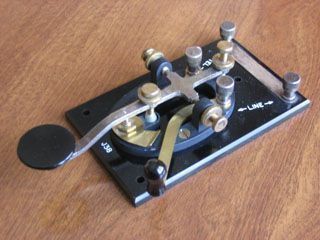
While many hams prefer using straight keys, I’m not a big fan of them myself. It takes practice to make dits and dahs that are the same length over and over, and I guess that I just don’t have the concentration necessary to do that.
Also, my arm tires very easily when using a straight key. I can’t send very long before I begin to feel it in my wrist and forearm. Hams experienced with straight keys tell me that this is because I don’t have the key adjusted properly or that I’m not holding my arm correctly. Whatever the reason, I can’t really operate for more than 30 – 45 minutes with a straight key.
Paddles
Paddles are keys that you use with an electronic keyer. They have two sets of contacts, one for the dits and one for the dahs. It doesn’t matter how long that you hold down the key. Once a set of contacts is closed, the electronic keyer will make the dit or the dah. The nice thing about this arrangement is that the electronic keyer makes each dit and each dah the same length every time.
Another thing I like about the paddle is that it’s very easy on the wrist and arm. Unlike the straight key, which you pump up and down, to operate a paddle, you rest your arm on the desk or table and simply actuate the paddle by moving your fingers or rotating your wrist. This is a lot less stressful, and I find that I can operate for hours using a paddle.
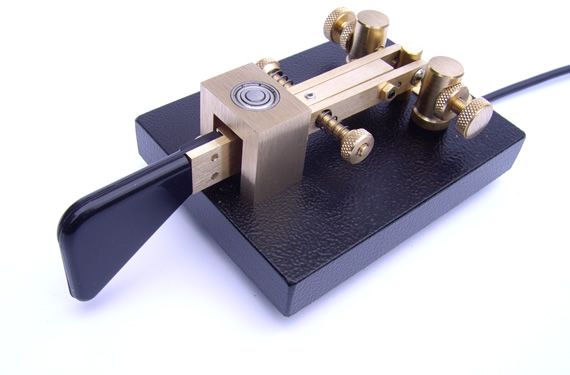
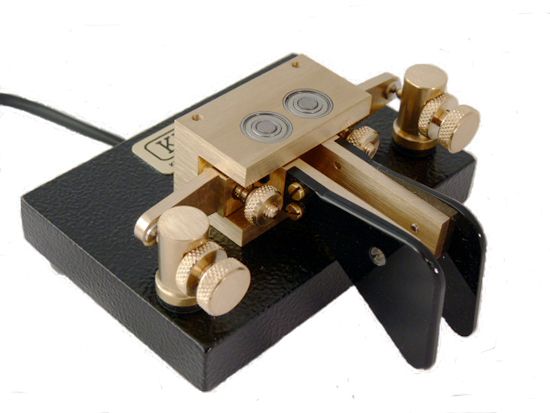
There are two main varieties of paddle: single-lever and dual-lever. The dual-lever paddle is sometimes called an iambic paddle. Bot the single-lever and the dual-lever paddles have two sets of contacts, but in a single-lever paddle, the lever is common to both and only one set of contacts can be closed at a time. The dual-lever paddle has two completely-independent sets of contacts, and both can be closed simultaneously.
When both are closed, most electronic keyers will send alternating dits and dahs. This is called the iambic mode. More about how this works in the next chapter.
Choosing between a single-lever and a dual-lever paddle
Chuck Adams, K7QO, has calculated that using a dual-lever paddle with an iambic keyer requires 11% fewer strokes than a single-lever paddle to send a message in Morse Code. Efficiency isn’t the whole story, though.
For one thing, it’s easier to make mistakes with a dual-lever paddle. The reason for this is that the timing of the contact closures is critical when using a dual-lever paddle. If you make a contact too early or too late, or hold down a contact for too long, the code that the keyer will generate will be wrong. For example, instead of sending a C (dah-di-dah-dit), you end up sending dah-di-dah-di-dah.
This is one reason that the winners of high-speed CW contests tend to use single-lever paddles and not dual-lever paddles. They get penalized for making mistakes, and it’s more difficult to make them with single-lever paddles.
You might also want to choose a single-lever paddle if you are used to using a semi-automatic key, or “bug.” Using a single-lever paddle more closely resembles using a bug than does using a dual-lever paddle.
My recommendation is to try both and see which one you like best. Some operators will prefer the single-lever paddle for its simplicity, while others will prefer the dual-lever paddle.
Touch paddles
Several companies make “touch paddles.” These paddles don’t have levers, per se, but rather metal paddles that one touches to close a contact. Instead of mechanically closing a contact, touch paddles have an integrated circuit them that senses the change in capacitance when you touch one of the paddles then electronically close a contact.
Many operators really like using touch paddles. Because there are no moving parts, there are no mechanical adjustments to make and no loud clicking sounds.
Semi-automatic keys, or “bugs”
Like the straight key, semi-automatic keys, or “bugs,” are purely mechanical. The difference between a straight key and a bug, though, is that the bug has a mechanism that makes dits automatically. Dahs are still made manually, though.
Using one of these keys properly takes a lot of practice, and is generally not a good choice for a beginner. I have one myself, and although I only use it occasionally, I still haven’t gotten the hang of using it after several years.
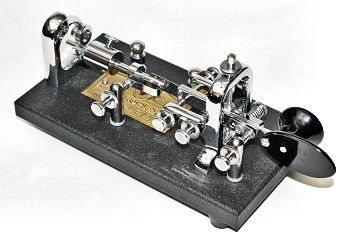
Vibroplex is a registered U.S. trademark. Photos, logos and name used by permission of trademark owner.
Which key is right for you?
If you do become a CW enthusiast, you’ll find that you tend to collect keys and use them all from time to time. In my collection, I have:
- three straight keys, including the key I used as a Novice and a World War II-vintage J37 key with a leg clamp;
- four paddles, including three dual-lever and two single-lever paddles; and
- one semi-automatic key, also called a “bug.”
My advice is to try them all and see which you like the best.
Key manufacturers/sellers
American Morse Equipment. www.americanmorse.com. American Morse sells both mini-paddles and regular-size paddles. For their Porta-Paddle, they even sell a leg mount, so you can operate portable or mobile.
Begali. www.i2rtf.com. When I used to bicycle, I only rode Italian bicycles. They not only were great bicycles, but they were stylish as well. That’s how I feel about Begali keys. My favorite key is my Simplex, Begali’s least expensive paddle, but I wish I could afford one of his fancier models.
Bencher. www.bencher.com. Bencher makes both inexpensive and more deluxe keys and paddles. I often recommend the Bencher BY-1 as a “starter” paddle. You can often find them online or at hamfests for $60-70.
Bulldog Keys. www.amateurradioproducts.com. Bulldog makes a link of small keys for QRP and portable operation enthusiasts.
CW Touch Paddles. www.cwtouchkeyer.com. This company only makes touch paddles.
Kent Engineers. www.kent-engineers.com. This company, located in England, has a long history in the Morse key business. They make straight keys, single-lever paddles, and dual-lever paddles (they call them single-paddle keys and twin-paddle keys). They are very nicely engineered and a good bargain.
Morse Express. www.morsex.com. Morse Express sells keys from Ameco (USA), Bencher (USA), BHC Bird Key (China), GHD (Japan), Hi-Mound (Japan), Palm Radio (Germany), Scheunemann Morsetasten (Germany), uniHAM (China), Vibroplex (USA), Nye Viking (USA), and MFJ (USA).
N3ZN Keys. www.n3znkeys.com. N3ZN makes some very nice hand-made keys.
Vibroplex. www.vibroplex.com. Vibroplex is the grand-daddy of key manufacturers in the U.S. They have been in business for more than 100 years. Their line of products includes straight keys, paddles, and semi-automatic keys, or “bugs.”
There are more manufacturers and sellers out there, but I’ll leave at that. If you have a favorite manufacturer that I haven’t included here, please let me know, so that I can include them in a future edition.
This is a good review. I’m still a little confused by the difference between a mechanical and an electric keyer–for example, “Paddles are keys that you use with an electronic keyer”. I thought the paddle was the keyer? That’s confusing to me. What’s the distinction.
Also, a lot of places sell things called something like automatic keyers or memory keyers. What are those?
Hi, Clark:
A paddle is not a keyer. A paddle is simply a set of contacts that connect to a keyer and tell it whether to send dits or dahs. A keyer is the electronic device that actually generates the dits and dahs, depending on which contacts are closed and the order in which they are closed.
An automatic keyer is essentially the same thing as an electronic keyer. A memory keyer is an electronic keyer with memories in which you can store messages. To send those pre-recorded messages, such as a CQ, you just push a button.
As to the question of what is a paddle vs. a keyer, the paddle is technically a “key”, which closes the circuits to the “keyer” in the radio (if so equipped), which creates the timed dits and dahs, or the external keyer, which creates the timed dits and dahs and sends them to the radio. A straight key is a key, a paddle is a key (either dual AKA iambic key, or single paddle key). A bug is a “semi-automatic key”.
I recently picked up a keyer with a plate that says STANDARD RADIO COMPANY
NEW YORK, U.S.A. SERIAL NO. 1579 MODEL NO.-NONE LISTED.
Could not find any information on a Standard Radio Company.
Can you be of any help. ?????
Hello Andre Gentes, I see you are wanting further info on the Standard radio key, I can share with you what I know about these keys emails me if you like zl2xt at gmx.com.
Michael
Nice quick study on key types, Dan, thanks very much.
Looking for your book now, Amazon or direct from you.
I’m an SSBer but getting onto 6m and 160 and want to
get the CW going now.
73,
Steve K0HAY
Thanks, Steve. I hope to hear you on the air sometime.
Dan,
The bulldog keys you mentioned are out of stock. Do you have recommendations for small, sturdy straight key or paddle manufacturers? Looking for something for my portable case that I just put together.
Thanks Andy
American Morse sells some nicely-made small keys and paddles. A friend of mine just bought a small paddle for his portable operations. He brought it over last week, andn it looked like nicely made. I’ll ask him what he got.
I am making my first morse code circuit board and I need a key for when I complete it. Does anyone have any suggestions on what key I should purchase?
Many thanks for taking the time to read this.
Can you tell us more about the “Morse Code circuit board” that you are building?
Enjoyed your site. Tnx….paul k2oy
Been “hamming” since 1960 when CW was required for the license, and really enjoyed this nicely-crafted synopsis of CW keying devices. I plan to re-read it. Well done.
As you noted, we CW ops tend to become collectors – I tossed out several previous straight keys I used to own, and now own a total of 6, one of which is a $656 Benali Sculpture Janus. It IS addictive.
I’m far from a radio expert, but have always been amazed at how unappreciated CW and Morse seem to be to those new to radio. From the speed that a seasoned operator can transmit detailed information even without a keyer (such as Jeremiah Denton blinking “torture” in Vietnam, or using flashlights), to the extended range and clarity one can get with limited transmitting power on CW. It’s truly amazing how Morse code was conceptualized back in the 1800’s and is still relevant today.
If you haven’t heard already, last year, Google unveiled a Morse keyboard option for use on mobile phones, and honestly that’s what made me finally decide to take the time to learning Morse. Now that I can practice on the go, there’s no excuse for me to wait any longer, and I’m quite pleased that I can now key a whopping 5 words a minute. While not that impressive to the seasoned operator, its actually quicker than I can type on a qwerty keyboard due to my arthritis and oversized thumbs.
In full disclosure, I am in the process of writing and article for my website on how Morse is still a relevant skill in the 21st century. As a firearms and tactics instructor, my page tends to attract a different audience than yours and I in no way intend to “steal” your traffic or plagiarize your posts. Your page was one of the first to appear when researching different types of keys, and I definitely learned something to pass along to my readers. I will provide a link to this post in my article, but felt that it was polite to inform you that this post was an influence to my writings.