
I’ve been threatening to get on the satellites for years now. It’s just been one of those things that never percolated up to the top of my list. I finally bit the bullet, though, and actually made my first satellite contact Tuesday!
Several things finally motivated me to do this. One, I’ve been feeling like I’ve been in a rut. Not just with ham radio, but with life in general. I’m sure that I’m not the only one feeling this way. I felt like I needed to do something different to shake things up a bit.
Two, among my followers, and those who I follow on Twitter, there are many satellite operators, including KI4ASK, KM4LAO, 2M0SQL, KX9X, and many others. Hearing about their exploits certainly gave me a push in the right direction.
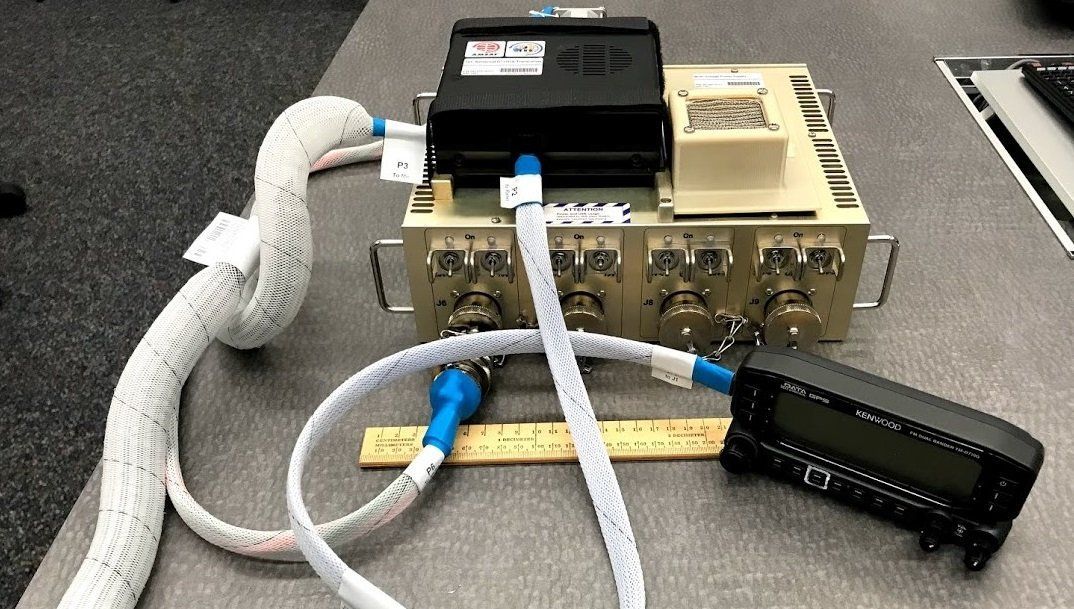
Third, was the news about the International Space Station’s new crossband repeater. It sounded pretty cool to me to be able to bounce a signal off the ISS. After reading this news, I programmed my HT to the receive frequency, 437.800 MHz, and wouldn’t you know it, the ISS was passing nearly overhead at that exact time, and I copied a few callsigns on just the HT antenna. I took that as an omen.
Next, I had to decide on what kind of antenna to buy or build. I initially considered building my own antenna. There are lots of web pages and YouTube videos that show you how to build a satellite antenna. One of the many that caught my eye was Satellite Log Periodic Antenna Project Pt. 1.
In the end, though, I decided that if I tried building one I might get bogged down in the construction process instead of making contacts. I did some research on commercial antennas, and the choice seemed to be an antenna from Arrow Antennas and the Elk Antennas. Both Martin, M1MRB and Edmund, M0MNG, my co-hosts on the ICQPodcast, have Elk antennas, but when I asked on Twitter, the nearly unanimous choice was the Arrow antenna. Jeff, KE9V, settled that dispute when he noted that if I bought an Arrow antenna through AMSAT, that AMSAT would make a few bucks from the sale. So, I got the Arrow. I re-joined AMSAT, too.
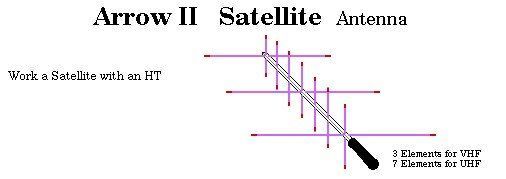
It took me a few days to put the antenna together, and then discovered that I didn’t have the right adapters to connect it to the radio. After consulting with the Twitter gods, I purchased some from Amazon (BNC-SMA, BNC-reverse SMA). In the meantime, I programmed my radio for the new ISS cross-band repeater. For help in doing so, I found this great blog post. I thought that this might be the most logical one to try first, but I didn’t take into account how busy it would be. Since it’s the newest satellite station on the air, everyone wants to work it.
Next, I had to figure out when when the ISS was going to be overhead. I went back to the Twitter gods for recommendations for a satellite-tracking program, and among them was N2YO.Com. I like N2YO.Com. Using it, I was able to determine that the ISS would be passing nearly over head a little after 0030Z that evening.
I thought that tracking the ISS was going to be easy. At 0000Z, the sky was clear, and on a 2m net, I was assured by a local ham, who happens to be a professor emeritus of astronomy at the University of Michigan, that the ISS would be the brightest object in the sky. Unfortunately, by 0030Z, the sky had clouded over, and I never actually saw the satellite. I didn’t make a contact, either. I did hear the ISS repeater, but no one heard me.
After that, I refined my approach. I expanded the number of satellites I now have programmed into my radio and upped the transmit power to 5W. The satellites that I have now programmed into my radio include:
- ISS
- DIWATA-2B (PO-101)
- FOX-1B
- FOX-1CLIFF
- SAUDISAT-1C (SO-50)
- FOX-1D
My strategy finally paid off. Just before lunch last Tuesday, I stood on my back porch and had a QSO with ND0C via PO-101! That was quite exciting. I can see where this might get addicting.
This has been a real learning experience, and isn’t that what ham radio is all about? I’ve been thinking about a number of ways to learn more and enhance my satellite operating experience:
- Build a satellite antenna. Like I said earlier, I’m a big believer in building, rather than buy antennas, and, if I build a log-periodic, I can compare the performance of the log periodic to the Arrow Yagi antenna.
- Build a SatNOGS ground station. I’ve always thought that this project was very cool. The SatNOGS website is a wealth of information on how to do this.
- Move to higher ground. I’m kind of in a hollow here, so I don’t hear the satellites until they get fairly high in the sky, and eventhen, the pass is fairly short, unless they are going right overhead. There’s a park up at the top of the hill, which is just about the highest point in Ann Arbor, and I think trying from there will give me clear shot at many satellites.
- Try the linear satellites. One bit of advice I got from Twitter is to try the linear satellites instead of the FM satellites. They’re less busy than the FM satellites, and you can work them with SSB and CW. I think that would be pretty cool. I may be wrong, but it looks to me like the IC-705 would be the perfect radio to do this. I think that if I sell my KX-3 and some other stuff I’m really not using, I could afford to buy one.
One thing’s for sure. This has gotten me out of my ham radio rut. And, in times like these, that’s a good thing.
I always worked the linear sats with a full duplex station, so I could spot myself in real-time. It helps to know you are getting heard through the sat, and also where in the downlink passband, as that is where most likely you will hear stations calling you.
I used the old iCOM mobile all-mode separates on Oscar 10 and 13, with the Hygain Oscar-Link antennas and SSB Electronic inline amps/RF-sense preamps. This was in the day of Molniya orbit sats, where the apogee was about 40,000 km slant distance, and required about 1000W ERP to be heard in the downlink about the same level as the beacon.
There was about a 1/2 second delay when listening to myself, so I had to get used to that, and not stutter from the delay in my headset.
Best DX? Sri Lanka
You report: “There was about a 1/2 second delay when listening to myself.” How did you listen to yourself?