
• Skip to primary navigation
  • Skip to main content
  • Skip to primary sidebar
  • Skip to footer

KB6NU's Ham Radio Blog

KB6NU's Ham Radio Blog
  • HOME
  • Study Guides
  • Teach a One-Day Tech Class
  • W8SRC Repeater Guide
  • Advertise
  • Hire Me

ARROW Antennas

Made my first satellite contact!

October 16, 2020 By Dan KB6NU 2 Comments

I’ve been threatening to get on the satellites for years now. It’s just been one of those things that never percolated up to the top of my list. I finally bit the bullet, though, and actually made my first satellite contact Tuesday!

Several things finally motivated me to do this. One, I’ve been feeling like I’ve been in a rut. Not just with ham radio, but with life in general. I’m sure that I’m not the only one feeling this way. I felt like I needed to do something different to shake things up a bit.

Two, among my followers, and those who I follow on Twitter, there are many satellite operators, including KI4ASK, KM4LAO, 2M0SQL, KX9X, and many others. Hearing about their exploits certainly gave me a push in the right direction.
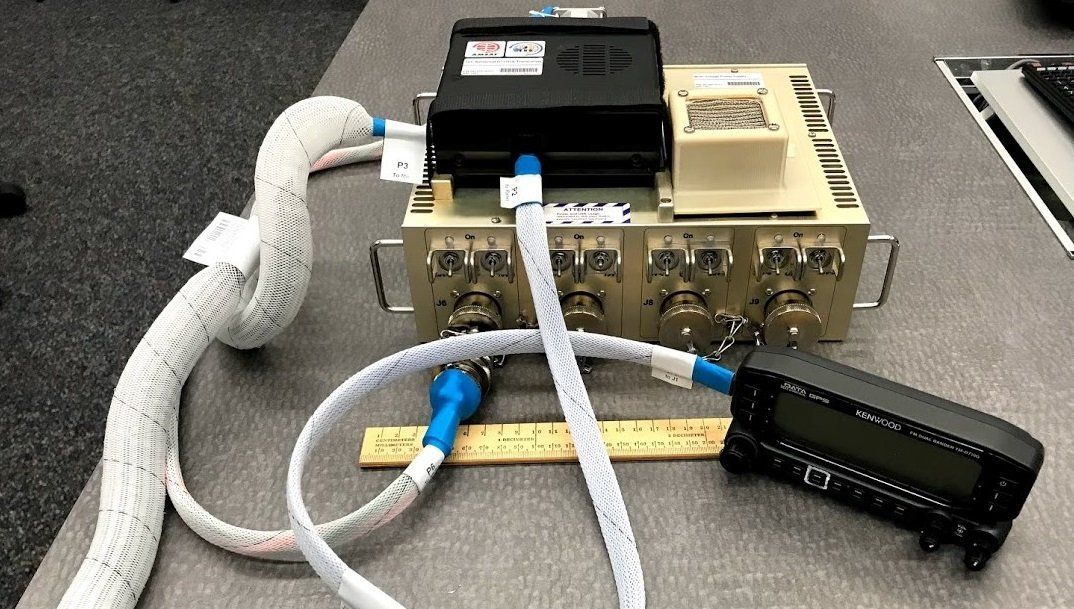
This recently-installed ham gear on the ISS includes a V/U crossband repeater.

Third, was the news about the International Space Station’s new crossband repeater. It sounded pretty cool to me to be able to bounce a signal off the ISS. After reading this news, I programmed my HT to the receive frequency, 437.800 MHz, and wouldn’t you know it, the ISS was passing nearly overhead at that exact time, and I copied a few callsigns on just the HT antenna. I took that as an omen.

Next, I had to decide on what kind of antenna to buy or build. I initially considered building my own antenna. There are lots of web pages and YouTube videos that show you how to build a satellite antenna. One of the many that caught my eye was Satellite Log Periodic Antenna Project Pt. 1.

In the end, though, I decided that if I tried building one I might get bogged down in the construction process instead of making contacts. I did some research on commercial antennas, and the choice seemed to be an antenna from Arrow Antennas and the Elk Antennas. Both Martin, M1MRB and Edmund, M0MNG, my co-hosts on the ICQPodcast, have Elk antennas, but when I asked on Twitter, the nearly unanimous choice was the Arrow antenna. Jeff, KE9V, settled that dispute when he noted that if I bought an Arrow antenna through AMSAT, that AMSAT would make a few bucks from the sale. So, I got the Arrow. I re-joined AMSAT, too.
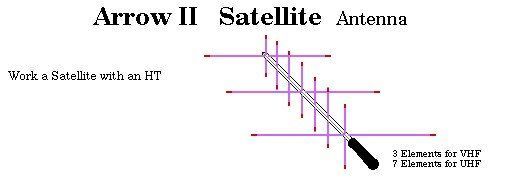
It took me a few days to put the antenna together, and then discovered that I didn’t have the right adapters to connect it to the radio. After consulting with the Twitter gods, I purchased some from Amazon (BNC-SMA, BNC-reverse SMA). In the meantime, I programmed my radio for the new ISS cross-band repeater. For help in doing so, I found this great blog post. I thought that this might be the most logical one to try first, but I didn’t take into account how busy it would be. Since it’s the newest satellite station on the air, everyone wants to work it.

Next, I had to figure out when when the ISS was going to be overhead. I went back to the Twitter gods for recommendations for a satellite-tracking program, and among them was N2YO.Com. I like N2YO.Com. Using it, I was able to determine that the ISS would be passing nearly over head a little after 0030Z that evening.

I thought that tracking the ISS was going to be easy. At 0000Z, the sky was clear, and on a 2m net, I was assured by a local ham, who happens to be a professor emeritus of astronomy at the University of Michigan, that the ISS would be the brightest object in the sky. Unfortunately, by 0030Z, the sky had clouded over, and I never actually saw the satellite. I didn’t make a contact, either. I did hear the ISS repeater, but no one heard me.

After that, I refined my approach. I expanded the number of satellites I now have programmed into my radio and upped the transmit power to 5W. The satellites that I have now programmed into my radio include:

  • ISS
  • DIWATA-2B (PO-101)
  • FOX-1B
  • FOX-1CLIFF
  • SAUDISAT-1C (SO-50)
  • FOX-1D

My strategy finally paid off. Just before lunch last Tuesday, I stood on my back porch and had a QSO with ND0C via PO-101! That was quite exciting. I can see where this might get addicting.

This has been a real learning experience, and isn’t that what ham radio is all about? I’ve been thinking about a number of ways to learn more and enhance my satellite operating experience:

  • Build a satellite antenna. Like I said earlier, I’m a big believer in building, rather than buy antennas, and, if I build a log-periodic, I can compare the performance of the log periodic to the Arrow Yagi antenna.
  • Build a SatNOGS ground station. I’ve always thought that this project was very cool. The SatNOGS website is a wealth of information on how to do this.
  • Move to higher ground. I’m kind of in a hollow here, so I don’t hear the satellites until they get fairly high in the sky, and eventhen, the pass is fairly short, unless they are going right overhead. There’s a park up at the top of the hill, which is just about the highest point in Ann Arbor, and I think trying from there will give me clear shot at many satellites.
  • Try the linear satellites. One bit of advice I got from Twitter is to try the linear satellites instead of the FM satellites. They’re less busy than the FM satellites, and you can work them with SSB and CW. I think that would be pretty cool. I may be wrong, but it looks to me like the IC-705 would be the perfect radio to do this. I think that if I sell my KX-3 and some other stuff I’m really not using, I could afford to buy one.

One thing’s for sure. This has gotten me out of my ham radio rut. And, in times like these, that’s a good thing.

Filed Under: Operating, Satellites Tagged With: AMSAT, ARROW Antennas, Elk Antennas, ISS, N2YO.COM, SatNOGS

New ham gear on the ISS generating some excitement

September 22, 2020 By Dan KB6NU 1 Comment

The ham gear that was recently installed on the International Space Station is generating a lot of excitement in the amateur radio world. This first element, called the InterOperable Radio System (IORS), was installed in early September in the the ISS’ Columbus module. The IORS replaces the Ericsson radio system and packet module that were originally certified for spaceflight on July 26, 2000.

Part of the new radio system includes an FM cross band repeater system that has an uplink frequency of 145.99 MHz with an access tone of 67 Hz and a downlink frequency of 437.800 MHz.  Hams are already making use of the repeater.

Phase 1 of the InterOperable Radio System (IORS), was installed onboard the Columbus module in early September.

According to ARISS,

[The equipment] consists of a special, space-modified JVC Kenwood D710GA transceiver, an ARISS developed multi-voltage power supply and interconnecting cables. The design, development, fabrication, testing, and launch of the first IORS was an incredible five-year engineering achievement accomplished by the ARISS hardware volunteer team. It will enable new, exciting capabilities for ham radio operators, students, and the general public. Capabilities include a higher power radio, voice repeater, digital packet radio (APRS) capabilities and a Kenwood VC-H1 slow scan television (SSTV) system.

A second IORS undergoes flight certification and will be launched later for installation in the Russian Service module. This second system enables dual, simultaneous operations, (e.g. voice repeater and APRS packet), providing diverse opportunities for radio amateurs. It also provides on-orbit redundancy to ensure continuous operations in the event of an IORS component failure.

Next-gen development efforts continue. For the IORS, parts are being procured and a total of ten systems are being fabricated to support flight, additional flight spares, ground testing and astronaut training. Follow-on next generation radio system elements include an L-band repeater uplink capability, currently in development, and a flight Raspberry-Pi, dubbed “ARISS-Pi,” that is just beginning the design phase.  The ARISS-Pi promises operations autonomy and enhanced SSTV operations.

I’ve gotten the bug myself. I rejoined AMSAT and ordered a satellite antenna. Not the best timing, as it’s starting to get cooler here in Michigan, but it is what it is.

After looking at a number of designs for homebrew antennas, and considering the Elk 2M/440L5 Dual-Band Antenna, I decided to buy an Arrow II 146/437-10WBP Handheld Yagi w/ Duplexer after consulting with the guys on Twitter. Nearly everyone recommended the Arrow antenna over the Elk, but what really clinched the deal was that Jeff, KE9V, noted that if I purchased the Arrow antenna via the AMSAT website, AMSAT would get a cut of the sale.

So, now, I’m eagerly awaiting delivery of the antenna, and hope to work the ISS and other satellites soon. See you on the satellites, I hope.


On Tuesday, October 27, 2020, at 7:00pm Eastern time, the Cherryland Amateur Radio Club will host a special presentation, “How to work satellites using you hand-held,” by Clint Bradford, K6LCS, who will present live from his home in California via ZOOM. Clint will be joined on-line with guests from AMSAT as well. Click here to register to attend.

Filed Under: Satellites Tagged With: ARISS, ARROW Antennas, Elk Antennas, InterOperable Radio System, IORS

Dayton 2016: Purchases (of lack thereof)

May 28, 2016 By Dan KB6NU 10 Comments

dayton-2016Last year, I made a significant purchase at Dayton—my 150 MHz Siglent oscilloscope. This year, I didn’t really buy anything, though not for lack of trying. I was looking for two things: a hex beam and a GPS-disciplined, 10 MHz oscillator.

I was disappointed and kind of surprised that there were only two hex beam manufacturers there: Vibroplex, that sells Spider Beams, and RadioWavs. I also wanted to get a look at the K4KIO, NA4RR, and SP7IDX hex beams, as they’ve all gotten such good reviews on the hex-beam mailing list. Based on the reviews there, I’ll probably go with either the K4KIO or the NA4RR antenna.

I was also looking for a 10 MHz, GPS-disciplined oscillator. It would be really nice to have an accurate frequency source in my shack, and I actually had a good use for one a couple of weeks ago when Thom, W8TAM, brought over a couple of Chinese frequency counters he’d purchased. I didn’t find one there, but not finding one wasn’t as surprising as not finding more hex beams.

The Leo Bodnar GPS disciplined oscillator, sold in the US by Force12.

There are quite a few options. Force12 has started selling a GPS-disciplined oscillator (GPSDO) made in the U.K. It looks like a nice unit, but it costs $226. There are some used Trimble Thunderbolt units available on eBay for about $150. And if you Google “GPS disciplined oscillator” you’ll find a number of homebrew solutions. I may opt for the easy thing here and purchase the unit from Force12.

If you have an opinion on either hex beams or GPSDOs, please feel free to weigh in here or e-mail me directly.

Aside from that, I was able to find a Bencher BY-1 in the flea market for $50. It doesn’t look like it’s been used for quite a while, and the plug was wired backwards (i.e. the tip was connected to the dah contact, not the dit contact), so I’m not sure how much it was ever used. This evening, I rewired the plug and adjusted the contacts, so it’s ready for the next user.

I also purchased the book, Getting Started with Amateur Satellites, by G. Gould Smith, WA4SXM,  published by AMSAT. Oddly enough, this book isn’t yet listed for sale in the AMSAT store, but I imagine that if you contact them, they’ll sell you a copy. The cost is $20.

The book purchase was triggered by my befuddlement at the ARROW Antenna booth. I wanted to buy an antenna to try to work some satellites, but they offer about a dozen different hand-held antennas for satellite work, and I just didn’t know what to get. They were really busy, too, and I didn’t feel like waiting around, so that I could ask them some questions. Perhaps after reading the book and perusing the ARROW website, which has a number of instructional articles and videos, I’ll be able to figure out what to get.

Filed Under: Antennas, CW, Hamfests, Satellites Tagged With: AMSAT, ARROW Antennas, Bencher, Dayton, Force12, hex beam, K4KIO, NA4RR, SP7IDX, Vibroplex

Primary Sidebar

No Nonsense Technician Class License Study Guide (for tests given between July 2026 and June 2030)

New No Nonsense Technican Class Study Guide now available!

The 2026 version of my Tech Class study guide is now available, and as always, the PDF version is FREE!. The ePub version costs $11.97, and a Kindle version and paperback version will be available on Amazon shortly.

Click here to get all of my "No Nonsense" study guides.

Also available: The CW Geek's Guide to Having Fun with Morse Code

W5SWL.Com
Retevis Ailunce H1 DMR Radio
DXpander: Cobweb antennas, Laser Cutting

You’ve got mail!

Enter your email address below and get an email every time I publish a new post.

Email


I frequently teach classes to help newcomers get their licenses. The next class will take place on Saturday, October 10, 2026 on the University of Michigan campus. Click here for more information.

If you can't make the class, subscribe to the mailing list to be notified of when the next class will be held.

You can always download my free study guide, and if you have any questions about the classes, or amateur radio in general, please feel free to email me directly.

Support KB6NU.Com

Donate $7.30 and get two of these cool stickers. Measuring 4.25-in. W by 2.75-in. H, it's perfect for your car, your shack, or wherever!

Contact me

If you have a question or comment about one of my blog posts, or a question about any of the material in my study guides, or just a question about ham radio in general, you can email me at [email protected].

Blogs You Should Also Read

  • AE5X: A CW-centric blog from Kingswood, Texas
  • K0LWC Blog
  • LA3ZA Ham Radio Blog
  • Little Radios, Big Fun – WB3GCK
  • Mr. Vacuum Tube's Blog
  • Radio Artisan – K3NG
  • The K0NR Weblog
  • VE3WDM's QRP Ham Radio Blog
  • W2LJ’s Blog

Ham Radio Websites

  • Dashtoons – The Hammin' Comedy by Jeff K1NSS

Podcasts

  • ICQ Podcast
  • Linux in the Ham Schack
  • No Nonsense Amateur Radio Podcast
  • Resonant Frequency Amateur Radio Podcast

Recent Comments

  • Brian Murrey on Is the ARRL finally feeling the heat?
  • Mike, KL7MJ on Operating notes: POTA ops becoming ragchewers, all quiet on 30 meters, give me a BK
  • Mike, KL7MJ on Is the ARRL finally feeling the heat?
  • Michael Burkhardt on Is the ARRL finally feeling the heat?
  • Radio Rick on Is the ARRL finally feeling the heat?

Meta

  • Log in
  • Entries feed
  • Comments feed
  • WordPress.org

Footer

Copyright © 2026 Daniel M. Romanchik, KB6NU · Log in