
• Skip to primary navigation
  • Skip to main content
  • Skip to primary sidebar
  • Skip to footer

KB6NU's Ham Radio Blog

KB6NU's Ham Radio Blog
  • HOME
  • Study Guides
  • Teach a One-Day Tech Class
  • W8SRC Repeater Guide
  • Advertise
  • Hire Me

Book Review: The 2003 Handbook

November 27, 2002 By Leave a Comment

The ARRL Handbook for Radio Communications 2003

1,216 pages, softcover, 80th Edition
© 2002 ARRL, ISBN 0872591921, $34.95 list price ORDER IT NOW!

It’s been a while since I bought a new Handbook, so I was excited when these arrived here at QTB.Com. This book is amazing in that it really does cover it all–from the basics of AC and DC circuit theory to more advances topics, such as satellite operation and moonbounce.

This year’s Handbook also has more comprehensive coverage of digital signal processing (DSP). Want to know what your fancy, new transceiver is doing to the signal. This chapter will give you some insight. The chapter on modulation sources has een updated to include coverage of digital voice modulation and the chapter on safety practices has also been improved.

One of the biggest strengths of the Handbook has always been its coverage of practical projects that hams can build. Just paging through it made me want to get out my soldering iron. There are hundreds of projects, from the very simple to the very complex. One of the simpler projects to catch my eye was the TiCK-2 Keyer. This keyer consists of an 8-pin microcontroller, a voltage regulator, and 2N2222 transistor, and a handful of resistors and capacitors.

There are also some really simple antenna projects, if antennas are your thing. For example, there is a short piece on how to build a tree-mounted HF groundplane antenna. I think I’ve got the perfect tree in my backyard for a 20m ground plane. There’s also a cool project for building a 10m, 1-wavelength loop antenna.

If you’re new to rolling your own, there’s plenty of help here, too. The Handbook includes chapters on component data, construction techniques, and testing and repair. The appendices also have data that will help you get your projects built.

I know it’s cliche to say it, but the Handbook has something for every ham, from beginners to OMs. It really will help you get more out of ham radio.

——————————————————————————–

Contents

Introduction

What is Amateur Radio?
Activities
Wireless Technology for Everybody

Fundamental Theory

Mathematics for Amateur Radio
DC Theory and Resistive Components
AC Theory and Reactive Components
Digital Signal Theory and Components
Analog Signal Theory and Components
Practical Design and Projects

Safety Practices
Real-World Component Characteristics
Power Supplies and projects
Modulation Sources (What and How We Communicate)
RF Power Amplifiers and Projects
AC/RF Sources (Oscillators and Synthesizers)
Mixers, Modulators, and Demodulators
Filters and Projects
Receivers, Transmitters, Transceivers, and Projects
Digital Signal Processing
Transmission Lines
Antennas and Projects
Propagation
Station Setup and Accessory Projects
Repeaters, Satellites, EME and DFing
Construction Techniques

Component Data
Circuit Construction
Test Procedures and Projects
Troubleshooting and Repair
Operating Practices

Electromagnetic Interference (EMI)
Regulations
References
Filed Under: Uncategorized

I Hate PL-259s!

November 25, 2002 By Leave a Comment

I really hate PL-259s. Well, not PL-259s, per se, but soldering them onto coaxial cable. It took me four tries yesterday to finally get one connector on properly. I suppose I should look into getting crimp-on connectors, but the tools are expensive, the connectors themselves are more expensive, and I have a gut feeling that they don’t perform as well as soldered-on connectors. I guess I’ll just have to learn how to do it correctly.

Filed Under: Uncategorized

Building the VA3TO EchoLink Board

November 23, 2002 By 4 Comments

My VA3TO kit arrived Thursday, and I began building it yesterday. The layout is very professionally done, and the instructions are well-written. I hope to finish building it today.

Next, I’ll have to reconfigure my computers. The computer that I want to use for the link is currently being used by my wife for Hotmail. I’ll have to move it downstairs to my shack and put a wireless Ethernet card in it. Another complication is that it’s currently running Linux, so I’ll have to make sure I have a Linux driver for the wireless NIC and then get the EchoLinux software to connect it to EchoLink.

Finally, I’ll have to make up the cables to connect my IC-22U to the board and then the board to the rig. That looks like another $15 and an hour or so of work. With any luck, I’ll have it on the air by next weekend.

Filed Under: Uncategorized

J-Poles

November 20, 2002 By Dan KB6NU 3 Comments

My biking and ham radio buddy, Mark, came over Monday evening. We had three objectives:

  1. measure the SWR of J-pole I built a couple of months ago,
  2. measure the SWR of the 2m/440 antenna I just purchased from Purchase Radio, and
  3. build a 2m J-pole for Mark

To measure the SWR, Mark brought over his MFJ 259 Antenna Analyzer. In some ways, it’s much nicer than the Autek Analyzer that I have. For one thing the display is much more informative. The Autek display consists of simply a five-digit numeric display, capable of displaying only one parameter at a time. The MFJ is a full alpha-numeric display and displays the test frequency, the measured SWR, and some other information simultaneously.

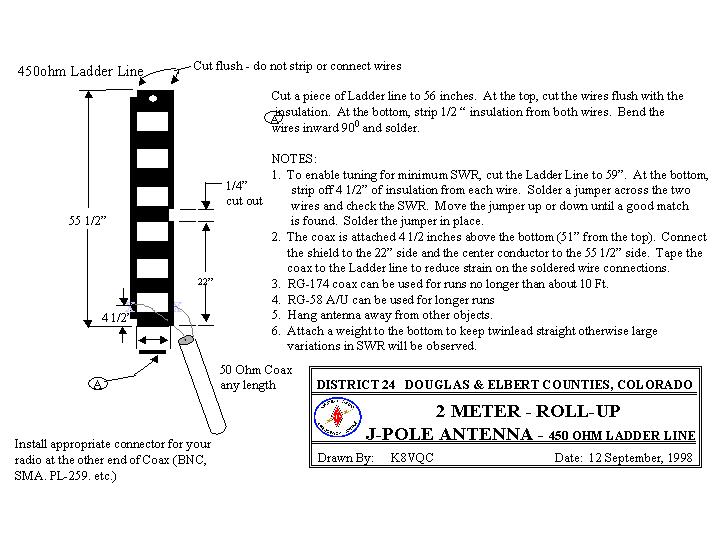
Here are the plans for the 2m j-pole antenna that we built.

The MFJ analyzer’s frequency range is also much greater. It covers the 2m and 440 MHz bands, while the Autek only goes up to 32 MHz. Mark doesn’t think it’s very accurate at 440, though.

The first thing we did was measure the SWR of the J-pole I’d built. I’ve been very happy with the antenna, so I was a little surprised that the first reading was slightly over 2.0. I did have it hanging very near to a fairly massive new barbecue grill we have, so surmising that the grill was detuning the antenna, I moved it away from the grill and the SWR did go down to about 1.5. Respectable in my opinion.

Next, we measured the SWR of the dual-band antenna. This antenna is a 5/8 wavelength antenna that I had mounted on a mast. Its SWR measured about 1.5 near the ARROW 2m repeater frequency of 14.96- MHz. I was happy with that, so we moved on to the antenna construction.

We built the J-pole from plans I found on the Net (shown above). You can build J-poles from 300 ohm twinlead, 450 ohm ladder line, and 1/2-in. copper pipe. The dimensions for each of these versions is slightly different, as the velocity factors are all different.

We opted to build ours with the ladder line because we each already had a hunk of it and it’s much easier to carve up some ladder line than solder up copper pipe. It’s not as sturdy, but it’s certainly sturdier than 300 ohm twinlead.

When I built mine, I did not have an SWR meter to tune the antenna with. So, I just built it to the recommended dimensions, and as mentioned earlier, it turned out to work pretty well. Since we had the analyzer when we built Mark’s we played around with the tuning stub, and it appears that he was able to get a slightly better match than I was.

Overall, it was mission accomplished.

Filed Under: Antennas

Busy Weekend

November 18, 2002 By Leave a Comment

I had a rather busy weekend with my real life–including raking up a mountain of leaves and visiting relatives–so I didn’t have much time for hamming.

I did make a few contacts on EchoLink, including one with a guy who lived in San Diego the same time I did. The funny thing about this contact is that we both were connected to a San Diego repeater via EchoLink, so we really didn’t need the repeater at all. It just provided a meeting ground for us. We were the only two talking, and our conversation was being transmitted by the repeater, even though neither of us actually needed the repeater to communicate.

I had a similar experience earlier in the week when I connected to a NW Ohio repeater. I talked with a guy who was also connected to the repeater via EchoLink. In this QSO, however,we were joined by a local ham, so the repeater was necessary.

Filed Under: Uncategorized

EchoLink, again

November 14, 2002 By Leave a Comment

Tuesday, I ordered the VA3TO board to set up a local link to EchoLink. It looked like it offered the best price/performance. In addition to EchoLink, the website noted that it would also support PSK31 operation, which is something I’m interested in trying.

We had an ARROW club meeting yesterday, and I floated the idea of setting up the link after the meeting. Everyone seemed to really like the idea. I don’t know how long it will take for the board to arrive, or how long it will take for me to put it together, but with any luck, I’ll have it up by the end of the month.

I really need to get back to my CW, too. I haven’t been on CW now for almost two weeks.

Filed Under: Uncategorized

EchoLink

November 11, 2002 By Leave a Comment

A couple of weeks ago, I was chatting with a guy on our local repeater, and he happened to mention that a friend of his had started using something called EchoLink. I just happened to be in my office, so I pulled up the website. How cool, I thought!

What EchoLink is is a way to connect to other amateurs over the Internet using VOIP (Voice Over Internet Protocol). Now VOIP is nothing new, and many chat programs use this technology. What makes EchoLink so cool is that amateur radio operators are using the technology to connect their VHF and UHF radios and repeaters to the Net. Via EchoLink, for example, I can make contacts through repeaters all over the world. Cool, eh?

The software is very easy to download, install, and use. The downloadable file is only about 1.5 Mbytes, which should be doable even on a dialup line. On my ADSL line, it took less than a minute. Once you’ve installed the software, all you have to do is point and click and you’re connected to the ham at the other end (once you have registered your callisgn with the server).

I did experience a couple of glitches. The first was my ADSL router. It has a built-in firewall that rejects accesses on all ports, except those I allow. Programming it to accept accesses on the ports that EchoLink uses cured that. The second was getting the microphone volume set properly. I’d never used a mike on this computer until now, so it was set way too high.

My first “QSO” was with Phil, a retired plumber in Connecticut. Just this afternoon, I worked my first DX when Wayne, an English ham called me. Both times, the audio was nice and clean, and we had nice chats.

The next step is to buy one of the audio card interface boards–the WB2REM board is inexpensive, as is the VA3TO board–and connect it up to my Icom IC-22U. That will open Ann Arbor up to the world and vice versa.

Filed Under: Uncategorized

No Antenna Work Today

November 10, 2002 By Leave a Comment

Today, I was going to put up a 10m loop antenna (unfortunately, you can only access this article if you’re an ARRL member). It’s raining, though, and not a good day for antenna construction. I did, however, build some supports for the antenna out of schedule 40 PVC pipe. I’ll also build the coax cable (out of some mini RG8 that I have). So, when the weather dries out, I’ll be able to put it up pretty quickly.

Filed Under: Uncategorized

Get on the repeater!

November 10, 2002 By Dan KB6NU Leave a Comment

As previously reported, I just bought an IC-207 dual-band rig. It’s a great rig, but for the first two days I didn’t make a single contact on the local repeater. I was not, of course, monitoring the whole time, but you’d think I could raise someone on a Friday or Saturday night. Maybe not, though. I guess the other hams in the area have a life. :)

I did finally manage a contact Saturday night with a fellow who was on his way to Detroit. We had a nice chat, and I found out that he’s a local guy who’d just gotten his license in June. The interesting thing is that despite living in Ann Arbor for the last four years (as a University of Michigan student), he was not familiar with our club, nor of the fact that we owned and operated the repeater we were using.

Of course, I took the opportunity to invite him to our meeting this Wednesday (for more details, see our website), and I think there’s a good chance he’ll show up. I had a similar experience last month. On my way to the club meeting, I had a QSO with a fellow ham, and I mentioned that I was on the way to the meeting, we’d love to have him attend, too. He replied that he’d been meaning to come to a meeting and join, but for one reason or another, just never got around to it. I pressed the point, and he actually did show up. In fact, he brought his checkbook along and paid his dues as well.

My point is that one of the best ways to promote your club is to monitor your local repeater and talk up your club and its activities at every opportunity. Invite people to attend your meetings. Invite them to check in to your nets. If you don’t have a net, start one. If you do some of these things, I think you’ll be pleasantly surprised at the results.

Filed Under: Clubs, VHF/FM/Repeaters

A Musing about Bluetooth

November 9, 2002 By 11 Comments

I’m kind of surprised that I haven’t seen any amateur radio projects that make use of Bluetooth. The Bluetooth frequencies are outside of the ham bands, but even so, it is wireless and that’s what hams do.

One application that I think Bluetooth would be good for is remote control. For example, I can purchase a wireless microphone for my Icom IC-207 for about $150. It uses an infrared link to communicate with the base unit, meaning that I have to be within sight of the rig.

Wouldn’t this work much better and cost less using a Bluetooth link instead of infrared? With a Bluetooth remote mike, for example, I could be in my home office on the first floor and still communicate through the rig in the basement.

What I envision is a transceiver that I can plug into the microphone (the mike has a quick disconnect right at the mike) and one that I can plug directly into the base unit. The link would have to be capable of handling both voice and control signals, but I think that’s part of the Bluetooth spec, isn’t it?

Anyone with a little more knowledge of Bluetooth care to correspond about some of the possibilities?

Filed Under: Uncategorized

  • « Go to Previous Page
  • Page 1
  • Interim pages omitted …
  • Page 467
  • Page 468
  • Page 469
  • Page 470
  • Go to Next Page »

Primary Sidebar

No Nonsense Technician Class License Study Guide (for tests given between July 2026 and June 2030)

New No Nonsense Technican Class Study Guide now available!

The 2026 version of my Tech Class study guide is now available, and as always, the PDF version is FREE!. The ePub version costs $11.97, and a Kindle version and paperback version will be available on Amazon shortly.

Click here to get all of my "No Nonsense" study guides.

Also available: The CW Geek's Guide to Having Fun with Morse Code

W5SWL.Com
Retevis Ailunce H1 DMR Radio
DXpander: Cobweb antennas, Laser Cutting

You’ve got mail!

Enter your email address below and get an email every time I publish a new post.

Email


I frequently teach classes to help newcomers get their licenses. The next class will take place on Saturday, October 10, 2026 on the University of Michigan campus. Click here for more information.

If you can't make the class, subscribe to the mailing list to be notified of when the next class will be held.

You can always download my free study guide, and if you have any questions about the classes, or amateur radio in general, please feel free to email me directly.

Support KB6NU.Com

Donate $7.30 and get two of these cool stickers. Measuring 4.25-in. W by 2.75-in. H, it's perfect for your car, your shack, or wherever!

Contact me

If you have a question or comment about one of my blog posts, or a question about any of the material in my study guides, or just a question about ham radio in general, you can email me at [email protected].

Blogs You Should Also Read

  • AE5X: A CW-centric blog from Kingswood, Texas
  • K0LWC Blog
  • LA3ZA Ham Radio Blog
  • Little Radios, Big Fun – WB3GCK
  • Mr. Vacuum Tube's Blog
  • Radio Artisan – K3NG
  • The K0NR Weblog
  • VE3WDM's QRP Ham Radio Blog
  • W2LJ’s Blog

Ham Radio Websites

  • Dashtoons – The Hammin' Comedy by Jeff K1NSS

Podcasts

  • ICQ Podcast
  • Linux in the Ham Schack
  • No Nonsense Amateur Radio Podcast
  • Resonant Frequency Amateur Radio Podcast

Recent Comments

  • CADProps on My first go at 3D printing not quite a success
  • Dan KB6NU on A Media Guide to Amateur Radio
  • Steve Stroh N8GNJ on A Media Guide to Amateur Radio
  • Walter Underwood on A Media Guide to Amateur Radio
  • Frank on Make amateur radio club nets fun

Meta

  • Log in
  • Entries feed
  • Comments feed
  • WordPress.org

Footer

Copyright © 2026 Daniel M. Romanchik, KB6NU · Log in