
Yesterday, one of my students asked:
I’m going to ask for an SWR meter for Christmas. When I look at various products there’s all sorts of types. What’s the basic kind I should look for?
I replied:
The first question you might ask yourself is whether or not you need an SWR meter. Most modern radios, including your FT-450D, have a built-in SWR meter. I currently do not use an SWR meter for HF.
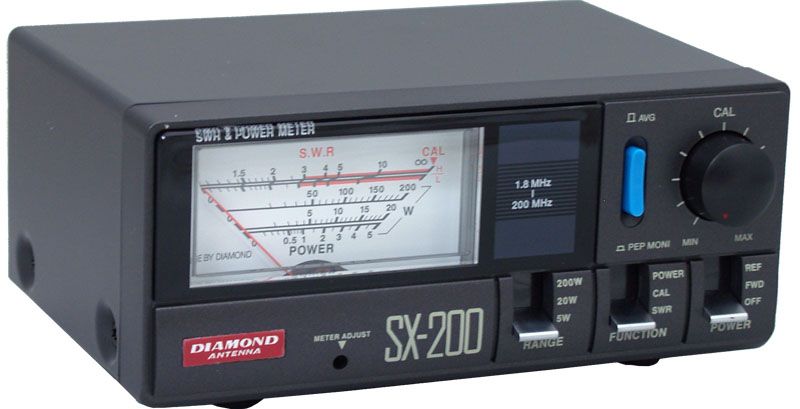
What might be useful is a combination power/SWR meter. A couple of relatively inexpensive products in this category are the Diamond SX-200 and the Daiwa CN-501H. They are both just under $100.
These products are not really very accurate when it comes to measuring power. At best, their accuracy is ±10%. They are much more accurate when measuring SWR because SWR is a relative, not an absolute measurement.
To get better accuracy, you have to move up to something like the Elecraft W2. A factory-assembled version is $300. A no-solder kit version (basically, you’re just doing the final assembly) is $250. Another, more expensive option is the Telepost LP-100A. It costs $475.
What other advice would you give this student?
My first question to your student is “what price range?” Without knowing those bounds, oh man, the field is wide open. Yes Dan, you are very right about the built-in SWR meter on the FT-450D, which opens up the question about the need for an external meter.
But rolling with the question as asked, and filtered through my 5 years of hamming and 4-1/2 years of owning a 450D, here’s what I’ve got, and what I’d advise myself if I could send an email back in time: get a tuner with a large crossed-needle SWR/power meter. I seldom actually use my MFJ-498 as a tuner, but as an SWR meter, power meter, and antenna switch box, it’s worth the MSRP ($170) right there. The ability to tune non-resonant antennas (way beyond the 450D’s 3:1 tuner range) and a 4:1 balun for balanced line and random wires opens up a lot of doors for a new ham too. I’m having fun with all kinds of experimentation that I never knew I wanted to do until I got this tuner and started using it. The meter is pretty great to have around too, it gives a quick confirmation that everything’s working right without having to wade through the 450D’s panel controls.
Another 450D feature I didn’t know about until stumbling upon it just this past year, the CS/Voice front panel button can be re-programmed to momentarily shoot a 10 watt carrier to the antenna line and switch the 450D’s meter to SWR. Details are on pg. 16 of the manual. It’s really convenient when tuning up some portable antenna experiments.
Sorry to go so far beyond the bounds of the original question. It’s just that there are such great options for a versatile combo meter/tuner/switchbox all in one package at a decent price, that it was worth a mention.
That’s an MFJ-948 that Rob is talking about, rather than an MFJ-498, which is something else entirely. It should be used at the 100W level max, rather than the 300W rating, because when loading into an odd load, you can generate some rather high voltages. Better to be conservative. Some folks have complained that the inductor switch gets flaky after a while, but that seems to be easily fixed/replaced (MFJ stocks a lot of replacement parts for their stuff).
I had a ‘Jr.’ version of this tuner (MFJ has a large number of variants) and it ran OK until someone tried to feed it one field day into a trap vertical that was built ‘upside down’. The tuner arced over internally, burning out some switches, and I deemed it not worth fixing, since I had gotten it from another ham essentially for free, I figured I had gotten my money’s worth out it.
I have a “collection” of SWR/power/analyzers these days:
Daiwa cross-needle SWR/power meter, good through 2m
MFJ-259 antenna analyer
Bird 43 watt meter and assorted slugs
Mini VNA with 2.5 GHz extender
Collecting test equipment can become a hobby all its own (and expensive, also). :-)
The one I find I use the most, though, is my MFJ-259 antenna analyzer. It covers up to 170 MHz, which means it doesn’t cover 70 cm, which is annoying. I have to pull out my Bird watt meter for that band.
The Bird is the thing I use 2nd most. Getting a used one at a swap, and a 2-3 slugs to cover needed bands and power levels will set you back about $300-$350, but it will last forever.
>>That’s an MFJ-948 that Rob is talking about, rather than an MFJ-498, which is something else entirely.
Thanks Dave. My lexidisia strikes again.
I would suggest putting the money toward an antenna analyzer instead. As you mention, the radio has a built in meter for SWR (and likely power too) so an external meter doesn’t buy very much.
I prefer a stand alone SWR/Power meter simply because when using older equipment, SWR may not be included as a function in the radio, or may be difficult to view. An alternative is to use a tuner with built in SWR meter. Since my tuner is usually in bypass mode, the meter still functions.
I have used MFJ SWR meters and find them sufficiently accurate for my purposes. My favorite though, is a Drake W-4 Watt meter. It is quite accurate and easy to use.
I actually have a W-4 wattmeter. It is indeed easy to use. I wonder what it would take to re-create it as a product.
I have a Astatic SWR Meter. The tiny design is one of its qualities that I find to be the most appealing. It is incredibly portable due to its compact form. I can easily transport it wherever there are CB radio antennae that I need to tune by doing it in this way.