• Skip to primary navigation
  • Skip to main content
  • Skip to primary sidebar
  • Skip to footer

KB6NU's Ham Radio Blog

KB6NU's Ham Radio Blog
  • HOME
  • Study Guides
  • Teach a One-Day Tech Class
  • W8SRC Repeater Guide
  • Advertise
  • Hire Me

wattmeter

What SWR meter should I buy?

December 7, 2017 By Dan KB6NU 7 Comments

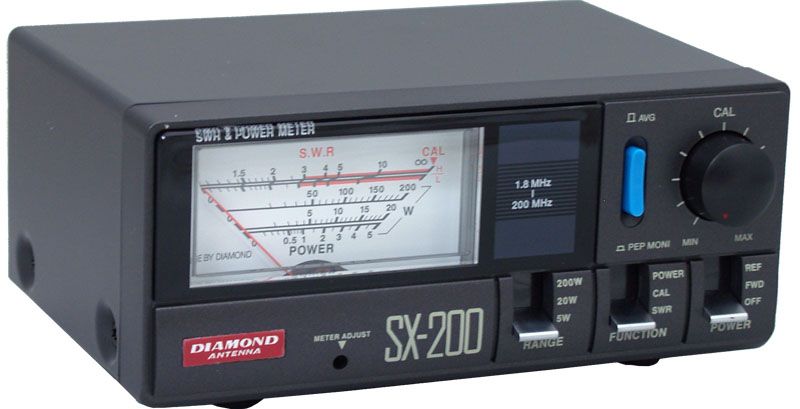
The Diamond SX-200 measures power up to 200 W and SWR from 1.8 MHz to 200 MHz.

Yesterday, one of my students asked:

I’m going to ask for an SWR meter for Christmas. When I look at various products there’s all sorts of types. What’s the basic kind I should look for?

I replied:

The first question you might ask yourself is whether or not you need an SWR meter. Most modern radios, including your FT-450D, have a built-in SWR meter. I currently do not use an SWR meter for HF.

What might be useful is a combination power/SWR meter. A couple of relatively inexpensive products in this category are the Diamond SX-200 and the Daiwa CN-501H. They are both just under $100.

These products are not really very accurate when it comes to measuring power. At best, their accuracy is ±10%. They are much more accurate when measuring SWR because SWR is a relative, not an absolute measurement.

To get better accuracy, you have to move up to something like the Elecraft W2. A factory-assembled version is $300. A no-solder kit version (basically, you’re just doing the final assembly) is $250. Another, more expensive option is the Telepost LP-100A. It costs $475.

What other advice would you give this student?

Filed Under: Test Equipment Tagged With: meter, SWR, wattmeter

New Heathkit power meter

July 21, 2017 By Dan KB6NU 10 Comments

Heathkit has finally announced their next amateur radio product – the HM 1002 Precision RF Power Meter. I say announced because it’s really not available yet. Instead, you can “pre-order” it for shipment in “late summer.”

Here’s what the HM-1002 web page says:

The HM-1002 Heathkit® Precision RF MeterTM is our first new amateur radio station accessory and our first test equipment product in over 30 years. This is a solder kit, suitable for people with no prior electronics experience. We believe it is a landmark in RF meters, in both technical features and price/performance.

Initial early pre-ordering is available for devoted fans, patient experienced kitbuilders and Heathkit Insiders, with payment by check, USPS money order, or eCheck. Regular sales may not open for a month or more.

Final product specifications, and product price for future orders, are subject to change. If lab tests show our design achieves our target goals for accuracy (better than nominals below), the price for orders placed later may increase. [[The pre-order price is $575….Dan]] Pre-orders are limited to two units per customer.  Price shown includes one power+frequency sensor.

THIS KIT WILL START TO SHIP IN LATE SUMMER 2017. 
This product will not ship when you order. You will be waiting but “first in line.” Orders will be processed on a first-paid first-shipped basis. 
Due to high expected demand, the earliest pre-orders have an estimated ship date of August or September. That’s an estimate, not a confirmed ship date, and if you wait to order and are not among the first 1,000 orders you likely will receive yours later than that. Initial pre-orders are a make-to-order, and it takes time to manufacture the First Production Run of a groundbreaking new product.

I’m just as befuddled by this product as I was by their first product—a $150 TRF AM radio. I just don’t see a big demand for this product when there are already so many good wattmeters on the market already, not to mention all of the Bird wattmeters floating around. Sure, this may have better specs than some of those wattmeters, but hams don’t need that kind of accuracy even if they could figure out what to do with it.

Hack-a-Day seems equally befuddled. For their take on the HM-1002, read Heathkit’s New RF Meter. Who is it for?.

Have any of you built one of the new Heathkits? If so, I’d like to hear your take on your experience building the kit and whether it was worth the money.

Filed Under: Gear/Gadgets, Kits, Test Equipment Tagged With: Heathkit, wattmeter

Use forward and reflected power to calculate SWR

September 27, 2016 By Dan KB6NU 6 Comments

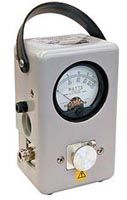
You can use a Bird 43 wattmeter to make forward and reflected power measurements and then calculate the SWR.

This morning, I got the following e-mail from a friend of mine who is a member of the University of Michigan Amateur Radio Club. He got a request from a researcher at the university, who wrote:

We put archival acoustic and motion sensing tags on marine mammals. The tags record for about a day and then release from the animals. A VHF transmitter (transmitting in the 220 MHz range) is built into the tag, along with the antenna. We then use directional antennas to ‘home in’ on the tag in the ocean for recovery and data offload.

I am looking for equipment on campus that I could use to tune the antennas I am making and would like to be able to measure things like standing wave ratio and  transmission frequency.

My friend wrote back:

Unfortunately 220 MHz is a band that isn’t very popular, so there aren’t as many “tools” available.  That means even if you find an HT or mobile unit that will transmit in that band, you won’t have very much luck finding an SWR meter for it. I think your best bet is an antenna analyzer. 

He then mentioned a couple of models that covered the 220 MHz band.

Next, he forwarded the e-mail exchange to me and another club member, asking for any guidance that we might be able to give. The first thing that occurred to me, of course, is question T7C08 from the Technician Class question pool. It asks, “What instrument other than an SWR meter could you use to determine if a feed line and antenna are properly matched?”

The answer is a directional wattmeter. By making both forward and reflected power measurements, you can calculate the SWR with the following equation:

vswr-equation

I suggested that they make these measurements with a Bird 43 wattmeter, with the appropriate plug-in. Bird even has an application note, “VSWR Measurements Using In-Line Power Meters” on how to do  this. This application note not only discusses the theory behind this equation, but also some of the practical aspects of making this measurement, including how the accuracy of a power meter affects the uncertainty of SWR measurement.

This sounds like a very interesting application, and I’m interested in finding out more about it. It’s a good example of how an amateur radio license could be of use to young people interested in pursuing a career  in science or technology, even if that career isn’t electrical engineering.

Filed Under: Antennas, Test Equipment Tagged With: SWR, wattmeter

Primary Sidebar

No Nonsense Technician Class License Study Guide (for tests given between July 2026 and June 2030)

New No Nonsense Technican Class Study Guide now available!

The 2026 version of my Tech Class study guide is now available, and as always, the PDF version is FREE!. The ePub version costs $11.97, and a Kindle version and paperback version will be available on Amazon shortly.

Click here to get all of my "No Nonsense" study guides.

Also available: The CW Geek's Guide to Having Fun with Morse Code

W5SWL.Com
Retevis Ailunce H1 DMR Radio
DXpander: Cobweb antennas, Laser Cutting

You’ve got mail!

Enter your email address below and get an email every time I publish a new post.

Email


I frequently teach classes to help newcomers get their licenses. The next class will take place on Saturday, October 10, 2026 on the University of Michigan campus. Click here for more information.

If you can't make the class, subscribe to the mailing list to be notified of when the next class will be held.

You can always download my free study guide, and if you have any questions about the classes, or amateur radio in general, please feel free to email me directly.

Support KB6NU.Com

Donate $7.30 and get two of these cool stickers. Measuring 4.25-in. W by 2.75-in. H, it's perfect for your car, your shack, or wherever!

Contact me

If you have a question or comment about one of my blog posts, or a question about any of the material in my study guides, or just a question about ham radio in general, you can email me at [email protected].

Blogs You Should Also Read

  • AE5X: A CW-centric blog from Kingswood, Texas
  • K0LWC Blog
  • LA3ZA Ham Radio Blog
  • Little Radios, Big Fun – WB3GCK
  • Mr. Vacuum Tube's Blog
  • Radio Artisan – K3NG
  • The K0NR Weblog
  • VE3WDM's QRP Ham Radio Blog
  • W2LJ’s Blog

Ham Radio Websites

  • Dashtoons – The Hammin' Comedy by Jeff K1NSS

Podcasts

  • ICQ Podcast
  • Linux in the Ham Schack
  • No Nonsense Amateur Radio Podcast
  • Resonant Frequency Amateur Radio Podcast

Recent Comments

  • mike on Instant Character Recognition is the key to CW speed
  • Matt W1CDN on A completely different picture of Wayne Green, W2NSD (SK)
  • Chana Walsh on Rethinking ham radio education
  • Rob WfourZNG on Videos: What’s next for POTA, ham radio helps rescue man trapped in cave
  • Dan KB6NU on The EMF Explorer: A badge for ham radio?

Meta

  • Log in
  • Entries feed
  • Comments feed
  • WordPress.org

Footer

Copyright © 2026 Daniel M. Romanchik, KB6NU · Log in