• Skip to primary navigation
  • Skip to main content
  • Skip to primary sidebar
  • Skip to footer

KB6NU's Ham Radio Blog

KB6NU's Ham Radio Blog
  • HOME
  • Study Guides
  • Teach a One-Day Tech Class
  • W8SRC Repeater Guide
  • Advertise
  • Hire Me

QST

A reader writes about his concerns with the ARRL

March 10, 2025 By Dan KB6NU 2 Comments

On Mar 7, 2025, a reader wrote:

Greetings,

I’m almost 50-year amateur , and a Life Member of the ARRL . I wanted to comment on your ideas how the League could improve its image .

I believe the ARRL has become a publishing firm with prices higher than a “hawks nest.” My first Repeater Directory was handed to me by Harry Dannals, who was the ARRL director at that time. It was free as a member. Today, the Directory with shipping is around $30.

Maybe because of my age, QST has become a magazine with articles that I can’t really understand. I’m familiar with coil and capacitor technology, which my R.L. Drake gear used. It served me well, and I was pretty much able to troubleshoot it. I still try to help hams in my area—Kalamazoo, MI—with antenna problems. I’m still the best on Home Made Tilts for a tip-over Tower . I am a retired tool and die maker from GM.

I have many more concerns about the ARRL. I will not quit, though, being a Life Member.

I replied:

Hi,

Thanks for your email. I am also a long-time ham—53, going on 54, years for me.

I found your comment about QST interesting. While you find that the magazine has “articles that [you] really can’t understand,” there are others that don’t find it technical enough. A friend of mine, who has been a ham longer than me and a retired electronics engineer, told me the other day that he just didn’t find QST interesting anymore.

To be fair, the ARRL has a tough job because amateur radio is such an expansive hobby. There are folks who just operate CW with vintage equipment and others who are pushing the boundaries with data modes at microwave frequencies. It seems to some of us, however, that the ARRL has given up on some aspects of the hobby and are not providing the leadership that it should be providing for all radio amateurs.

One example of this is the membership crisis—and I don’t think I’m being hyperbolic by calling it a crisis. Membership has been dropping like a rock. See this blog post by my friend Frank, K4FMH, for a good analysis of the data. Not only is membership dropping in terms of absolute numbers, but also as a percentage of licensed radio amateurs. The percentage of licensed radio amateurs who are also ARRL members is now south of 20%. How can the ARRL call itself the “national association for amateur radio” when less than 1 in 5 hams are ARRL members?

It appears to me that they either don’t care about membership levels or have just given up. My membership was set to expire at the end of March, and several weeks ago, I got a letter from the League asking me to renew. I could either renew at $59/year or $174/three years. Seriously? They’re only offering me a discount of $1/year to renew for three years? They did say that they’d send me a coffee mug for renewing for three years, but I already have a cheap ARRL mug that I never use from when I renewed for three years three years ago.

Their latest attempt to increase membership is a raffle of a “dream station.” Hams get “tickets” when they join or renew their memberships, and life members, like you, are given chances when you donate at least $50 to the Diamond Club. This is all well and good, but I highly doubt that it’s going to increase membership at all, much less make up the deficit. I’ll be interested to read about the effectiveness of the raffle in the 2025 Annual Report.

Aside from the three-year discount and the raffle, I don’t see any other efforts to increase membership. There is nothing mentioned in the Membership, Marketing and Communications section of the 2023 Annual Report (the 2024 annual report isn’t out yet), except that the ARRL had a presence at the Dayton Hamvention, Huntsville Hamfest, Northeast HamXposition, and Pacificon. That’s fine, but just showing up isn’t going to increase membership, and I would argue, that those events cater to older and more traditional hams and not the kind of people that we want to get into ham radio and become ARRL members.

Well, that’s enough (probably more than you bargained for 😀) for now. I’d be happy to hear more about what you think.

73!

Dan, KB6NU

p.s. I did renew my membership, but for only a single year. I figure that I’ll get a better return my money by investing that $115 in a CD or maybe some Costco stock than I would by paying for an extra two years of ARRL membership.

Filed Under: ARRL Tagged With: membership, QST

More thoughts about QST

February 13, 2024 By Dan KB6NU 14 Comments

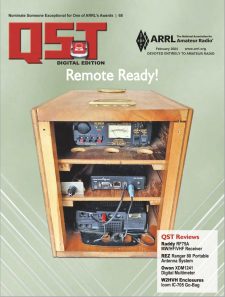
Cover from the February 2024 QST
I completely missed this issue of QST.

Today, I got The Current email newsletter from the ARRL. This newsletter discusses what’s new in the latest editions of QST, On the Air, QEX, and the National Contest Journal (NCJ). For example, the featured article from the March 2024 QST is “Common Mode Current and Common Mode Chokes” by Larry Lamano, WA0QZY.

When I read that, it occurred to me that I hadn’t even looked at the February issue yet. So I reached for my tablet and pulled up the February issue. Sure enough, I didn’t recall reading any of the articles. I bet I’m not alone.

This is a bad thing on several counts. First of all, going all digital like this is going to inevitably reduce readership. I’m not talking about the number of subscriptions (although that’s probably going to decline, too), but the number of eyeballs that actually read the magazine. Fewer people reading the magazine is going to lead to fewer people seeing the advertisements, and ultimately, making QST advertisements less effective. And, if the advertisements are less effective at attracting customers, these companies will eventually pull their advertisements, and the ARRL will make less money from advertising.

(Come to think of it, I’m a QST advertiser, albeit a small classified ad subscriber. See below. I don’t do a very good job of tracking how well that ad performs, but it only costs $34/month. Perhaps I should discontinue the ad and see if my sales actually go down. Doing that could save me some money.)

No Nonsense study guides classified ad.
This classified ad has appeared in QST for nearly five years now.

Fewer readers means fewer engaged members

Secondly, fewer readers will mean less member engagement. QST is the main way that the ARRL communicates with its members. If people start to forget to read QST, they’ll be less likely to renew their membership when it expires. Not only that, they’ll be less like to contribute to the special interest funds, such as the Spectrum Defense Fund or the ARRL Foundation.

Rotary International understands this concept. As a member of Rotary, I get a print version of Rotary every month, even though advertising is now practically non-existent in the magazine. They know that keeping in touch with members is important. Engaged members participate in more service projects (which is what Rotary is all about) as well as contribute to the Rotary Foundation, which funds projects around the world. Rotary has had problems growing its membership in recent years, but I imagine that membership would be even more of an issue without Rotary magazine.

Where does the ARRL go from here?

I wonder if the ARRL has considered any of this. I also wonder if any of the advertisers were offered lower rates now that the print version is only going to those who paid for it. I know some of the advertisers. Maybe I’ll ask them how they feel about it.

I might suggest that they take a look at what the Institute of Electrical and Electronics Engineers (IEEE) does. Advertising in Spectrum, the IEEE’s flagship publication, has dropped precipitously in recent years, but they continue to print it and send it to members. But, they have also created a series of eight special-interest newsletters based on that content, to which members can subscribe. Titles in the series include  Tech Alert, and

If the ARRL did something similar, the titles might include Building/Homebrewing, Contesting, and VHF/UHF. They’re sort of doing this now with separate publications for contesters (NCJ), technical topics (QEX), and beginners (On the Air), but what I’m suggesting is that take all this content and reorganize it and be more targeted as to who they send it to. I will admit that this is only a partly-baked idea, but I do like the way that the IEEE delivers information to me.

I realize that this is a tough situation. The trade magazines that I worked for are now almost all gone. With some creative thinking, though, I think that the ARRL can continue to serve the members and advance amateur radio as well.

Filed Under: ARRL Tagged With: QST

100, 50, and 25 years ago in QST: QRM, finding parts, the internet in 1995

October 13, 2020 By Dan KB6NU 1 Comment

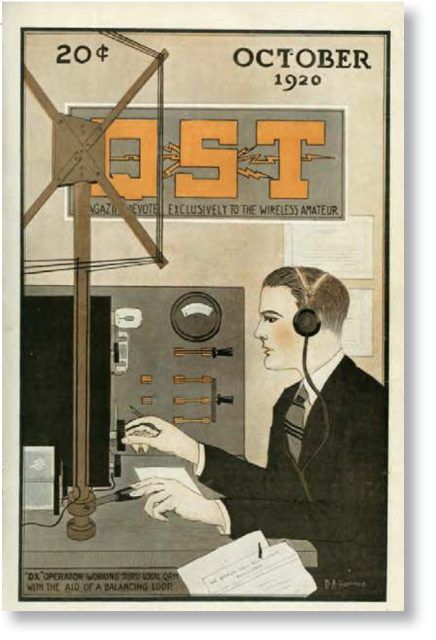
October 1920

The only article of interest to me in the October 1920 QST is “A Paper on QRM” by John Gray, 6MZ.  QRM is still sometimes a problem today, but the QRM problem in 1920 was a much different one. They were still using spark-gap transmitters in 1920, and radio gear was pretty broadband. As 6MZ put it,

All radio communication is more or less affected by interference, but the situation is particularly bad in amateur work. When you come to thing about it this is not very surprising. Nobody expects very good service out of a six-party telephone. So why should we expect to whomever we please, whenever we please, on the several-hundred party line of two hundred meters? When you look at it that way, I sometimes wonder that we ever succeed in talking to each other at all.

Another thing to note is the price: 20¢. That equates to $2.72 in today’s dollars, so for some reason, the price of magazines has gone up way more than the rate of inflation in the ensuing 100 years.

October 1970

The October 1970 QST features the article, “The Ham Builder’s Nightmare” by Doug DeMaw, W1CER. The article reports on complaints by some QST readers that the parts called out in some of the construction articles were difficult to obtain. W1CER says, “Regretfully, the parts procurement situation seems to be going from bad to worse, feeding fuel to the fires of frustration which contribute to the counting of sheep…or sine waves.”

Geez, what would he have to say about the situation today? At the end of the article, he lists the following suppliers:

  • Allied Radio Shack
  • Allied Electronics
  • Amidon Associates
  • Arrow Electronic Supply
  • Barry Electronics
  • Burstein-Applebee
  • Harrison Radio
  • Harvey Radio, Inc.
  • Henry Radio
  • Lafayette Electronics
  • J. W. Miller Co. (now part of Bourns Co.)
  • Newark Electronics
  • Poly Paks
  • Radio Shack (Tandy Corp.)
  • Stafford Electronics Corp.
  • World Radio Labs

I’ve crossed out the companies that are no longer in business. As you can see, most of them are now long gone.

October 1995

The editorial in the October 1995 QST, “Thinking Strategically” by Dave Sumner, K1ZZ, is a piece on the inevitability of the internet. K1ZZ didn’t have any predictions about how the internet would affect amateur radio, just that it would in some way. It certainly has, hasn’t it?

He notes that surveys have pointed out that 48% of 1995’s radio amateurs had access to the internet and compared the use of the internet to the various amateur radio modes: FM, SSB – 79%, CW – 54%, packet radio- 40%. I wonder what these percentages would be today. Certainly, more than 90% of today’s ham use the internet and would guess that fewer than 25% operate CW.

Filed Under: Books and Magazines, Building/Homebrew Tagged With: QST

In the August QST of 1920, 1970, and 1995

July 25, 2020 By Dan KB6NU Leave a Comment

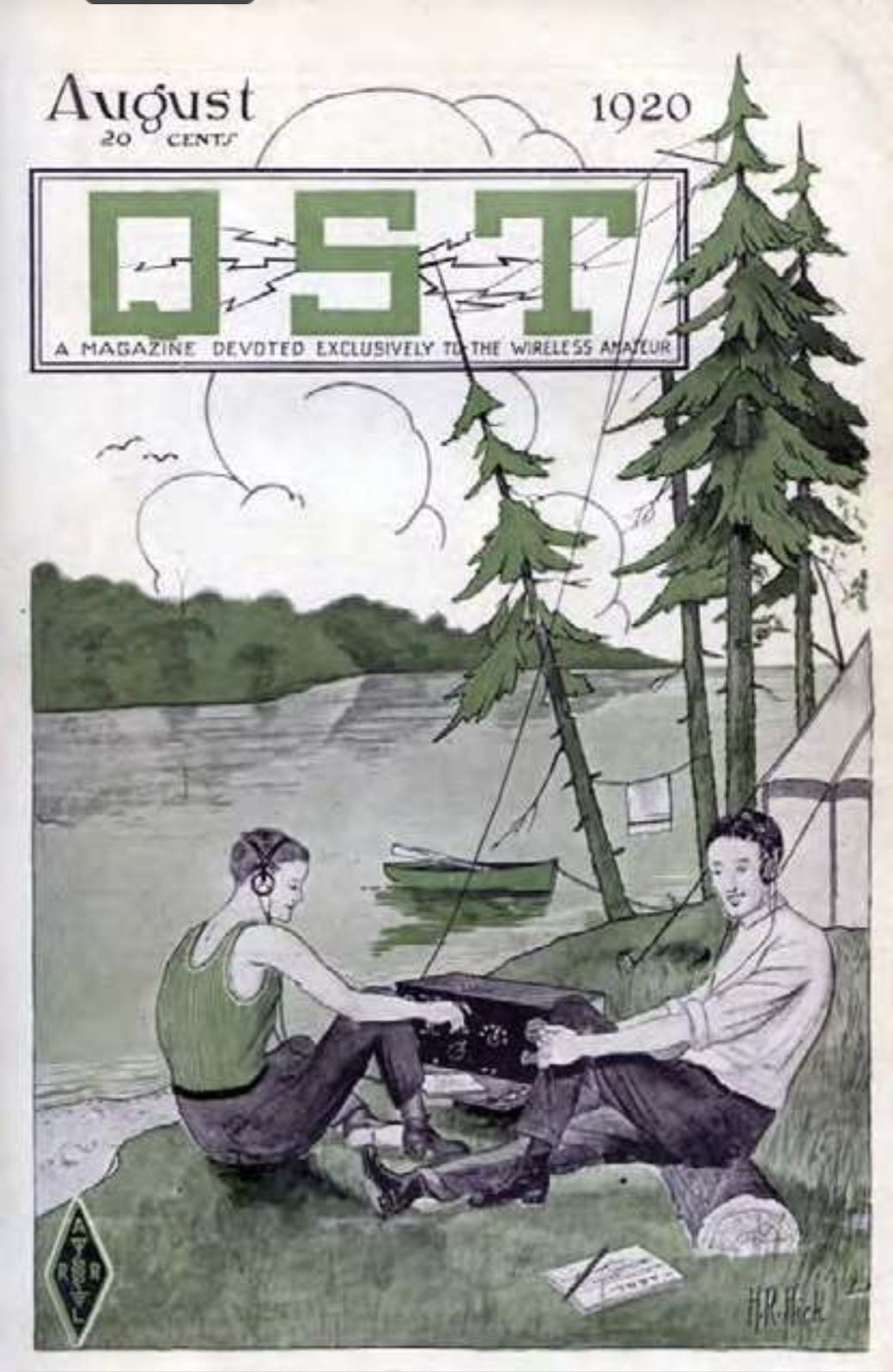
August 1920

In the 1920s, it appears that the Strays feature was a collection of random news and gossip, unlike today’s Strays, that are short items that can be fit into small spaces when an article isn’t quite long enough. Here’s a selection from the 1920 Strays:

By the way, the A.R.R.L. fading tests are going to show the maximum transmitting range of some of our stations—in the summer, at that.


A card to stations over 500 miles whom you hear will certainly be appreciates and will do more towards causing that particular station to improve his outfit than any other thing—it will create a genuine desire to get the maximum out of his apparatus. Do it.


Comply with the radio laws! Do you know that the Navy Dept. keeps a log of amateur activities so as to have data to show against us if it is ever needed? Keep down on 200 (meters) and whet up that wave—it will carry just as far—farther, even.


It pays to have your picture in “Who’s Who?” A lady in Wyoming or somewhere has fallen in love the Charlie Service’s likeness. QST  in the role of matchmaker—we never even dreamed it!

Remember that this was a time of real experimentation. Hams were relegated to 200 meters and down, meaning that they couldn’t transmit below 1.5 MHz because it was thought that the frequencies above 1.5 MHz were useless!

August 1970

In Once More with QRP, Doug DeMaw, W1CER, describes an updated version of the QRP rig he wrote about in the March 1970 QST. It’s all solid-state design could easily have been a predecessor to the Elecraft K1 and K2. The oscillator can be crystal-controlled or VFO-controlled and the rig outputs 1.5 W. It even uses a couple of ICs for audio output.

The editorial in this issue exhorts members to recruit their friends to become ARRL members. It seems the ARRL had a membership problem 50 years ago as well.

August 1995

This issue has two antenna construction articles that would still be worth building today:

  • A Simple 2-Meter Bicycle/Motorcycle Mobile Antenna. This antenna is  a j-pole antenna supported by a fiberglass safety flag. It’s a great design, and being a j-pole, probably works well, too.
  • A Paint Pole Antenna. This antenna uses a 16-ft. painter’s pole to implement a 20-meter/17-meter vertical antenna. This looks like it would be a great antenna for portable operations or situations where you have to take down an antenna after using it.

Filed Under: Antennas, Building/Homebrew Tagged With: j pole, paint pole, QRP, QST

New benefit for ARRL members

April 24, 2020 By Dan KB6NU 2 Comments

This just in from the ARRL. You can accuse me of being an ARRL fanboy, but I think this is a nice benefit…..Dan


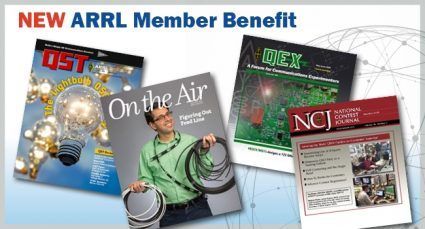
ARRL members will now receive digital access to four ARRL magazines beginning with their latest issues. Joining QST and On the Air on a digital platform will be the bimonthly editions of QEX — The Forum for Communications Experimenters and NCJ — National Contest Journal. QEX includes articles, columns, and other features ranging from construction projects to more advanced technical information in radio theory and practice. NCJ targets radio amateurs active in radiosport, and includes scores, technical articles, contributions from top contesters, and advice for radiosport enthusiasts alike.

“All members can enjoy specialized content and a high-quality reading experience whether at their desk or on the go. Offering this suite of digital magazines is an opportunity for us to give members more of what they want while adding value to ARRL membership” said ARRL Publications Manager Steve Ford, WB8IMY.

ARRL’s digital magazine editions provide replicas of the printed editions with added functionality, allowing users to fully search issues, enlarge pages, share articles, and more. All four are easily accessible through any web browser from members-only links. The free ARRL Magazines app also supports downloading complete issues for offline reading. It is available for iOS and Android in the Apple App Store and Google Play.

For more information visit www.arrl.org/arrl-magazines

Filed Under: ARRL, Books and Magazines Tagged With: NCJ, On the Air, QEX, QST

Digital QST coming soon

January 27, 2012 By Dan KB6NU 11 Comments

In his last missive to ARRL members in the Great Lakes Division, Jim Weaver, K8JE, reports:

ONE TOPIC MANY members will appreciate is a free, digital version of QST via the Internet.  This version offers the ability to read our membership journal online in a manner quite similar to that in which we read the hard-copy version.  It also offers the ability to include full schematics and other information that sometimes can merely be referenced in the print edition, as well as direct links to items contained in the ads.

Becoming accustomed to the online version may require a little familiarization, but I believe it will become a welcome enhancement to membership.

It is inevitable that two questions regarding digi-QST will arise.  The first is if a member can opt-out of receiving the hard-copy version.  The answer:  yes.  The second question is:  Is there a reduction in dues for members who opt-out of the print version.  The answer to this is no.  The hard-copy version is financed largely by advertisement, not by membership dues.

Digi-QST should be unveiled yet this winter or early spring.

I think this is great, but it sounds to me like we’ll have to read the magazine on-line rather than being able to download a PDF file.  I’ve never really liked these online magazines. Reading them is a real pain, and you often can’t download and archive them. Let’s hope the ARRL thinks about this when they set this up.

Filed Under: ARRL, Books and Magazines Tagged With: QST

Primary Sidebar

No Nonsense Technician Class License Study Guide (for tests given between July 2026 and June 2030)

New No Nonsense Technican Class Study Guide now available!

The 2026 version of my Tech Class study guide is now available, and as always, the PDF version is FREE!. The ePub version costs $11.97, and a Kindle version and paperback version will be available on Amazon shortly.

Click here to get all of my "No Nonsense" study guides.

Also available: The CW Geek's Guide to Having Fun with Morse Code

W5SWL.Com
Retevis Ailunce H1 DMR Radio
DXpander: Cobweb antennas, Laser Cutting

You’ve got mail!

Enter your email address below and get an email every time I publish a new post.

Email


I frequently teach classes to help newcomers get their licenses. The next class will take place on Saturday, October 10, 2026 on the University of Michigan campus. Click here for more information.

If you can't make the class, subscribe to the mailing list to be notified of when the next class will be held.

You can always download my free study guide, and if you have any questions about the classes, or amateur radio in general, please feel free to email me directly.

Support KB6NU.Com

Donate $7.30 and get two of these cool stickers. Measuring 4.25-in. W by 2.75-in. H, it's perfect for your car, your shack, or wherever!

Contact me

If you have a question or comment about one of my blog posts, or a question about any of the material in my study guides, or just a question about ham radio in general, you can email me at [email protected].

Blogs You Should Also Read

  • AE5X: A CW-centric blog from Kingswood, Texas
  • K0LWC Blog
  • LA3ZA Ham Radio Blog
  • Little Radios, Big Fun – WB3GCK
  • Mr. Vacuum Tube's Blog
  • Radio Artisan – K3NG
  • The K0NR Weblog
  • VE3WDM's QRP Ham Radio Blog
  • W2LJ’s Blog

Ham Radio Websites

  • Dashtoons – The Hammin' Comedy by Jeff K1NSS

Podcasts

  • ICQ Podcast
  • Linux in the Ham Schack
  • No Nonsense Amateur Radio Podcast
  • Resonant Frequency Amateur Radio Podcast

Recent Comments

  • Dan KB6NU on The EMF Explorer: A badge for ham radio?
  • Travis Good on The EMF Explorer: A badge for ham radio?
  • MARTIN ROBERT ROTHFIELD on The EMF Explorer: A badge for ham radio?
  • Mike Chen on Operating Notes, January 5, 2026
  • Rob W4ZNG on The EMF Explorer: A badge for ham radio?

Meta

  • Log in
  • Entries feed
  • Comments feed
  • WordPress.org

Footer

Copyright © 2026 Daniel M. Romanchik, KB6NU · Log in