
• Skip to primary navigation
  • Skip to main content
  • Skip to primary sidebar
  • Skip to footer

KB6NU's Ham Radio Blog

KB6NU's Ham Radio Blog
  • HOME
  • Study Guides
  • Teach a One-Day Tech Class
  • W8SRC Repeater Guide
  • Advertise
  • Hire Me

100, 50, and 25 years ago in QST: QRM, finding parts, the internet in 1995

October 13, 2020 By Dan KB6NU 1 Comment

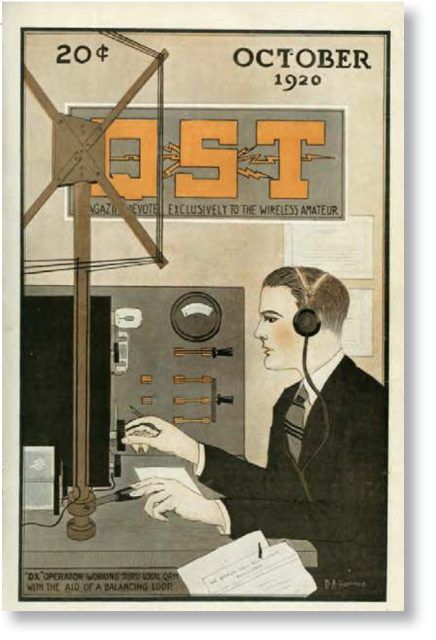
October 1920

The only article of interest to me in the October 1920 QST is “A Paper on QRM” by John Gray, 6MZ.  QRM is still sometimes a problem today, but the QRM problem in 1920 was a much different one. They were still using spark-gap transmitters in 1920, and radio gear was pretty broadband. As 6MZ put it,

All radio communication is more or less affected by interference, but the situation is particularly bad in amateur work. When you come to thing about it this is not very surprising. Nobody expects very good service out of a six-party telephone. So why should we expect to whomever we please, whenever we please, on the several-hundred party line of two hundred meters? When you look at it that way, I sometimes wonder that we ever succeed in talking to each other at all.

Another thing to note is the price: 20¢. That equates to $2.72 in today’s dollars, so for some reason, the price of magazines has gone up way more than the rate of inflation in the ensuing 100 years.

October 1970

The October 1970 QST features the article, “The Ham Builder’s Nightmare” by Doug DeMaw, W1CER. The article reports on complaints by some QST readers that the parts called out in some of the construction articles were difficult to obtain. W1CER says, “Regretfully, the parts procurement situation seems to be going from bad to worse, feeding fuel to the fires of frustration which contribute to the counting of sheep…or sine waves.”

Geez, what would he have to say about the situation today? At the end of the article, he lists the following suppliers:

  • Allied Radio Shack
  • Allied Electronics
  • Amidon Associates
  • Arrow Electronic Supply
  • Barry Electronics
  • Burstein-Applebee
  • Harrison Radio
  • Harvey Radio, Inc.
  • Henry Radio
  • Lafayette Electronics
  • J. W. Miller Co. (now part of Bourns Co.)
  • Newark Electronics
  • Poly Paks
  • Radio Shack (Tandy Corp.)
  • Stafford Electronics Corp.
  • World Radio Labs

I’ve crossed out the companies that are no longer in business. As you can see, most of them are now long gone.

October 1995

The editorial in the October 1995 QST, “Thinking Strategically” by Dave Sumner, K1ZZ, is a piece on the inevitability of the internet. K1ZZ didn’t have any predictions about how the internet would affect amateur radio, just that it would in some way. It certainly has, hasn’t it?

He notes that surveys have pointed out that 48% of 1995’s radio amateurs had access to the internet and compared the use of the internet to the various amateur radio modes: FM, SSB – 79%, CW – 54%, packet radio- 40%. I wonder what these percentages would be today. Certainly, more than 90% of today’s ham use the internet and would guess that fewer than 25% operate CW.

Related posts:

  1. 100, 50, and 25 Years Ago in the July QST
  2. 25, 50, and 75 Years Ago in QST
  3. 2014 Tech study guide: radio direction finding; radio control; contests; linking over the Internet; grid locators
  4. In the August QST of 1920, 1970, and 1995

Filed Under: Books and Magazines, Building/Homebrew Tagged With: QST

Reader Interactions

Comments

  1. Dave, N8SBE says

    October 14, 2020 at 12:38 pm

    Maybe a lot of old part sources are gone, but a number of new providers have stepped in, in particular Mouser and Digikey. And there are more speciality suppliers that are easier to find and interact with, due to the Internet. In particular, there seem to be a lot of kit suppliers of top-notch kits, these days.

    Reply

Leave a Reply Cancel reply

Your email address will not be published. Required fields are marked *

This site uses Akismet to reduce spam. Learn how your comment data is processed.

Primary Sidebar

No Nonsense Technician Class License Study Guide (for tests given between July 2026 and June 2030)

New No Nonsense Technican Class Study Guide now available!

The 2026 version of my Tech Class study guide is now available, and as always, the PDF version is FREE!. The ePub version costs $11.97, and a Kindle version and paperback version will be available on Amazon shortly.

Click here to get all of my "No Nonsense" study guides.

Also available: The CW Geek's Guide to Having Fun with Morse Code

W5SWL.Com
Retevis Ailunce H1 DMR Radio
DXpander: Cobweb antennas, Laser Cutting

You’ve got mail!

Enter your email address below and get an email every time I publish a new post.

Email


I frequently teach classes to help newcomers get their licenses. The next class will take place on Saturday, October 10, 2026 on the University of Michigan campus. Click here for more information.

If you can't make the class, subscribe to the mailing list to be notified of when the next class will be held.

You can always download my free study guide, and if you have any questions about the classes, or amateur radio in general, please feel free to email me directly.

Support KB6NU.Com

Donate $7.30 and get two of these cool stickers. Measuring 4.25-in. W by 2.75-in. H, it's perfect for your car, your shack, or wherever!

Contact me

If you have a question or comment about one of my blog posts, or a question about any of the material in my study guides, or just a question about ham radio in general, you can email me at [email protected].

Blogs You Should Also Read

  • AE5X: A CW-centric blog from Kingswood, Texas
  • K0LWC Blog
  • LA3ZA Ham Radio Blog
  • Little Radios, Big Fun – WB3GCK
  • Mr. Vacuum Tube's Blog
  • Radio Artisan – K3NG
  • The K0NR Weblog
  • VE3WDM's QRP Ham Radio Blog
  • W2LJ’s Blog

Ham Radio Websites

  • Dashtoons – The Hammin' Comedy by Jeff K1NSS

Podcasts

  • ICQ Podcast
  • Linux in the Ham Schack
  • No Nonsense Amateur Radio Podcast
  • Resonant Frequency Amateur Radio Podcast

Recent Comments

  • Dan KB6NU on 2015 General Class study guide: Section G2E – Digital operating: procedures, procedural signals, and common abbreviations
  • Jimi on 2015 General Class study guide: Section G2E – Digital operating: procedures, procedural signals, and common abbreviations
  • Ali on Some Good Advice on Learning Morse Code
  • mike on Instant Character Recognition is the key to CW speed
  • Matt W1CDN on A completely different picture of Wayne Green, W2NSD (SK)

Meta

  • Log in
  • Entries feed
  • Comments feed
  • WordPress.org

Footer

Copyright © 2026 Daniel M. Romanchik, KB6NU · Log in