
• Skip to primary navigation
  • Skip to main content
  • Skip to primary sidebar
  • Skip to footer

KB6NU's Ham Radio Blog

KB6NU's Ham Radio Blog
  • HOME
  • Study Guides
  • Teach a One-Day Tech Class
  • W8SRC Repeater Guide
  • Advertise
  • Hire Me

sunspot cycle

Just when you thought it couldn’t get any worse…

December 16, 2018 By Dan KB6NU 12 Comments

If you operate HF, it’s no secret that band conditions have not been great. The reason, of course, is that we’re at the bottom of the sunspot cycle. If we’re at the bottom of the sunspot cycle, then there’s no way to go but up, right? Maybe not. Recent data from the NOAA’s Space Weather Prediction Center seems to suggest that solar activity isn’t going to get better any time soon.

Here’s their solar flux projection as measured by the F10.7 index:
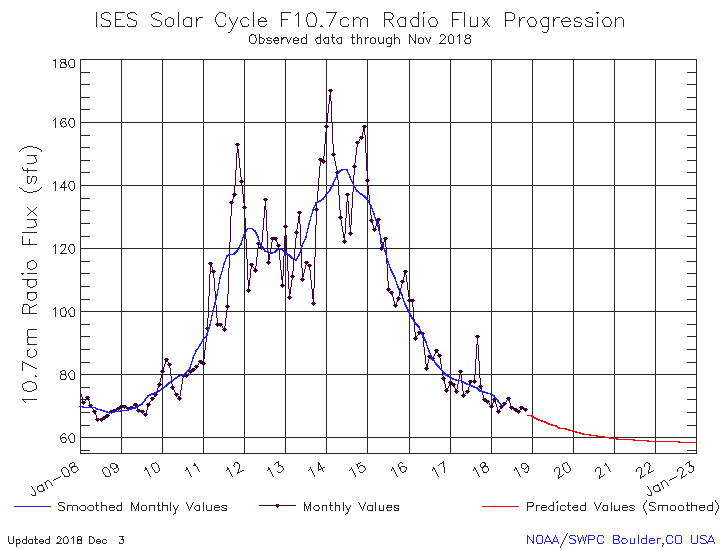
As you can see, the projection is for declining solar activity through 2022!

And, if that wasn’t depressing enough, I recently came across an article reporting on the research of Prof. Valentina Zharkova, who is predicting a grand minimum of 30 years!

The article states:

The gist of the matter is that all three main cycles are entering minimum phase, beginning with the end of this current solar cycle (Cycle 24). Cycle 25 will be even lower than 24, with 26 being very nearly flat-lined. Cycle 27 will begin to show a few signs of life, then there will be a gradual rise to full activity over several more solar cycles, even as the last three cycles have slowly decreased in levels. This means that the bottom of the extended, or ‘Grand’ minimum (to use Zharkova’s terminology), should run from ~2020 to ~2053.

The “grand minimum” not only affects HF propagation, but our climate as well. I’m not enough of an earth scientist to say much more about that, but you might want to watch the video of Zharkova’s presentation to the Global Warming Policy Foundation last October:

The good news is that less solar flux means satellites will have an easier time of it. I guess I really do need to get serious about satellite operation and sooner rather than later.

Filed Under: Propagation Tagged With: sunspot cycle

Solar minimum not expected until 2019 or 2020

July 8, 2017 By Dan KB6NU Leave a Comment

If you think propagation is bad now, this article from NASA notes that the solar minimum won’t occur until 2019 or 2020….Dan

High up in the clear blue noontime sky, the sun appears to be much the same day-in, day-out, year after year.

But astronomers have long known that this is not true. The sun does change. Properly-filtered telescopes reveal a fiery disk often speckled with dark sunspots. Sunspots are strongly magnetized, and they crackle with solar flares—magnetic explosions that illuminate Earth with flashes of X-rays and extreme ultraviolet radiation. The sun is a seething mass of activity.

Until it’s not. Every 11 years or so, sunspots fade away, bringing a period of relative calm.

“This is called solar minimum,” says Dean Pesnell of NASA’s Goddard Space Flight Center in Greenbelt, MD. “And it’s a regular part of the sunspot cycle.”

The sun is heading toward solar minimum now. Sunspot counts were relatively high in 2014, and now they are sliding toward a low point expected in 2019-2020.

While intense activity such as sunspots and solar flares subside during solar minimum, that doesn’t mean the sun becomes dull. Solar activity simply changes form.

For instance, says Pesnell, “during solar minimum we can see the development of long-lived coronal holes.”

Coronal holes are vast regions in the sun’s atmosphere where the sun’s magnetic field opens up and allows streams of solar particles to escape the sun as the fast solar wind.

Pesnell says “We see these holes throughout the solar cycle, but during solar minimum, they can last for a long time – six months or more.” Streams of solar wind flowing from coronal holes can cause space weather effects near Earth when they hit Earth’s magnetic field. These effects can include temporary disturbances of the Earth’s magnetosphere, called geomagnetic storms, auroras, and disruptions to communications and navigation systems.

During solar minimum, the effects of Earth’s upper atmosphere on satellites in low Earth orbit changes too.

Normally Earth’s upper atmosphere is heated and puffed up by ultraviolet radiation from the sun. Satellites in low Earth orbit experience friction as they skim through the outskirts of our atmosphere. This friction creates drag, causing satellites to lose speed over time and eventually fall back to Earth. Drag is a good thing, for space junk; natural and man-made particles floating in orbit around Earth. Drag helps keep low Earth orbit clear of debris.

But during solar minimum, this natural heating mechanism subsides. Earth’s upper atmosphere cools and, to some degree, can collapse. Without a normal amount of drag, space junk tends to hang around.

There are unique space weather effects that get stronger during solar minimum. For example, the number of galactic cosmic rays that reach Earth’s upper atmosphere increases during solar minimum. Galactic cosmic rays are high energy particles accelerated toward the solar system by distant supernova explosions and other violent events in the galaxy.

Pesnell says that “During solar minimum, the sun’s magnetic field weakens and provides less shielding from these cosmic rays. This can pose an increased threat to astronauts traveling through space.”

Solar minimum brings about many changes to our sun, but less solar activity doesn’t make the sun and our space environment any less interesting.

For more news about the changes ahead, stay tuned to science.nasa.gov

Filed Under: Propagation Tagged With: solar minimum, sunspot cycle

Primary Sidebar

No Nonsense Technician Class License Study Guide (for tests given between July 2026 and June 2030)

New No Nonsense Technican Class Study Guide now available!

The 2026 version of my Tech Class study guide is now available, and as always, the PDF version is FREE!. The ePub version costs $11.97, and a Kindle version and paperback version will be available on Amazon shortly.

Click here to get all of my "No Nonsense" study guides.

Also available: The CW Geek's Guide to Having Fun with Morse Code

W5SWL.Com
Retevis Ailunce H1 DMR Radio
DXpander: Cobweb antennas, Laser Cutting

You’ve got mail!

Enter your email address below and get an email every time I publish a new post.

Email


I frequently teach classes to help newcomers get their licenses. The next class will take place on Saturday, October 10, 2026 on the University of Michigan campus. Click here for more information.

If you can't make the class, subscribe to the mailing list to be notified of when the next class will be held.

You can always download my free study guide, and if you have any questions about the classes, or amateur radio in general, please feel free to email me directly.

Support KB6NU.Com

Donate $7.30 and get two of these cool stickers. Measuring 4.25-in. W by 2.75-in. H, it's perfect for your car, your shack, or wherever!

Contact me

If you have a question or comment about one of my blog posts, or a question about any of the material in my study guides, or just a question about ham radio in general, you can email me at [email protected].

Blogs You Should Also Read

  • AE5X: A CW-centric blog from Kingswood, Texas
  • K0LWC Blog
  • LA3ZA Ham Radio Blog
  • Little Radios, Big Fun – WB3GCK
  • Mr. Vacuum Tube's Blog
  • Radio Artisan – K3NG
  • The K0NR Weblog
  • VE3WDM's QRP Ham Radio Blog
  • W2LJ’s Blog

Ham Radio Websites

  • Dashtoons – The Hammin' Comedy by Jeff K1NSS

Podcasts

  • ICQ Podcast
  • Linux in the Ham Schack
  • No Nonsense Amateur Radio Podcast
  • Resonant Frequency Amateur Radio Podcast

Recent Comments

  • Walter Underwood on One lump or two (or three)?
  • Mike, KL7MJ on Question pools should make teaching classes easier
  • Karl Heinz - K5KHK on Question pools should make teaching classes easier
  • CD on Do these radios make ham radio better?
  • Wallace Barron KR4IAA on EchoLink or D-Star?

Meta

  • Log in
  • Entries feed
  • Comments feed
  • WordPress.org

Footer

Copyright © 2026 Daniel M. Romanchik, KB6NU · Log in