
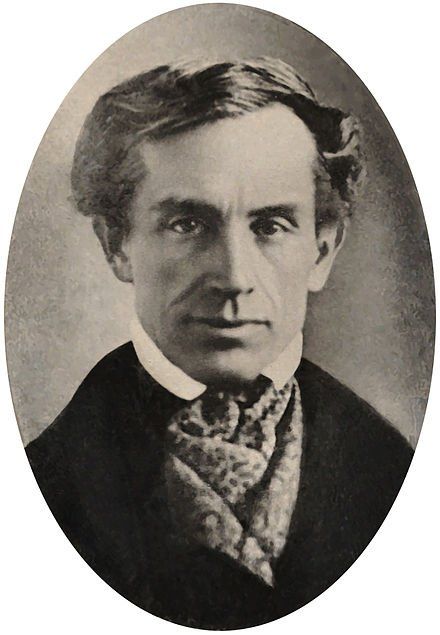
I’m working with an author who is working on amateur radio reference book. It will have a glossary of terms, a list of Q-signals, and some other good stuff. Yesterday, he sent me a link to the Wikipedia page for Samuel Morse, the inventor of the Morse Code. He asked, “Would this be useful? Can we use it?”
We’re having enough trouble getting this book done without adding material to it, so I jokingly replied, “Maybe this is the start of your next book, something like Profiles in Amateur Radio, short biographies of the 10 most important figures in the history of amateur radio.” I did mean it as a joke, but the more I think about it, the more I like this idea. I’m thinking maybe short biographies of perhaps the ten most influential people in the history of amateur radio.
The question, then, is who are these ten people? Here’s a list that I’ve come up with off the top of my head:
- Samuel Morse, inventor of Morse Code
- Guglielmo Marconi, the “inventor” of radio
- Lee de Forest, inventor of the vaccum tube
- Hiram Percy Maxim, the first president of the ARRL
- Hugo Gernsback, one of the first publishers of radio magazines and the founder of the Wireless Association of America
- Arthur A. Collins founder of Collins Radio
- William Halligan, founder of the Hallicrafters Company
- Joseph Taylor, Nobel laureate and inventor of many weak-signal digital modes
- Howard Anthony, the man who got Heathkit into the electronics business
- Wayne Green, W2NSD, editor of CQ and editor/publisher of 73 and various computer magazines
I’d love to get your input on this. Please email me with your recommendations, or comment below.
What about:
R.L.Drake?
The founders of Flex, first SDR?
Amsat founders?
I do like the idea of including the founders of AMSAT and whoever developed the SDR. Got any names?
Edwin Armstrong, perhaps? He did invent the superhet receiver and FM, those are pretty significant for amateur as well as the rest of radio.
There’s a lot of overlap between the amateurs and professionals, especially early on. Maybe a first chapter on the pre-ham figures like Morse, Faraday, Maxwell, Hertz, etc. That’d let you fudge a little and pick ten people who were more directly involved in radio as as a purely amateur pursuit.
I believe Fleming invented the vacuum tube, a diode, and von Lieben and De Forest refined it to create the triode and thus amplification. Armstrong is credited with developing FM.
Philip “Gil” Guildersleeve, QST cartoonist/illustrator, surely captured the earnest, goofy, warm heartbeat of 20th century ham radio. Gil’s style was old-fashioned when I was a 60s ham kid, and therein lay much of his appeal to me and countless others, evidenced by the ubiquity of his imagery in ham visual culture worldwide. I submit ham radio is much, if not more about the feeling, the camaraderie, the hammin’ comedy so to speak, than the technics. Yes, electromagnetic phenomena and hardware provide the scaffolding of our hobby, but the emotion entwined is relatively little addressed, with such elegant simplicity and gracious good humor as Gil’s art.
I think Alfred Vail had much morr to do with modern Morse Code than Morse, himself. Also, Edwin H. Armstrong was the developer of the regenerative radio circuit while at Columbia University, patented in 1914; the suoerhet in 1918.
IMHO, can’t have radio without both Marconi and Tesla. Both brilliant minds. The technology demonstrated the concept of wireless transmission belongs to Nikolai Tesla. A contemporary of Marconi who was more interested in power transmission than developing a signaling system for his Tesla Coils. Here’s a link referencing his 1893 prototype demonstration. (https://en.wikipedia.org/wiki/History_of_the_Tesla_coil).
And, here’s a historical summary of the radio patenting kerfuffle between Marconi & Tesla.(https://www.pbs.org/tesla/ll/ll_whoradio.html).
What about Hidetsugu Yagi and Shintaro Uda, inventors of the Yagi–Uda antenna .
Reginald Fessenden
https://en.wikipedia.org/wiki/Reginald_Fessenden
Briefly, from Wikipedia, “Fessenden is best known for his pioneering work developing radio technology, including the foundations of amplitude modulation (AM) radio. His achievements included the first transmission of speech by radio (1900), and the first two-way radiotelegraphic communication across the Atlantic Ocean (1906). In 1932 he reported that, in late 1906, he also made the first radio broadcast of entertainment and music, although a lack of verifiable details has led to some doubts about this claim.”
Note that his first transmission of speech occurred BEFORE Marconi spanned the Atlantic, the latter never independently confirmed in the first place.
https://www.amazon.com/Empire-Air-Men-Made-Radio/dp/0060981199
What about including Don Wallace W6AM(SK)?
I don’t know Don Wallace. Educate me?
An mechanical transmitter by a Swede!
An Alexanderson alternator is a rotating machine invented by Ernst Alexanderson in 1904 for the generation of high-frequency alternating current for use as a radio transmitter. It was one of the first devices capable of generating the continuous radio waves needed for transmission of amplitude modulation (sound) by radio.
Thorn L. Mayes identified the production of ten pairs of 200 KW Alexanderson alternators, totaling 20 transmitters, in the period up to 1924 used for intercontinental communication.
In 1904, Reginald Fessenden contracted with General Electric for an alternator that generated a frequency of 100,000 hertz[citation needed] for continuous wave radio. The alternator was designed by Ernst Alexanderson. The Alexanderson alternator was extensively used for long-wave radio communications by shore stations, but was too large and heavy to be installed on most ships. In 1906 the first 50-kilowatt alternators were delivered. One was to Reginald Fessenden at Brant Rock, Massachusetts, another to John Hays Hammond, Jr. in Gloucester, Massachusetts and another to the American Marconi Company in New Brunswick, New Jersey.