
I recently acquired a Yaesu FT-991A and have been able to play with it over the past couple of days. Since I already own an ICOM IC-7300, it’s inevitable that I should compare the two. They are alike in many ways, but quite different, too.

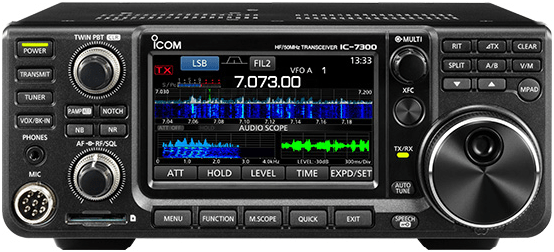
One of the obvious similarities is the size. They are both compact rigs, with the FT-991A being slightly smaller. They both cost about the same. Gigaparts is selling the FT-991A for $1180, while the IC-7300 costs $980.
The other similarity is that both radios have a color display with band scope. That’s where the similarity ends, though. The IC-7300’s display is larger and has a higher resolution than the FT-991A’s display. That allows the IC-7300 to display a lot more information than the FT-991A, and thereby, making it much more usable.
The other big difference, for me, is that the IC-7300 offers touchscreen tuning. You can tap a signal on the IC-7300 band scope, and the radio tunes to that frequency. The FT-991A does not have that capability.
The FT-991A display is less capable in other ways, too. The narrowest bandwidth the FT-991A can display is 50 kHz, 25 kHz on either side of the center frequency. I’ve had the IC-7300’s band scope down to 10 kHz bandwidth. This kind of resolution really lets you find open frequencies in a contest or a pileup.
I’m guessing that the IC-7300 can offer more resolution because it has a more powerful processor than the FT-991A. Another indication that this is the case is that the IC-7300 refreshes the band scope faster than the FT-991A. The upshot is that the IC-7300 is nicer to use.
The receivers seem comparable. Sherwood Engineering rates the IC-7300 receiver higher than the FT-991 (not the FT-991A), but I’m not sure that I’m good enough to tell the difference. The receiver sounded a little noisier to me, but that could have been that it just sounded different. The FT-991A’s DSP filtering seemed just as effective as the IC-7300’s filtering. When I set the narrow filter setting to 500 Hz and turned it on, it effectively eliminated nearby signals.
It may be because I’ve been an ICOM user for many years now, and have become used to how ICOM does things, but the IC-7300 seems easier to use in other ways, too. The IC-7300’s tuning dial, for example, is larger than the tuning dial on the FT-991A. I think the larger tuning dial has a nicer feel.
In other ways, the IC-7300 seems easier to use than the FT-991A. For example, to automatically zero beat a CW signal on the FT-991A, you have to call up the menu system, page over to the appropriate page, then touch the screen. To do this on the IC-7300, all you have to do is hit the AUTO TUNE button.
The biggest difference between the two radios is that the FT-991A includes the 2 m and 70 cm bands, while the IC-7300 does not. That’s a very attractive feature if you’d like to operate the satellites. Here’s a video of KG6AJH working the AO-92 satellite using an FT-991A:
I think that the bottom line is that the IC-7300 is a better HF rig, while the big advantage of owning the FT-991A is its 2m and 70 cm coverage. I may hang on to the FT-991A and give satellite operation a try, but I’m not a big VHF/UHF guy.
If you have an FT-991A, and especially if you use it for satellite work, I’d love to hear what you have to say about the rig. What features work best for you? What am I missing in this admittedly quick review.
this review is a disgrace. the review is based on some pretty cosmetic features and menus. Hello for $$ value the ft991a comes with 2m and 70cm and all mode. A review should be general for the user base. this is not a review but useless observations. A bias comments
You’re a real ham, eh? Real hams use their call signs.
You mustn’t have read to the end of the post. There, I say, “I think that the bottom line is that the IC-7300 is a better HF rig, while the big advantage of owning the FT-991A is its 2m and 70 cm coverage.” If you’re going to work sideband on 70 cm, then the FT-991A is for you. If VHF/UHF isn’t your thing, then you’re better off with an IC-7300.
It’s multy mode UHF VHF. SSB CW you can send wspr FT8 JS8 work 2mtr DX. Why is it that people worship Frequently Mundane FM on the VHF UHF bands .
ve7lgt
I agree. This was the worst review I’ve seen in a long time lol
Compared apples to oranges and then went back to his biased opinion on what he’s been using vs a general review 😂
Dan, thank you for the valuable comparison of two great, new rigs. Keep you the great comentary. Let us know how the FT991 works on those satellites. Terry N8AB
I have owned a 991A for the last 3 years. Have traveled the world with it, used it in contests and as a satellite rig. I have bought 2 of them in fact. I agree with your evaluation Dan. I also own a K3, the 991A isn’t as selective as the K3, but close in pileups on a DXpedition. Compared to the 7300, it is more menu driven but there is very little difference in performance. I prefer the 991A because of it’s VHF capabilities.
Dan, thanks for your fair review of the two rigs. Agree, they both have their strong points, and fundamentally they are significantly different. One is SDR HF only (7300), and the other is Analog HF/VHF/UHF with C4FM digital (991). So it’s no surprise to me, the IC-7300 has an advantage on HF over the FT-991. The inclusion of the VHF and UHF bands in a HF transceiver platform, always tends to affect HF performance, as circuitry compromises have to made to incorporate the extra hardware for those bands.
One thing you did not convey, the results of any A/B testing you may have performed. To me, the best metric amateurs can use as a guide, how well does each transceiver perform on a given signal? Mainly, could you hear a signal on one, that you could not on the other. That would be interesting to know. 73, Jim AB4D
I have the FT-991A and like it a lot. It’s my first rig so I don’t have much to compare it to. I got it mainly for the “shack in a box” quality of having everything in one radio HF/VHF/UHF. I also liked having the USB port available to just plug it in to the radio and do FT8 and other digital modes. I also like having the digital System Fusion mode available. The menus are a bit clunky but I got used to them. Overall, I’ve been very satisfied although I can see how the bigger screen and faster processor would be helpful.
I’d like to try my FT-991A on FT8. How do I set it up to pipe the audio into the computer via the USB cable? Is that explained in the manual or online somewhere?
You can find detailed instructions here that worked for me. https://www.n1rwy.org/?p=157
Great ‘use’ review. I’m considering purchasing one or the other. Had numerous HF rigs but would like something new and these are both the price I was expecting to pay. Well done!
I’ve read a lot of reviews of both and there seems to be a rather even split among which is “better”.. you know, Ford vs Chevy. So easy to find reviews that prove how one is better than the other.. I think just about any ham would be quite satisfied with either rig, they are both very nice. (Yes, I’ve used both) I looked into buying a 7300, read glowing reviews and others that trashed the rig. Who do you believe? I don’t care about nit-picking down to the smallest detail or difference. My old ears can’t tell much difference anymore.. But I wanted a rig mainly for portable use. By portable I don’t mean picnic tables on Saturdays, but taking with me on 1-2 week trips. I ended up buying the 991A. It is somewhat smaller but the VHF/UHF was a HUGE factor considering the price comparison. Perhaps I should have gone even smaller with a FT-891 at half the price! Base your purchase on end use, what’s important for YOU.. that will decide on how “better off” you will be with either rig.
I think, for the size of the radio, the FT991A is one of the best, “One Radio Do All” radio. I say that because is included the two high bands. I just purchased the 991A and really like it. There are some BIG down sides to this radio compared to the IC7300 and the band scope is one. The 991’s band scope is usable and kind of fits my needs for portable operation. But that’s about it. I really don’t see the 991 an easy radio to use. You MUST fully read the manual. Once you get a good understanding of the radio, it really is a great little radio.
You must set up the equalizer. I set mine so it attenuates the lows and peaks some of the highs. I’ve gotten so many great unsolicited audio reports and that says a lot to me.
I am very happy with my FT991A and I think I made the right choice. The IC7300 is a great radio, but on 40 meters, in the evening hours, the radio is continuously overloading. Putting the attenuator on is a band aid. For me that is a major flaw in the IC7300.
KU3X
My two cents to the topic coming from a guy who has owned ALL radios in the market from the low end to the highest end and having now the IC-7851 so I know perfectly well how efficient or not a radio can be.
I owned first the IC-7300 and then later the FT-991A and my review is this:
Rx audio, definitively the 7300 received audio is smoother, better, easier to listen for hours with no ears fatigue it has more lows than the 991A.
Tx audio, without a doubt the 7300 even having a very simple mic EQ as treble and bass, it will TX much better audio quality even with the hand mic but if you use the SM30 as I did, you will sound as an AM broadcast. The 991A if you know how to djust the three bands parametric equalizer will sound as well very good but not as good as the 7300.
Rx noise, the 7300 is less noisy than the 991A BUT the digital noise reduction from the 991A works much better than the NR from the 7300 been able to wipe out all band noise and making it sound like FM.
Menu, the 7300 is way easier to maneuver than the one in the 991A.
Panadapter, no brainer, the 7300 is much better not only because of been faster but also with higher resolution and the cact that you can touch any freq with your finger is awesome, 991A will not have that feature.
But what I liked in my 991A was the fact that I could have all bands, from 160 to 2M in all modes, something the 7300 is limited at.
So I will say If I had just $1300 bucks to spend in a radio, even the 7300 is better for HF, I will choose the 991A for a full complete station that for its size and features will make it a favorite to take anywhere with you.
Yaesu as usually built a good radio.
Hector
AD4C
Very useful comment.
Thank you.
Sorry I have not received my callsign yet (just passed the exam on 24th).
This was a very helpful comparison. Thank you
The biggest difference to me is that Yaesu offers a 3-year warranty while ICOM’s is a standard 1 year. To add an additional 2 years to the ICOM 7300 warranty costs $149 as of May 2019. I know Yaesu’s 3 year warranty is from the manufacturer but the extended warranty on the ICOM may only be offered by the dealer. I had a friend who is a very active Ham in Norman, OK and her 7300 went out during a contest. Fortunately is was during the first year and I believe ICOM fixed it but it took over a month.
The three year manufacture warranty is a very good marketing scheme. Since my charge card extends a warranty for an additional year, my 991A actually has a four year warranty.
I’ve seen a few 991A’s for sale used at what looked like a low price, but I was not going to pass up a three year, or in my case, a four year warranty.
I think all electronic gear should have a 3 year warranty. Look at cars, now they have 100,000 mile power train warranties.
I think all things considered the review is very fair. I do have both rigs. I also have some premium-class Yaesu, Icom, and Ten Tec gear. You don’t spend $1,000 thinking you’re going to get the best radio in the world. However, I’ve been a ham for a really long time, and even calling this an entry-level rig, both are excellent. The addition of 2 meter and 70cm of course makes it very attractive. Especially for a new ham. By the way I also have the Icom 9700, that’s an excellent rig also. Can’t go wrong with either one.
Both are excellent radios. Great as starter rigs, but the lack of features on the backside of these rigs limits how long they will serve as base stations. I see these simple/small rigs as primarily portables. And for camping trips in the Airstream, there is simply no contest. The FT-991A handles uhf/vhf local coms during the day (while I’m off dirt biking, 4-wheeling, or hiking) and the wife is back at the airstream reading her books. At night, it’s able to hunt DX on the hf bands from the mountain top. The 7300 is really, really nice. But it’s half the radio the 991A is.
The one thing that stuck in my mind before I decided to buy a 991A was this ” it doesn’t matter how good or bad a display is, it won’t get you any extra contacts at the end of the day”
I don’t know who said that, but it definitely wasn’t me. There have been many times when I’ve seen a signal on the panadapter, clicked on it, and found someone calling CQ. Those are contacts I may not have made because by the time I’d tuned to that frequency, they’d have stopped calling.
Another way that a display helps you make more contacts is by letting you see signals from stations calling you that are a little off frequency. If you didn’t tune around after calling CQ you might miss those calls, but when you see a signal pop up near your calling frequency immediately after you stop transmitting, you can kind of assume that they’re answering your CQ.
i had an ft 991a a couple years back. the receive was pretty hot, but i felt on tx, you had to be very careful with settings. ie, little to no alc action to keep it clean. c4fm was a blast, and as far as sensitivity on vhf and uhf, it totally blew my ts 2000 out the water.
i did not like the 3 band eq in the menu. it would have been a lot easier to put 3 adjustable knobs on the back panel or under a hatch. my ftdx 9000 is the same, takes way too long to adjust!
i parted company with the radio after it developed a fault whereby the touchscreen would freeze, and the vfo would turn but frequency would remain the same.
im currently running an old ft 847 for vhf and uhf, and it does a good job there, but its not in the same class as the 991a for hf !
last thoughts. i detest these small screens with bandscope. i looked at the new ftdx 101 but was totally turned off by the gimmicky screen. i prefer to tune across the bands and find stations that way. when radios start to look like cellphones, i will go back to an old ts 830 or 101zd .
I have an IC 7300 at home and, I know I’ll get comments, but I think it’s the best HF rig out there for basic operation. It is soooooo easy to use and works very well. I wish it had two antennas though. My situation is different, though. We have a place in Hobe Sound , FL and, since I already have a 7300, I decided to buy an FT-991A since it is a little smaller to carry on on the airplane AND it includes VHF/UHF capabilities. I bring it back with me and run it right next to the 7300.
I’m looking to buy my first HF rig. Is there a difference in the built-in antenna tuners of these radios? Or should I be getting an external tuner? Thank you!
Check the specifications. The built-in antenna tuners of most radios are designed to only match a 3:1 SWR or less. One exception to this is the Elecraft K3 antenna tuner. It will match up to a 10:1 SWR. It depends on what type of antenna that you plan to use. If you’re using resonant dipoles, you should be able to tune them well enough, so that the internal 3:1 antenna tuners will make that final tweak. If you’re going to be using a non-resonant antenna, like my homebrew Cobra doublet, then you’ll want an internal tuner with more range or an external tuner.
Greetings! I don’t think the range is a problem when you use a MFJ tuner extender MFJ-914 300 watts which I use every day just to optomize SWR on different bands/different coax lengths relative to frequency. I just click it into the closest best SWR range and into my amp to bypass, to an external tuner or internal one. https://mfjenterprises.com/products/mfj-914
Hi Dan, Great review. I am leaning toward the IC-7300, I just passed my Technician examined am really interested in doing HF CW work. Which rig is best for CW?
I’d say the IC-7300 hands down. The only way I’d choose the FT-991A is if I was going to be doing a lot of VHF/UHF work.
The biggest diff is how the Yaesu can pull signals from the noise much better than the IC7300. I’ve put the IC-7300 aside for the time being given how noisy my environment and bands are. I can make contacts on the Yaesu where the same are unintelligible on the Icom.
Maybe it’s because I’m an Icom fanboy, but I didn’t find that to be the case at all. I found the FT-991A to be a lot noisier and harsher to use than the IC-7300.
Hola e leído todos los comentarios,ya que estoy en duda entre un IC 7300 y un FT 991A, aun no se cual comprar, que hay del receptor, IC 7300 es SDR y Yaesu Triple conversión, Cual Compro?
I think both radios have great receivers, so I think the question is still how much you’ll use the radio to operate VHF and UHF. If you’ll primarily operate HF, go with the IC-7300.
[Google translation] Creo que ambas radios tienen excelentes receptores, por lo que la pregunta sigue siendo cuánto usará la radio para operar VHF y UHF. Si opera principalmente HF, vaya con el IC-7300.
Gracias amigo Dan.
Solo HF, aunque soy fanático de Yaesu, pero me asusto algo la dificultad de programar el actualizador parametrico, vere el IC 7300, gracias.
oscar
I need a new rig: Hf/uhf/vhf. My choices:
1. Icom 7300 with hand held with dstar. No 9700(too expensive for the two)
2. Yaesu 991 a (but no dstar (which seems to be most popular)
3. Icom 705 with linear
( I have a flat swr hexbeam and 2/70 antenna)
I need opinions before I pull the trigger on purchase. Thank you
Thank you for helping me make my decision. I chose the 991a due to 3 year warranty, HF and UHF additions, plus operators who stated they could not tell the differences in receive or transmit. Also operators who successfully turned the radio into an SDR with a panadapter.
I have both the IC-7300 and the FT-991A. The 7300 is very susceptible to overloading the front end with strong signals, resulting in cross modulation, etc. whereas the FT-991A doesn’t suffer this thanks to its excellent filtering. Yes, the 7300 has a faster and more usable waterfall and bandscope, but to be honest, a bandscope on such a small screen of either rig is IMHO just about usable. I personally use an SDR with Omnirig for a decent high resolution bandscope/waterfall for only £100. As a result, the two rigs are equal in this area. Yes, the 7300 has a better/more user friendly menu system than the Yaesu. However, the Yaesu has WAY more options for adjustments in the menus than the Icom has, so although more complex, far better marks to the Yaesu.
How do you set the radio to display the satellite being tracked at the top of the screen?
Thank you, John G0OZY
Thanks for the review Dan. I’ve been reading different reviews about the IC-7300 and initially was leaning towards the 7300. Then I started seeing a multitude of reviews criticizing the internal battery in the 7300 in that if the transceiver isn’t left plugged in the internal battery can go dead affecting the clock after a few weeks. Over on eHam.net there were a lot of complaints.
I just discovered the FT-911A a few days ago. I like that it has the VHF and UHF additions. Also the three year warranty kind of seals the deal for me. I purchased an 11 inch screen laptop recently and I’m waiting for my SDR addition to get here so I’ll be using that for a waterfall screen. I like the shack in the box concept for the 911A.
It would reduce the radio clutter on the desk.
Right now I have a HF XIEGU G90 transceiver, a 6 meter, 10 meter and a VHF/UHF as separate units. I’ll keep the G90 for future field use.
I have both, if I didn’t need 2m 432 ssb, , I’d get the 7300. 991A is a fine radio, but the 7300 is easier to use, menu wise.
I like the 7300 display better also.
No need for 144, 432 ssb, get the 7300. But you can’t go wrong with either.
Wa7dxz
Great article! As a new HAM I found it very helpful in venturing beyond 2 meter and 70 cm.
An equivalent Kenwood comparison would be good too.
Did you ever get to working the sats on the 991? I’m about to get one for the scope and to try the sats and ysf. Thanks for the review!
Neal, KA3UON
No. I only used it on HF.
I would be carfeful with the 991 a because the power transistors are only specified up to 30MHZ.
Above leads to overheating, output reduction and finally failure