
UPDATED August 28, 2017
Yesterday evening, I was trying to make some WV QSO Party contacts, with the hope of reprising my victory in 2004 (I was the high scorer from the state of MI). Unfortunately, either the skip was too long or there just weren’t any WV stations on 80m CW.
So, I started tuning around and heard Bill, K4JYS, calling CQ. We had a very nice QSO, and it turned out that Bill was using a homebrew, one-tube transmitter using a 6A6 tube. I Googled “6A6 transmitter” and found a site that described the circuit. Unfortunately, that site is now offline, but I just Googled again and found this item on the QRZ.Com forum.
Apparently, this transmitter can be made with many different types of dual triode tube types. Here’s one with 6N7 tube:
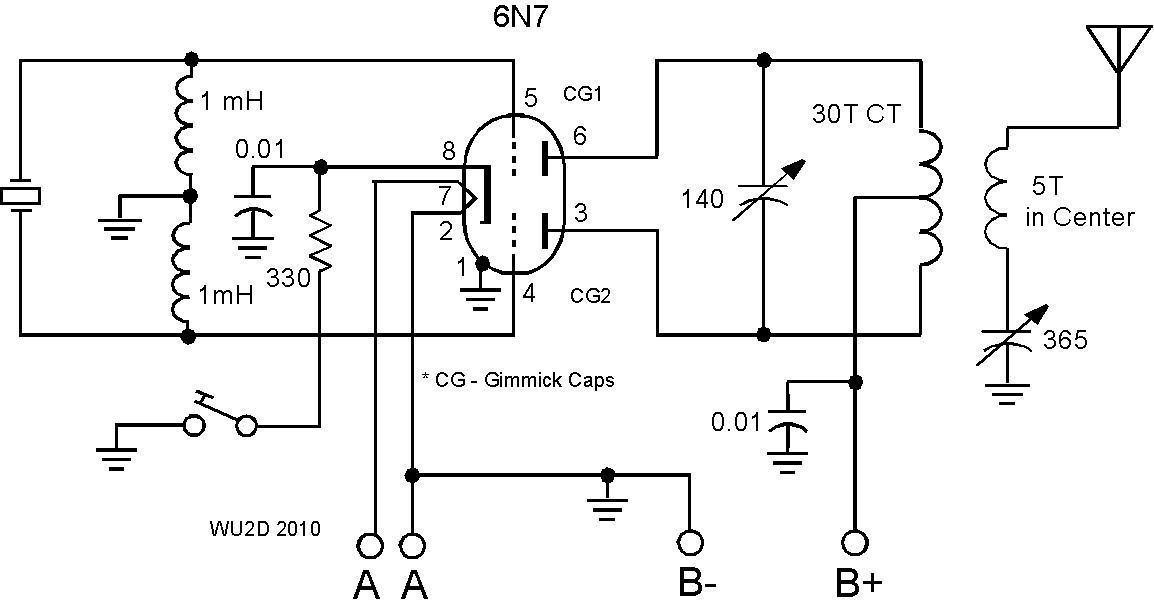
The transmitter had a very nice note with only a little bit of chirp. Bill said he was using 16, 9-V batteries connected in series for the plate supply. I think that helped keep the plate voltage quite steady and thereby the chirp to a minimum.
I have a 6J6 that I got when I purchased a couple hundred tubes from the local recycling center. It’s slated to be part of a one-tube transmitter here at KB6NU if I can ever get around to it.
I am not a ham but got interested in tubes and built a dozen or so tube guitar amps over the last 3 years. Needless to say I am hooked. I recently started to learn Morse code. I will probably sit for the Technician license at some point.
I saw your 1936 Jones transmitter. Pardon the stupid question but does the transmitter work gor different frequencies? Is there a simple tube receiver that might work well with this transmitter? Thanks
I just did a quick Google search and came up with this, “A Three Tube Regenerodyne Receiver” by Gary Johanson, WD4NKA. The URL is http://www.qsl.net/wd4nka/TEXTS/REGENf~1.HTM.
Hi, What is the besr way to couple this transmitter to an antenna? I currently have an inverted V fed with coaz. Can I use a tuner and feed to coax or would a single lead or twin lead be better>
73,
Mike
Mike,
The output turns on the coil are low z and can be connected directly to the
unbalanced coax with good results. I’ve built Sandy Blaize’s 50JY6 PP
transmitter which is identical except for discrete tubes instead of a dual
triode. This is truly “The Magic Circuit” as described by Arnie Coro of
RHC.
73,
Andy
KA9DOL
Hi Andy, Sorry I tool so long. I’ve been working on some other things. Thank you for the information. I just may make it.
Tnx and 73,
Mike
N1CHP
If you replace the tuning cap with a symetrical dual gang tuning cap and connect the centre frame of the cap to grd or B neg with a .001 cap or less the chirp will vanish. Each end if the coil is connected to one of the tunpng caps fixed plate sections. I built mine with a 12bh7 and am having remarkable success. Reports from as far away as 2263mi.
Just built the Sandy Blaize 50jy6 version. Will.probably throw the rest out.
Do you have a link to a web page or schematic for this verstion?
I cant seem to refind it. Same as yours except a pair of pentodes. So screens are joined and fed with a 25k from B+ and suppressors are joined and grounded.
Power comes in from the outlet through a switch and then a 150 ohm 5 W resistor to the filaments which are connected in series. Also power comes from the switch to a voltage doubler. ( two resistors, two 450 volt electrolytics, two diodes ) otherwise same as yours.
Hi Dan,
Dan,
May I ask if you have measured the grid current for the6N7 push pull? I have some vintage mini-core inductors/ rf chokes that I would like to use but are only rated at about 35ma. It seems to me that the above set up would be fine for them but I thought I might ask. Secondly, is it reasonable to use ganged 365 receiving caps for the build (I would isolate the stator from chassis ground) at QRP power levels? I have also been looking at another one of these on QSL.net that uses 6L6s and a bit more juice. 73 Brian KB2idy
I have not. This is one of those projects that hasn’t gotten past the thinking/researching phase.
I built four different versions of the original Frank Jones circuit in his 1935 Radio Handbook.
tubes were the original #53, 6A6, 6N7 (these tubes are same except for different filament voltage and/or tube base) & 6SL7.
On the first three tubes I ran 300vdc to the plate for 10w RF output. Large crystals were needed. I used B&W JVL-80 and JVL-40 coils. These have the swing link and using a “chicken stick” can be adjusted to improve output. I used a 240pf variable across the coil, this allowed 160 mtr and 80 mtr operation with JVL-80 but still tuned 40mtrs fine.
On the 6SL7 transmitter I used little National coils with swing link. All built on a small chassis with power supply. 225vdc plate voltage for 5 watts on 80 & 40 and about 3 watts on 160. Installed 3 different types of xtal sockets wired parallel to take advantage of a bunch of odd mil-surp xtals I had.
I found on all these transmitters that when tuned to peak output (indicated on the MA meter) I found that if tuned slightly to one side of the peak (you have to experiment to find which side) the chirp would go away.
They are all gone now, been thinking about building another one.
John