• Skip to primary navigation
  • Skip to main content
  • Skip to primary sidebar
  • Skip to footer

KB6NU's Ham Radio Blog

KB6NU's Ham Radio Blog
  • HOME
  • Study Guides
  • Teach a One-Day Tech Class
  • W8SRC Repeater Guide
  • Advertise
  • Hire Me

Kids

Amateur radio in the news: Hams help police nab criminals, elementary school club boasts 30 members

December 13, 2017 By Dan KB6NU Leave a Comment

I thought this was an odd story. There was a story not long ago about how the Indian military used hams to help them track rebels….Dan

Ham radio bounces back in new role to track criminals’ location. PUNE: A ham radio club that will help the Pune police spot the location of criminals has been established by Muktangan Science Exploratory Centre on Saturday. Deputy Inspector General of Police (wireless) Abdur Rahman, who inaugurated the club, said the wireless department is taking help from the ham radio clubs in Pune to resolve communication problems and now a mobile locator will help zero in on criminals.


Antietam Elementary School reaches for the stars. Ham-tietam, the school’s ham radio club, currently has 30 students. The Woodbridge Wireless Amateur Radio Club helped establish the club and continues to mentor the students. Ham-tietam has tripled in participation since its inception three years ago. When asked why ham radio is popular with students, Marcia Wieduwilt, principal of Antietam, shared, “It gives students the opportunity to see the world beyond their own community. “ With help from staff, administrators, and the Woodbridge Wireless Amateur Radio Club, Antietam ES students are given real-world application to academic subject matter. The sky’s the limit for Antietam Elementary School.


‘His one true love’: Vietnam veteran’s last wish to broadcast on ham radio fulfilled. For Vietnam veteran John Nugent, who served in the U.S. Army Signal Corps, coming home to Newburgh, N.Y., meant some isolation, according to his son Chris, but his love of ham radio allowed him to reach out to other people throughout the world. “It was tough for him. The radio made him feel comfortable, and helped with his transition,” Chris Nugent said.

Filed Under: Emergency Communications / Public Service, Kids, People

TryEngineeringTogether helps kids get into technology

December 10, 2017 By Dan KB6NU 4 Comments

Want to help kids get involved with technology? This short item from EDN magazine describes and IEEE program that might be worth your while…Dan

Want to inspire the next generation of engineers and scientists? For a few hours of your time each month, you can do your part. Once students hit grade 8, apparently half have already lost any interest in STEM subjects.

(source: TryEngineering Together)

So…the IEEE has teamed with Cricket Media to create TryEngineering Together, facilitating eMentoring relationships between techies just like you and students in grades 3-5.

My colleague Nicole DiGiose over at sister pub EBN has written about this in much more depth. Go check it out – change a kid’s life.

  • Nurturing the Next-Gen STEM Workforce: Cricket Media & IEEE Collaborate on TryEngineering
  • TryEngineering Together

Filed Under: Kids Tagged With: IEEE, STEM

CQ Girl Scouts

October 3, 2017 By Dan KB6NU Leave a Comment

Last June, while demoing amateur radio at the Ann Arbor Mini Maker Faire, I was approached by a woman who asked if I’d consider organizing an amateur radio demo at a Girl Scout event in the fall called the International River Crossing. This event is  held in Marine City, MI, which is on the St. Clair River, and attracts Girl Scouts from both the U.S. and Canada. While I might have done this, Marine City is an hour and a half away, and I didn’t think I could ask my fellow Ann Arbor hams to hike all the way up there.

So, I asked Stan, AC8W, who’s one of the mucky-mucks of the Eastern Michigan ARC (EMARC). They are a lot closer than I am, and I knew they’d do a great job.

A couple of days ago, Stan sent me the October issue of the EMARC Sparks. Below, reprinted with Stan’s permission, is an article describing what they did at the event…Dan


Girl Scouts 50th Annual International River Crossing

The Girl Scouts of Southeastern Michigan held their annual event International River Crossing in Marine City on September 30, 2017th Stan, AC8W, and President Tony, KE8BIT, went down to Marine City at 7:30 a.m. and set up a display.

Tony, KE8BIT, at the EMARC table.

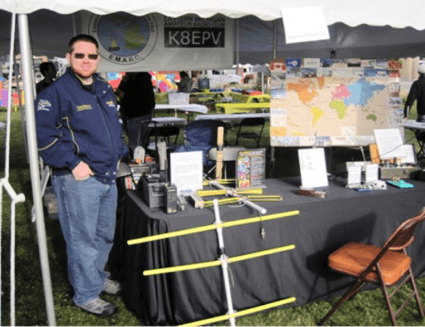
Our table included a hidden transmitter (fox) and a DF antenna, a world map with DX QSLs, a Morse code oscillator, sample Arduino kit, a QRP transceiver and two “Paraset” Spy radios on display.

Many of the exhibitors around us had kits to build or games to play. Next to us was the Purple Protons robotics team with two operating bots which was very popular. Another booth had kids make a rocketfrom a sheet of paper, seal the end and place it on a home built air pump the kid would jump on. Flying rockets went everywhere, Great fun.

Tony, KE8BIT, showed the direction-finding equipment and explained about the hidden transmitter. He even had a few girls find the fox. Stan, AC8W, was busy spelling girls names in Morse Code and having them send a message back to him. Bob, K8WMW, came down in the afternoon and helped.

Several Hams stopped by along with their Girl Scouts including KC8MSD, VE3BBX, and the families of K1ND and KG4AK (Guantanimo Bay Cuba).

All in all a fun experience!

Filed Under: Everything Else, Kids Tagged With: Girl Scouts

Parents are key to being successful with kids

May 1, 2017 By Dan KB6NU 1 Comment

Yesterday, a friend emailed me:

Did you see Tom Gallagher’s editorial, “Lessons of Grace,” on page 9 of the May 2017 QST on teaching electronics and amateur radio in schools? Any thoughts on his ideas?

Here was my reply:

I tried twice to set up a ham radio class/club in a middle school. Both were successful in that they did introduce the kids to ham radio and electronics, but both efforts failed in that neither of them resulted in any of the kids getting their licenses. 

The first time I tried this was at a charter school. We did a bunch of things like set up an antenna and made contacts, and I taught them other stuff that they needed to know to pass the test. At the end of the semester, there were two kids who were interested enough and who had learned enough to pass the test, but their parents never took them to the exam session! There was no ham radio club there the next semester.

The second time I tried this, I was actually paid by the Ann Arbor Public Schools to provide a ham radio club for a bunch of middle schoolers. We did some of the same things. I set up a station a couple of times and we made contacts. I also had them build no-solder, code practice oscillators.

This was an after-school activity, and predictably attendance dwindled throughout the semester. By the end of the semester, there was one kid who could have passed the test, but again, he got no support from his parents, and I don’t think he ever got a license.

In both cases, I got little or no support from the school, aside from a little bit of money from the Ann Arbor Public School District.

I learned two big lessons from my experiences. First, for this to be successful at all, you have to have the participation of not only the school, but the parents. In both cases, the schools only minimally participated and the parents not at all. Not getting the school and the parents involved really dooms an effort like this to failure.

Second, I’m not really cut out to work with kids. At times, I could barely keep the class under control. That’s probably partly due to my lack of training in classroom management, but whatever the reason, I just don’t have the skill set to work with middle school kids or kids that are there just to be there. I have no desire to try this again with kids of any age. 

As a final comment, I’ll note that I just swapped email with Tom Gallagher, NY2RF about this article. He wrote that the sessions, “culminated in administering the test to five students,” yet he only notes that Shui Se Phoe passed the test. I asked about  the other four, and he said, “The others came close, but the overwhelming amount of brute memorization interfered with their school obligations.” 

That’s fair enough, but I don’t think that he gives enough weight to parental involvement. He never mentions this in his editorial, and I think it’s as critical as all the other factors. Kids need the support of their parents to both get their licenses and to then become active radio amateurs.

Filed Under: Kids

Amateur radio in the news: Kids get radios,

April 18, 2017 By Dan KB6NU 3 Comments

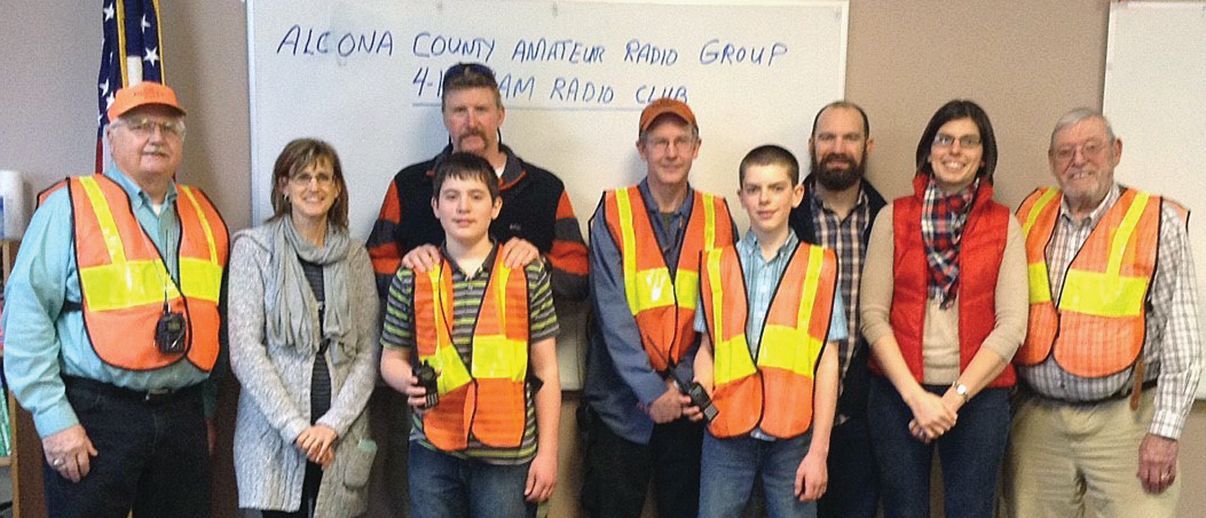
Two youth receive radio equipment. Alcona County Amateur Radio Group and Alcona County 4-H have teamed-up for 14 years to sponsor Amateur Radio FCC license classes for more than 50 youth. Included is a youth equipment program for those who successfully complete the license class. The program provides new radios and is funded primarily by donations and group member “silent key” bequests.

Shown from left are Stan Darmofal, W8SZ, Alcona County emergency coordinator and radio officer; parents Anne and Bob Mills and their son, Robby Mills, KE8GLG; Rick Gull, KD8AQT, instructor; Mark Collins III, KE8GLF, and his parents Mark and Traci Collins II; and Art Laatz, K8AKL, youth program administrator.

Christian vocal legend at Rose Hill Sunday. Larnelle Harris, a legendary voice in Christian music for more than four decades, is coming to Ashland on Sunday night. The singer/songwriter will be part of “Super Sunday” at Rose Hill Missionary Baptist Church.

In amateur radio circles, Larnelle is known as Stu, WD4LZC. I’ve worked him many times, and he’s a great CW operator in addition to being a “vocal legend.”


High-altitude balloons are the average person’s SpaceX. Space travel today is largely ruled by government agencies and billionaire tech magnates. But for the average person, it’s much easier to reach Earth’s outer limits than you might think. All you need is a big weather balloon, some helium, a camera, and a dose of good timing. [And, I might add amateur radio…Dan] High-altitude “ballooning” allows hobbyists, photographers, and students alike to view our planet from as high as 100,000 feet. These balloons can capture the curvature of the Earth and fields of endless clouds from greater heights than drones, and with richer detail than a satellite.

Filed Under: Gear/Gadgets, Kids, People

Clothespin keyer gives Boy Scouts a taste of ham radio

March 22, 2017 By Dan KB6NU 1 Comment

A week ago, Mike, WH6YH, ordered one of my One-Day Tech Class DVDs. He wrote:

Gave an overview of CW to Boy Scout Troop 88, Savannah, GA last week and spoke to this great hobby. I will donate this to help water that planted seed. 73, Mike WH6YH

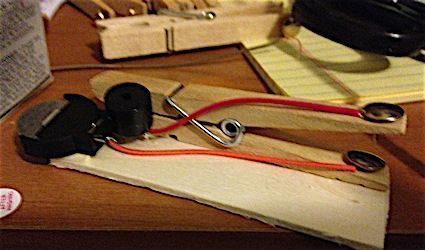
Yesterday, he heard me calling CQ on 30m and answered my call. He filled me in a little more about the presentation he gave and described the “clothespin keys” that he made for the kids. I asked him to send me a picture (shown below).

In his email, he described the key and his experience with the kids in more detail:

Hi Dan,

I passed these out to Boy Scout Troop 88 in Savannah, GA as gift during the Intro to Morse Code a couple weeks ago. Total costs about $5 for 10 straight keys as I purchased the magnetic resonator and coin cell holder on eBay china, both 3v. One can even purchase the CR2032 battery there as well, but plan ahead as it takes a couple weeks to arrive. Cannot go wrong with the cost of goods on eBay these days!

 I used clothes pins, some old thumb tacks, and a little hook up wire, and soldered everything in place for sturdy, kid-friendly use! The flat wood on the bottom is part of a free paint stirring stick from HD or Lowes. I cut it to length and super glued the clothes pin to it to prevent the key from moving while sending. 

The kids and parents were amazed to see something made with inexpensive parts. The parents wanted to pay me for the keys, but these were so cheap, I just let them have them. I consider this public license and free for others to use in their presentations.

These are so cool I might make up a few myself and pass them out at the MakerFaires and other events where I do CW presentations.

Filed Under: CW, Kids

Help the Boy Scouts this summer

November 23, 2016 By Dan KB6NU Leave a Comment

This appeared in my inbox this morning…

IEEE STEM Summer Project

Teach Youth Electricity & Electronics in the WV Mountains
— Two weeks this summer     — July 15-29, 2017

embCan you help us raise the awareness and understanding of technology and its impact on society among middle and high school students from around the world? The IEEE emeritbadges Project is a global pre-university technology education program for boys and girls. emeritbadges has developed a program to foster the accomplishment of its vision around the Electricity Merit Badge and the Electronics Merit Badge programs. A group of thirty (30) volunteers is needed to implement most of the project objectives at the 2017 National Jamboree at the Summit Bechtel Reserve in Glen Jean, West Virginia from 15 – 29 July 2017. The Jamboree will be attended by thousands of boys and girls from around the world. YOU are needed to staff the Electricity and Electronics Merit Badge booth in the STEM Quest area at the 2017 National Jamboree.

Contact Ralph W. Russell to ask for details regarding volunteering to spend two (2) weeks in the scenic West Virginia mountains adjacent to the New River Gorge National River area to teach boys and girls the basics of electricity and electronics.

Sounds like fun, and I’m guessing that if they get enough volunteers, you wouldn’t have to be there for the entire two weeks. Oddly, emeritbadges.org doesn’t seem to work, but the program does have a Facebook page.

Filed Under: Kids Tagged With: Boy Scouts, Girl Scouts

From ACM Tech News: Ultralow power transistors, STEM, teaching Morse Code

November 20, 2016 By Dan KB6NU Leave a Comment

acm-tech-newsAs a member of the Association for Computing Machinery (ACM), I get technology news bulletins a couple of times per week. Here are some items that may be of interest to radio amateurs….Dan


Engineers Design Ultralow Power Transistors That Could Function for Years Without a Battery

University of Cambridge (United Kingdom) (10/20/16) Sarah Collins

A new transistor designed by engineers at the U.K.’s University of Cambridge captures a tiny leakage of electrical current and harnesses it for its operations. The transistor’s operating voltage is less than a volt, with power consumption below a billionth of a watt. The transistor’s ultralow power consumption makes it most suitable for applications in which function is valued over speed. The researchers say the transistors can be produced at low temperatures and printed on almost any material, from glass and plastic to polyester and paper. They also report they were able to keep the electrodes independent from one another, so the transistors can be scaled down to very small geometries. “We’re challenging conventional perception of how a transistor should be,” says Cambridge professor Arokia Nathan. “We’ve found that these Schottky barriers, which most engineers try to avoid, actually have the ideal characteristics for the type of ultralow power applications we’re looking at, such as wearable or implantable electronics for health monitoring.” The researchers say devices based on this type of ultralow power transistor potentially could function for months or even years without a battery by scavenging energy from their environment. They also think the transistors could be used for devices for the Internet of things.

View Full Article


I hope that amateur radio can play a role in this….Dan

Computer Science/STEM Leaders Explain How to Spark STEM Interest in Youth

HPC Wire (11/01/16)

With discrimination discouraging women and minorities from pursuing careers in science, technology, engineering, and math (STEM), the time is ripe to encourage interest in today’s youth, according to scientists leading the ACM/IEEE-hosted SC16 international conference, which takes place Nov. 13-18 in Salt Lake City, UT. Students@SC16 chair Jeanine Cook from Sandia National Laboratories says a lack of diversity in STEM leadership “adds up to a steady drumbeat that can drive people out of science study and work.” Nevertheless, STEM careers promise to be both lucrative and rewarding. Interest in them is being sparked by the growth of coding clubs, robotics classes, and other hands-on experiences. The Obama administration also has led a national effort to prioritize STEM education and prepare 100,000 STEM teachers over the next decade. SC16’s leaders suggest parents can nurture STEM interest in their children by first recognizing and rejecting any outdated norms about their own experiences with science, math, and academic achievement. Another suggestion is to overcome personal biases and read to their children about science, math, and technology, and encourage and reward them for being curious from a young age. Parents also should enroll their children in after-school enrichment programs, find STEM mentors and teachers for them, and always encourage them despite any difficulties they might encounter.

View Full Article


While this sounds pretty good on the face of it, they’re teaching the code by touch here, not by sound, so I’m not so sure this learning method will be of much use to radio amateurs. Also, they never say at what speed they’re sending the code…..Dan

Learning Morse Code Without Trying

Georgia Tech News Center (10/27/16) Jason Maderer

Georgia Institute of Technology (Georgia Tech) researchers have developed a system that teaches people Morse code within four hours using vibrations felt near the ear. Participants learned Morse Code by wearing a Google Glass headset and playing games while feeling the taps and hearing the corresponding letters. The taps represented the dots and dashes of Morse code and passively “taught” users through their tactile senses. In a few hours, participants could key a sentence that included every letter of the alphabet with 94-percent accuracy, and were able to write codes for every letter with 98-percent accuracy. The taps were created when the researchers sent a very low-frequency signal to the headset’s speaker system, which was sensed as a vibration. Half of the participants in the study felt the vibrations and heard a voice prompt for each corresponding letter. The other half served as the control group and felt no taps to help them learn. This study shows “that [passive haptic learning] lowers the barrier to learn text entry methods–something we need for smartwatches and any text entry that doesn’t require you to look at your device or keyboard,” says Georgia Tech professor Thad Starner.

View Full Article

Filed Under: CW, Electronic components, Kids

Operating Notes: Disappointing JOTA turnout, operating at 35 wpm

October 17, 2016 By Dan KB6NU Leave a Comment

2016_jota_patchA couple of months ago, I was asked to host Jamboree on the Air at our club station, WA2HOM, at the Ann Arbor Hands-On Museum. The museum folks said that they would handle the publicity, and expecting a big turnout, I suggested that they schedule groups in one-hour slots. One of the reasons for this is that the shack at the museum cannot accommodate more than about five or six at a time.

Early last week, the museum’s scout coordinator e-mailed me that she had two groups scheduled—one at 10 am and one at 3 pm. I was a little disappointed that they couldn’t get more to come, but  that was OK.

Saturday morning, I got there about 9:40 and got the station running. The noise level was incredibly high, but conditions were good, and I heard quite a few JOTA stations. Then, I waited, and waited. The 10am group never did show, so I went home to eat lunch and take care of some errands. 

Around 2:20 pm, I got a  phone call from a Scout leader who said he was at the museum and had been waiting for 20 minutes. I apologized, noting that I thought he wasn’t supposed to arrive until 3 and drove down to the museum. Fortunately, I live less than 10 minutes away. When I got there, I was  little disappointed that there was only one scout, but we had a fun session with Cub Scout Charlie, making contacts with stations in CT and NC. 

I think part of the reason we had such a low turnout is that the museum charged the scouts admission. At the very least, I think they should have given them a discount.

Cranking it up

cw-geek-button-250x250Last Thursday, I turned on the radio about 5:30 pm, and happened to run into Rick, N4RLD, on 40m CW. I’d worked Rick before, and knew he was a good operator. On his second transmission, he said that he had just read my QRZ.Com page, where I brag, “I’ve increased my code speed to 30 wpm. Feel free to send that fast if you read this while we’re in contact. I’m proud of this achievement, and am continually trying to get guys to work more CW.” He suggested that we try 35 wpm, and feeling adventurous, I agreed.

Well, I’m not sure if it was I was having a good CW day, or it was because that Rick has such a good fist, but I was having no trouble at all copying him at 35 wpm. Then, he suggested we try 40 wpm.

At 40 wpm, I started missing characters, but I was able to keep up with the conversation. That made me feel pretty good.

Then, he cranked it up even faster. At 40+ wpm, he started making a significant number of sending errors, and he apologized for that, but no apologies were necessary. We were just having some fun.

As far as my own sending goes, I must admit that I was pretty bad at sending 35 wpm. I was making a lot of mistakes. It’s kind of funny that at high speeds, it’s sometimes easier to receive than to send. It’s just the opposite at lower speeds when you’re getting started.

Rick noted that he often practices sending at 40+ wpm in order to get better. I think that I might devote 10 to 15 minutes a day sending at higher speeds. And, I’m going to update my QRZ.Com page to say that I can now copy at 35 wpm.

Filed Under: CW, Kids Tagged With: Boy Scouts, JOTA, QRQ

I (N1)SPY

June 14, 2016 By Dan KB6NU 2 Comments

As I recounted earlier, I met Tommy, N1SPY, at Dayton this year, while doing booth duty at the CWops’ booth. Tommy used my study guides to get his Tech and General Class tickets, and I signed his study guide for him. He and I (and his father, NO2CW) talked about operating CW, and what might make a good key to buy.

As  you can see below, they purchased a Vibroplex paddle, and Tommy is now on his way to becoming a hotshot CW operator:

I told him that I’m going to be listening for him on 40m. If you hear him on the air, give him a call.

Filed Under: CW, Kids

  • « Go to Previous Page
  • Page 1
  • Interim pages omitted …
  • Page 4
  • Page 5
  • Page 6
  • Page 7
  • Page 8
  • Interim pages omitted …
  • Page 15
  • Go to Next Page »

Primary Sidebar

No Nonsense Technician Class License Study Guide (for tests given between July 2026 and June 2030)

New No Nonsense Technican Class Study Guide now available!

The 2026 version of my Tech Class study guide is now available, and as always, the PDF version is FREE!. The ePub version costs $11.97, and a Kindle version and paperback version will be available on Amazon shortly.

Click here to get all of my "No Nonsense" study guides.

Also available: The CW Geek's Guide to Having Fun with Morse Code

W5SWL.Com
Retevis Ailunce H1 DMR Radio
DXpander: Cobweb antennas, Laser Cutting

You’ve got mail!

Enter your email address below and get an email every time I publish a new post.

Email


I frequently teach classes to help newcomers get their licenses. The next class will take place on Saturday, October 10, 2026 on the University of Michigan campus. Click here for more information.

If you can't make the class, subscribe to the mailing list to be notified of when the next class will be held.

You can always download my free study guide, and if you have any questions about the classes, or amateur radio in general, please feel free to email me directly.

Support KB6NU.Com

Donate $7.30 and get two of these cool stickers. Measuring 4.25-in. W by 2.75-in. H, it's perfect for your car, your shack, or wherever!

Contact me

If you have a question or comment about one of my blog posts, or a question about any of the material in my study guides, or just a question about ham radio in general, you can email me at [email protected].

Blogs You Should Also Read

  • AE5X: A CW-centric blog from Kingswood, Texas
  • K0LWC Blog
  • LA3ZA Ham Radio Blog
  • Little Radios, Big Fun – WB3GCK
  • Mr. Vacuum Tube's Blog
  • Radio Artisan – K3NG
  • The K0NR Weblog
  • VE3WDM's QRP Ham Radio Blog
  • W2LJ’s Blog

Ham Radio Websites

  • Dashtoons – The Hammin' Comedy by Jeff K1NSS

Podcasts

  • ICQ Podcast
  • Linux in the Ham Schack
  • No Nonsense Amateur Radio Podcast
  • Resonant Frequency Amateur Radio Podcast

Recent Comments

  • Bulin 47 AI on ICQPodcast Episode 485 – World Cup Special Event Station
  • Jesse Alexander on What do you think of this artwork for the ham radio EMF Explorer
  • CADProps on My first go at 3D printing not quite a success
  • Dan KB6NU on A Media Guide to Amateur Radio
  • Steve Stroh N8GNJ on A Media Guide to Amateur Radio

Meta

  • Log in
  • Entries feed
  • Comments feed
  • WordPress.org

Footer

Copyright © 2026 Daniel M. Romanchik, KB6NU · Log in