
Yesterday, a guy on the /r/amateurradio sub-reddit asked:
Hello all, I’ve got my tech back in October and have been lurking here for about that long. I’m looking to eventualy make some satellite contacts with a DIY antenna but don’t know what plans to go with. I would like to build a dualband 2m/70cm yagi to transmit from my HT and receive with a handheld scanner I have. I have some solid uninsulated copper wire currently. Thanks in advance for any advice!
I was very interested in what kind of answers that he might have gotten, so this morning, I clicked over to the post. I was surprised to find only one comment, telling him to Google “tape measure Yagis.” So, I did a little Googling of my own.
The first reference that caught my eye was the $4 Ham Radio Satellite Antenna. I saw this web page a couple months ago, and was thinking about building it, but haven’t gotten around to it yet. It looks like a very cool and easy project.
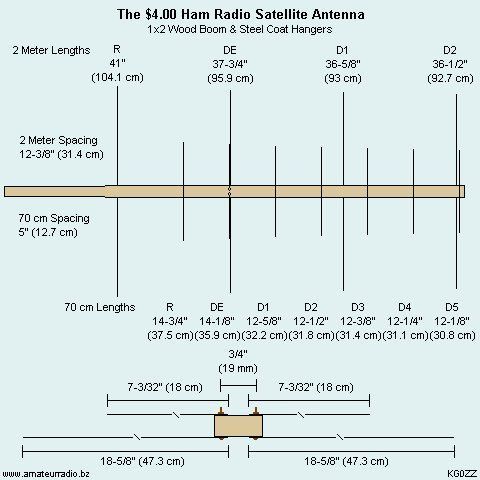
One thing I was wondering about is why the 2m and 70 cm elements aren’t perpendicular to one another as they are on the commercial antennas. I guess since this antenna seems to work just fine (I found a YouTube video showing one guy in the UK using it), I’m guessing that the elements don’t need to be perpendicular, but there must be some reason that Arrow and Elk build them that way. Anyone know?
With a little more Googling, I found VE2ZAZ’s homebrew satellite antenna. One of the cool links on this page is to plans for building KI0AG’s Micro Duplexer. I always wondered what was in one of these things, and now I know.
The page notes that there’s a PC board for the project available from Fair Circuits. The board uses surface mount components, though. I’m wondering if I can simply build this on some perf board, though. I think that I have all the toroid cores and silver mica caps I need. On the other hand, the surface-mount inductors are only $2.50 each and buying all the components and printed circuit boards greatly increases the chances that I’ll actually build the thing. :)
The surface mount components are now outdated, I would have to dig through my digikey history to find the replacments K1OAG helped me find. The circuit boards are still available.
I bought enough parts for 4, 1 to keep and three to help absorb the cost. Never did finish the other two but I did build, coax, test two and installed one to keep in my arrow antenna.
One of the guys in my local club built one of these, and I got to see it in action on Field Day – definitely a decent way to get a cheap antenna together pretty quickly.
Hello, congratulations 73 HC4Z
You asked why some antennas like the Arrow have the 2m/70cm at different polarizations. The answer is that the satellites are at different polarizations between RX and TX. So if you want to be doing full duplex or just want to make life easy on your wrist… If you want to adapt the coathanger by having the elements at 90 degrees it’s not dificult to do just buy a more expensive square bit of wood and put the feedline at the 70cm terminals and use wire to bring the 2m terminals around to them keeping the wire lengths as short as posible but even in length and avoid putting sharp corners or bends in.
I was under the impression that the two bands were cross polarized so that no duplexer is required coax just hooks to both – just my take on it
If using a dualband radio with separate antenna connections or separate Vhf and UHF radios that would work. If you are using one radio with only one antenna connection you will want to build the duplexer to combine the signals.
My plan to build this yagi.
The only question :
What about coax connection ?
There is two individual coax for both dipol or a shared one.
Have you a useful drawing about please ?
Gréetings vy 73 ex HA/HG8GA
Yes, you would have to use two separate feedlines, one for each antenna, or build the duplexer linked to in the article.
Very interesting design. I’ve been wanting to build one for some time now. But I have 2 questions regarding the driven elements. First, the drawing shows the driven elements looking like they are electrically bolted together. This would prevent the use of a duplexer. Shouldn’t they be isolated?
Second, if the elements are turned on 90° to each other, will repositioning all of the 440 elements forward/backward a bit to prevent both sets of driven elements mounting elements hardware from interfering from each other, cause any problems???