
• Skip to primary navigation
  • Skip to main content
  • Skip to primary sidebar
  • Skip to footer

KB6NU's Ham Radio Blog

KB6NU's Ham Radio Blog
  • HOME
  • Study Guides
  • Teach a One-Day Tech Class
  • W8SRC Repeater Guide
  • Advertise
  • Hire Me

One of these days I’m really going to learn how to use a Smith Chart

April 14, 2019 By Dan KB6NU 3 Comments

I keep saying that one day I’m going to really master the Smith Chart. I kind of understand them, but don’t ask me to give an impromptu lecture on how they work and what they’re used for. That being the case, I keep collecting links to articles on the net that are supposed to explain how they work. Here’s my latest collection:
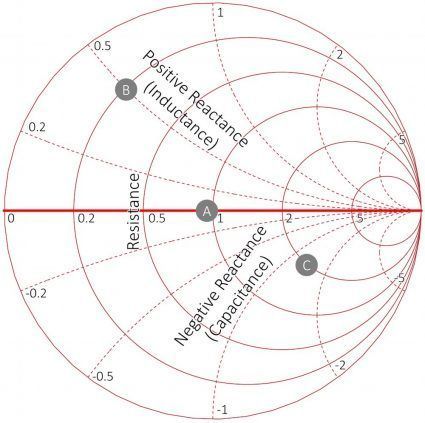
How does a Smith Chart work?
The Smith chart appeared in 1939 as a graph-based method of simplifying the complex math (that is, calculations involving variables of the form x + jy) needed to describe the characteristics of microwave components. Although calculators and computers can now make short work of the problems the Smith chart was designed to solve, the Smith chart, like other graphical calculation aids remains a valuable tool.

The Smith chart: more vital after all these years
Using the Smith chart, you can graphically illustrate the complex impedance, Z=R+jX, of a transmission line, antenna, amplifier, or any signal point in the RF range at which the simple resistive approximation is not sufficiently valid. However, the ability to place the real and imaginary parts of Z on a 2-D graph instead of using numbers for R and X is not what makes the Smith chart significant.

Smith Chart: Old tool, new home
Even in these days, when news travels instantly and there are few secrets, it’s possible to miss an important or interesting story. That’s what happened to me recently: I was doing some online research and came across an item from October 2015, published at IEEE Microwave Magazine : “The Smith Chart Comes Home [President’s Column].”

The news was simple: the column explained that IEEE MTT-S [Microwave Theory and Techniques Society] was buying “the rights from the Smith family of the Smith trademark belonging to Analog Instruments, along with the copyright. In return, the MTT-S would make the Smith chart available to students, practitioners, and indeed people all over the world involved in microwave technology.”


Related posts:

  1. From my Twitter feeds: Smith chart, inkjet PCBs, SW books
  2. 2016 Extra Class Study Guide: E9G – The Smith Chart
  3. From my Twitter feed: WSPR antenna testing, 3D Smith Chart, SW activity monitor
  4. Extra Class question of the day: Smith Chart

Filed Under: Antennas Tagged With: Smith Chart

Reader Interactions

Comments

  1. Markus Lenggenhager says

    April 14, 2019 at 12:57 pm

    To “play” and get familiar with the Smith Chart I recommend SimSmith: http://harriman.ddns.net/Smith_Charts.html

    Browse thru the manual and take a look at the excellent YouTube tutorials!

    73, Markus HB9BRJ aka AE6MG

    Reply
  2. Eugene Mah says

    April 16, 2019 at 1:57 pm

    Alan Wolke (W2AEW) has a few great videos demonstrating Smith charts on his YouTube channel too (https://www.youtube.com/user/w2aew/). Definitely worth watching. #274-276 and #278

    Eugene, AB4UG

    Reply
  3. Rob W4ZNG says

    April 18, 2019 at 9:05 pm

    And I’m going to understand Smith charts too someday… just after I (puts head in hands) … I learn CW.

    Reply

Leave a Reply Cancel reply

Your email address will not be published. Required fields are marked *

This site uses Akismet to reduce spam. Learn how your comment data is processed.

Primary Sidebar

No Nonsense Technician Class License Study Guide (for tests given between July 2026 and June 2030)

New No Nonsense Technican Class Study Guide now available!

The 2026 version of my Tech Class study guide is now available, and as always, the PDF version is FREE!. The ePub version costs $9.97, and a Kindle version and paperback version will be available on Amazon shortly.

Click here to get all of my "No Nonsense" study guides.

Also available: The CW Geek's Guide to Having Fun with Morse Code

W5SWL.Com
Retevis Ailunce H1 DMR Radio
DXpander: Cobweb antennas, Laser Cutting

You’ve got mail!

Enter your email address below and get an email every time I publish a new post.

Email


I frequently teach classes to help newcomers get their licenses. The next class will take place on Saturday, February 7, 2026 on the University of Michigan campus. Click here for more information.

If you can't make the class, subscribe to the mailing list to be notified of when the next class will be held.

You can always download my free study guide, and if you have any questions about the classes, or amateur radio in general, please feel free to email me directly.

Support KB6NU.Com

Donate $7.30 and get two of these cool stickers. Measuring 4.25-in. W by 2.75-in. H, it's perfect for your car, your shack, or wherever!

Contact me

If you have a question or comment about one of my blog posts, or a question about any of the material in my study guides, or just a question about ham radio in general, you can email me at [email protected].

Blogs You Should Also Read

  • AE5X: A CW-centric blog from Kingswood, Texas
  • K0LWC Blog
  • LA3ZA Ham Radio Blog
  • Little Radios, Big Fun – WB3GCK
  • Mr. Vacuum Tube's Blog
  • Radio Artisan – K3NG
  • The K0NR Weblog
  • VE3WDM's QRP Ham Radio Blog
  • W2LJ’s Blog

Ham Radio Websites

  • Dashtoons – The Hammin' Comedy by Jeff K1NSS

Podcasts

  • ICQ Podcast
  • Linux in the Ham Schack
  • No Nonsense Amateur Radio Podcast
  • Resonant Frequency Amateur Radio Podcast

Recent Comments

  • Skip K4EAK on Button, button. Who’s got the button?
  • Ed K8MEJ on Is anyone running for the board this year in the Great Lakes Division?
  • Skip Behnke on 2020 Extra Class study guide: E9F – Transmission lines: characteristics of open and shorted feed lines; coax versus open-wire; velocity factor; electrical length; coaxial cable dielectrics
  • Mike on Map your contest QSOs
  • Phillip Cardwell on J-Poles

Meta

  • Log in
  • Entries feed
  • Comments feed
  • WordPress.org

Footer

Copyright © 2026 Daniel M. Romanchik, KB6NU · Log in