• Skip to primary navigation
  • Skip to main content
  • Skip to primary sidebar
  • Skip to footer

KB6NU's Ham Radio Blog

KB6NU's Ham Radio Blog
  • HOME
  • Study Guides
  • Teach a One-Day Tech Class
  • W8SRC Repeater Guide
  • Advertise
  • Hire Me

antennas

17m!

August 30, 2010 By Dan KB6NU 1 Comment

I’m happy to report that I’m now on 17m.  I don’t know really what took me so long—especially since I enjoy working 30m so much—but I finally put together a dipole for 17m and hung it up yesterday.

Yesterday evening, the band seemed to be hopping. The first station I copied was CE3FZ at about an S5. I tried calling him a couple of times, but after no response, I went hunting. I found PY7WC pounding in at S9. After a couple of calls, he became my first 17m contact.

I tried calling a couple other stations, but without success. This led me to believe that my antenna was far from optimal. It is kind of low, but so is my 40m dipole. The 40m dipole works pretty well, and I was hoping the 17m dipole would work well, too.

This morning, however, I had a quite different experience. Even though it was quite early in the morning (1230Z), I punched the 17m button on the IC-746PRO. There wasn’t much activity, and what I could hear was kind of weak, but I tuned around until I heard EA1ARV calling CQ. He was barely moving the meter, but I gave him a call anyway. Not only did he hear me, but we had a decent contact.

So, I guess the upshot of all this is that the dipole is not in an optimal position (which I knew anyway), but it does work, and I can make contacts. I’ll have to play around with getting it up higher, maybe in an inverted-V configuration. It seems like a fun band to operate, though.

Filed Under: Antennas, WARC Bands Tagged With: antennas, WARC Bands

iPhone Problems Show Apple Could Use Some Hams!

July 27, 2010 By Dan KB6NU Leave a Comment

Some purchasers of the latest Apple iPhone have been experiencing reception problems. Apparently, the band around the phone is the phone’s antenna, and when held in a certain way, the antenna doesn’t function as well as it should.

Well, doh! Any amateur radio operator could tell you that you probably don’t want to touch your antenna while you’re transmitting and probably not while you’re trying to receive, either. I guess there aren’t many hams on Apple’s engineering staff.

For more technical information, listen to this IEEE podcast with antenna engineer Spencer Webb.

Filed Under: Antennas Tagged With: antennas

Back on the Air

July 20, 2010 By Dan KB6NU 4 Comments

I was off the air for nearly a week. I had to take down my antennas so that some tree guys could come in and take down a couple of elm trees that finally succumbed to Dutch Elm Disease.

Before I could even do that, I had to hack a path through the undergrowth to the tree supporting the far end of my 40m/30m fan dipole. I had been negligent about clearing the buckthorn and honeysuckle, and it took me about a half hour just to get enough of that out of the way to take down the antenna.

I also had to take down the 80m random wire. To do that, I had to get to the mulberry tree that was supporting the far end of the wire. This was a chore as in the past year or so, several thick strands of poison ivy had climbed up the trunk. It took a fair amount of time to carefully pry the vines from the trunk and carefully them.

It took the tree guys three days—Wednesday through Friday—to take down the two trees. On Saturday, I had other things to do, and besides it’s been very hot here, so I wasn’t motivated to do a lot of work outside. On Sunday, though, I decided to finish the job of clearing the buckthorn and honeysuckle and then get the antenna back in the air.

I seriously misjudged the amount of work. I worked from 9 am until noon cutting branches, digging out saplings, and bundling it all up for pickup. By the time noon rolled around, I still hadn’t finished the bundling, but it was already quite warm, so I retreated inside and turned on the air conditioning. Just before dinner, I went back out and finished the bundling, but had other plans for the evening, so once again put off setting up the antenna.

Yesterday, I did go out and finish the job. This time, instead of running the 30m legs at an angle to the 40m legs, I decided to run them along the same plane. The antenna seems to like this orientation for some reason. To do this, I simply connected a 12-ft. piece of cord to the end of the 30m legs and tied the other end to the end insulators of the 40m legs. With this arrangment, the 30m legs droop down below the 40m wires.

I hooked it all up and everything seems to work just fine. I made four contacts last night, including two DX contacts: DL7UKA on 30m and PY3XAT on 40m.

I do have a couple of observations on how the antenna has weathered the elements:

  • The splice in one of the 40m legs that I made three years ago seems to be holding up quite well. I expected it to fail by now.
  • The fancy, UL-resistant dacron rope that I bought when I first put up the antenna is weathering quite well, but so is the cheap nylon rope I used on the 30m legs.
  • This spring I noticed that the adapter in the PL-259 that plugs into the balun had somehow worked its way out and had slid a couple of feet down the coax. I thought that was kind of amusing. I screwed it back in before I hoisted the antenna up again.

So, I’m back on the air now, but it really is time to do some more antenna tinkering. I really need something better for 80m, and I do want to try 17m. I just have to get off my butt and do it.

Filed Under: Antennas Tagged With: antennas

Wish I’d Have Thought of This…

June 30, 2010 By Dan KB6NU 1 Comment

On the Ten-Tec Omni VII mailing list, Bert, W0RSB, reported on his recent experience with Customer Service. He said,

Rig came back this past Monday, a day early. The auto tuner now appears to be working correctly. Unfortunately, the invoice simply says “Could not duplicate complaint.”

Maybe being manhandled by UPS or being poked and prodded by the service tech bounced something into place. At any rate, this exercise cost me nearly $200; if the problem comes back, I can buy a decent external auto tuner for little more than that.

I had a similar problem with my Icom IC-746PRO. I sent it in, and the service tech could not duplicate the problem, and when I got it back, it worked just fine.  My guess is that it was a sticky relay that got unstuck with all the jostling during shipping.  My bill was about $170, but for that, I at least got them to fix a minor problem with the LCD backlight as well as install all of the factory updates.

I never even considered buying an external tuner instead of getting the internal tuner fixed, but this is a really good idea.  At Field Day, we used an LDG Z-11Pro  that plugged right into the IC-746PRO and was tuned by hitting the TUNE button on the radio.  Worked like a charm.  Universal Radio sells them for $170. They handle a wider SWR range, too, than the internal tuner on this Icom. If the internal tuner ever goes out again, I’m buying an LDG.

Filed Under: Antennas, Gear/Gadgets Tagged With: antennas, Gear/Gadgets

Your First HF Dipole

June 19, 2010 By Dan KB6NU Leave a Comment

On the HamRadioHelpGroup mailing list, Tim, N9PUZ, pointed a link to the eHam article, “Your First HF Dipole.” As Tim points out, the article “describes a good technique for zeroing in on a low SWR,” Here’s that portion of the article:

  • Put the thing in the air as high as you can. Then find the frequency where the SWR is lowest. This might be at the bottom of the CW band or at the top of the phone portion. It doesn’t matter. RECORD that frequency.
  • Then take the actual length of the antenna (you wrote it down, remember?) and multiply it by the frequency (in MHz) of the lowest SWR. That number will be your new constant, to replace 468.
  • Divide the new constant by the frequency you want to have in the middle of your preferred range. This is the length the antenna should be. Now you need to adjust the one you have in the air to this length. You might find it’s easier to simply add or take away equal lengths on either side near the center insulator rather than on either end.
  • After doing this haul the antenna back up into position. It should now give you the lowest SWR at the desired frequency.

If for some reason you later want to trim an HF wire antenna (say, you decide to move to a different band segment), don’t waste your time cutting a half-inch at a whack. You can estimate how much to cut or add based on the band and how far you have to move it.

For example, compare 468/ 14.0 = 33.42 ft with 468 / 14.35 = 32.61 ft , so only about 10 inches to move the width of the entire band on 20 meters.
On 75/80 meters, the difference between the band extreme edges is better than sixteen feet.

Filed Under: Antennas Tagged With: antennas

Diana, KC2UHB, Does It Again

May 5, 2010 By Dan KB6NU 2 Comments

Diana, KC2UHB does it again, coming up with a roll-up yagi for satellite communication.

Who’d have thought that sewing would be an essential skill for homebrewers?

Filed Under: Antennas, Building/Homebrew Tagged With: antennas, Satellites

The Ultimate Stealth Antenna?

January 27, 2010 By Dan KB6NU 3 Comments

From the 2010-01-26 issue of NIST Tech Beat:

Engineered Metamaterials Enable Remarkably Small Antennas

NIST Z Antenna
This Z antenna tested at the National Institute of Standards and Technology is smaller than a standard antenna with comparable properties. Its high efficiency is derived from the “Z element” inside the square that acts as a metamaterial, greatly boosting the signal sent over the air. The square is 30 millimeters on a side. Credit: C. Holloway/NIST

In an advance that might interest Q-Branch, the gadget makers for James Bond, the National Institute of Standards and Technology (NIST) and partners from industry and academia have designed and tested experimental antennas that are highly efficient and yet a fraction of the size of standard antenna systems with comparable properties. The novel antennas may be useful in ever-shrinking and proliferating wireless systems such as emergency communications devices, micro-sensors and portable ground-penetrating radars to search for tunnels, caverns and other geophysical features.

NIST engineers are working with scientists from the University of Arizona (Tucson) and Boeing Research & Technology (Seattle, Wash.) to design antennas incorporating metamaterials—materials engineered with novel, often microscopic, structures to produce unusual properties. The new antennas radiate as much as 95 percent of an input radio signal and yet defy normal design parameters. Standard antennas need to be at least half the size of the signal wavelength to operate efficiently; at 300 MHz, for instance, an antenna would need to be half a meter long. The experimental antennas are as small as one-fiftieth of a wavelength and could shrink further.

In their latest prototype device,* the research team used a metal wire antenna printed on a small square of copper measuring less than 65 millimeters on a side. The antenna is wired to a signal source. Mounted on the back of the square is a “Z element” that acts as a metamaterial—a Z-shaped strip of copper with an inductor (a device that stores energy magnetically) in the center (see photo).

“The purpose of an antenna is to launch energy into free space,” explains NIST engineer Christopher Holloway, “But the problem with antennas that are very small compared to the wavelength is that most of the signal just gets reflected back to the source. The metamaterial makes the antenna behave as if it were much larger than it really is, because the antenna structure stores energy and re-radiates it.” Conventional antenna designs, Holloway says, achieve a similar effect by adding bulky “matching network” components to boost efficiency, but the metamaterial system can be made much smaller. Even more intriguing, Holloway says, “these metamaterials are much more ‘frequency agile.’ It’s possible we could tune them to work at any frequency we want, on the fly,” to a degree not possible with conventional designs.

The Z antennas were designed at the University of Arizona and fabricated and partially measured at Boeing Research & Technology. The power efficiency measurements were carried out at NIST laboratories in Boulder, Colo. The ongoing research is sponsored by the Defense Advanced Research Projects Agency.

* R.W. Ziolkowski, P. Jin, J.A. Nielsen, M.H. Tanielian and C.L. Holloway. Design and experimental verification of Z antennas at UHF frequencies. IEEE Antennas Wireless Propag. Lett., 2009 vol. 8, pp. 1329-1332.

Filed Under: Antennas, Emergency Communications / Public Service Tagged With: antennas, emcomm

Stuart Gets on the Air

November 4, 2009 By Dan KB6NU 3 Comments

After several months, we finally got Stuart, KD8LWR, on HF from his home. The first hurdle was deciding on what antenna to put up. This choice was complicated by two factors:

  • Stuart’s family lives in a relatively new subdivision carved out from a farm field, with absolutely no trees to hang an antenna from.
  • The homeowner’s association had some antenna restrictions.

Jack, Stuart’s father, met with the homeowner’s association and got them to agree to let him put up a trap vertical, and after some back and forth, we decided to put it towards the back of his lot near some pine trees. In that spot, it’s away from the house, and the pine trees hide it from plain view.

The antenna they purchased was a Hustler 4BTV, and we put it up Sunday afternoon. It took us about two and a half hours to construct the antenna, cut and lay the radials, and run the coax in a shallow trench from the antenna to the house. We started at 3 pm and finished just as it was getting dark. I was hoping that we wouldn’t have to do much in the way of tuning, as this would be pretty much impossible in the dark.

I used the dimensions called out in the instructions, and was kind of surprised to find that the resonant point on 40m was actually around 7150 kHz. The SWR at 7030 kHz was about 1.5:1, meaning that Stuart could work pretty much the entire CW portion of 40m. I didn’t get a chance to check the SWR on any of the other bands.

The rig Stuart’s using is a Kenwood TS-140 that had been donated to the museum. We connected the antenna to the rig, and it came to life. Unfortunately, the band had gone out by this time, and there was very little activity. We did copy a PA5 around 7026, and that was exciting, but there were very few stations on.

Actually, it didn’t matter. We couldn’t transmit anyway. It slipped my mind that the TS-140 didn’t have a built-in keyer, and I didn’t make a cable to connect Stuart’s old MFJ keyer to the rig. Transmitting would have to wait until Monday.

Monday evening, around 7:30, I returned with the cable. We tuned around a bit, but again the band had gone out, and we could hear only a very few weak stations. Stuart called CQ a couple of times, but without any success. I then suggested that I go home and we work a little ground wave.

It took me about twenty minutes to get home, and Stuart was waiting for me. We got coordinated using one of the local repeaters, and soon we were having our first CW QSO. After a nice 20-minute contact, it was time for Stuart to hit the sack, so we said 73.

I’m sure that will be the first of many contacts. I still need to get over there and tune up the antenna a bit more, but I think it’s going to work out very well. So, be listening for him, especially on 40m CW, and when you do contact him, tell him that you read all about it on this blog. :)

Filed Under: Antennas, Elmering Tagged With: antennas, Elmering

Sad News…and a Reminder

October 13, 2009 By Dan KB6NU 2 Comments

Sad news today from the ARRL website:

Three People Killed While Erecting Ham Antenna

At approximately 8:40 PM on Monday, October 12, a man, woman and their 15 year old son were killed while trying to erect a 50 foot vertical antenna at the home of the man’s mother, Barbara Tenn, KJ4KFF, in Palm Bay, Florida. The deceased were not licensed amateurs.

“It happened in an instant,” Palm Bay Fire Marshal Mike Couture said in a statement. “It is an unfortunate set of circumstances that led to the most tragic result.”

According to police reports, Melville Braham, 55, Anna Braham, 49, and their 15 year old son Anthony were putting up an antenna — Tenn’s second — at night when they lost control of the antenna and it crashed into nearby overhead power lines. The impact sent 13,000 volts of electricity through the pole the three were holding. A family friend, a 17 year old boy, was on the roof at the time of the accident. He and the couple’s daughter, who was in the house at the time, were not injured.

The mother was pronounced dead at the scene. When paramedics arrived, the father and son were not breathing; rescue crews immediately tried to resuscitate them. They were transported to a hospital where they later died.

Neighbor Jim Vallindingham told television station WFTV that he called 911 when he saw the fire in the back yard and then he ran over: “I had no idea it was electrical until we got over there and saw the three people laying on the ground. So I called 911 a second time to tell them there were casualties. You know, there were people on the ground. So [the 911 operator] told me that’s electric, you back away don’t touch anything.”

Couture said that night was not the best time to be attempting to put up an antenna. “It wasn’t the best time, meaning it was night time. Obviously, in darkness, and trying to do something like this and not being keenly aware of where the power line is in the backyard, [was not a good idea],” he said.

Neighbors said that Tenn, an ARRL member, used Amateur Radio to talk with her family in Jamaica. — Thanks to WFTV and Central Florida News 13 for the information

BE SAFE, PEOPLE!

Filed Under: Antennas Tagged With: antennas

Anyone Got a T-2?

September 11, 2009 By Dan KB6NU 30 Comments

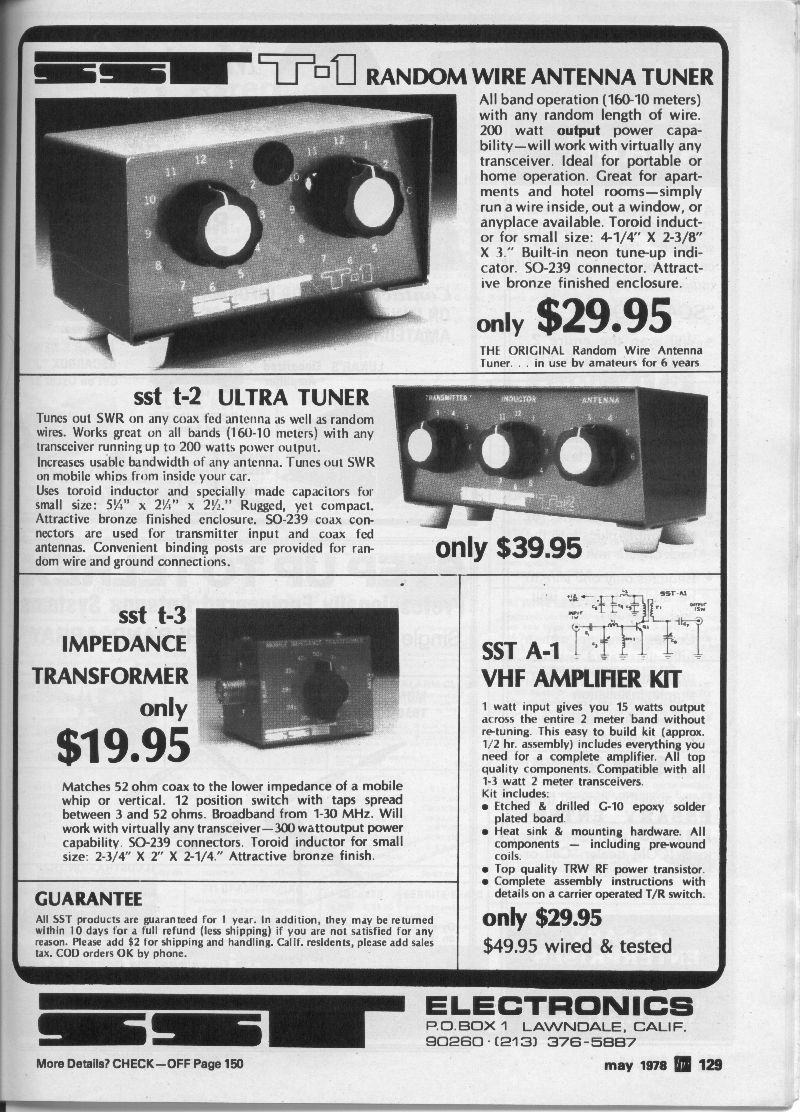
Thirty or more years ago, I bought a random-wire tuner from a company called SST Electronics. I never did get it to work right back then, but a couple of years ago, I dug it out of the desk drawer and got it to tune a random wire on 80m. (See “The W3EDP Antenna” for more information).

A couple of weeks ago I was reading an old ham radio magazine, and lo and behold, I found an ad for the company. Not only that, they were advertising an SST T-2 Ultra Tuner, in addition to the T-1 (see below).

Now, I’d like to purchase a T-2 to complete my collection. Anyone got one?

Filed Under: Antennas Tagged With: antennas

  • « Go to Previous Page
  • Page 1
  • Page 2
  • Page 3
  • Go to Next Page »

Primary Sidebar

No Nonsense Technician Class License Study Guide (for tests given between July 2026 and June 2030)

New No Nonsense Technican Class Study Guide now available!

The 2026 version of my Tech Class study guide is now available, and as always, the PDF version is FREE!. The ePub version costs $11.97, and a Kindle version and paperback version will be available on Amazon shortly.

Click here to get all of my "No Nonsense" study guides.

Also available: The CW Geek's Guide to Having Fun with Morse Code

W5SWL.Com
Retevis Ailunce H1 DMR Radio
DXpander: Cobweb antennas, Laser Cutting

You’ve got mail!

Enter your email address below and get an email every time I publish a new post.

Email


I frequently teach classes to help newcomers get their licenses. The next class will take place on Saturday, February 7, 2026 on the University of Michigan campus. Click here for more information.

If you can't make the class, subscribe to the mailing list to be notified of when the next class will be held.

You can always download my free study guide, and if you have any questions about the classes, or amateur radio in general, please feel free to email me directly.

Support KB6NU.Com

Donate $7.30 and get two of these cool stickers. Measuring 4.25-in. W by 2.75-in. H, it's perfect for your car, your shack, or wherever!

Contact me

If you have a question or comment about one of my blog posts, or a question about any of the material in my study guides, or just a question about ham radio in general, you can email me at [email protected].

Blogs You Should Also Read

  • AE5X: A CW-centric blog from Kingswood, Texas
  • K0LWC Blog
  • LA3ZA Ham Radio Blog
  • Little Radios, Big Fun – WB3GCK
  • Mr. Vacuum Tube's Blog
  • Radio Artisan – K3NG
  • The K0NR Weblog
  • VE3WDM's QRP Ham Radio Blog
  • W2LJ’s Blog

Ham Radio Websites

  • Dashtoons – The Hammin' Comedy by Jeff K1NSS

Podcasts

  • ICQ Podcast
  • Linux in the Ham Schack
  • No Nonsense Amateur Radio Podcast
  • Resonant Frequency Amateur Radio Podcast

Recent Comments

  • Michael Burkhardt on One lump or two (or three)?
  • Eric on POTA notes, 7/27/26
  • Steve KB3JC on How to “ragchew” on CW
  • Dan KB6NU on Yaesu FT-710: What’s the big deal?
  • Andrei on Yaesu FT-710: What’s the big deal?

Meta

  • Log in
  • Entries feed
  • Comments feed
  • WordPress.org

Footer

Copyright © 2026 Daniel M. Romanchik, KB6NU · Log in