
• Skip to primary navigation
  • Skip to main content
  • Skip to primary sidebar
  • Skip to footer

KB6NU's Ham Radio Blog

KB6NU's Ham Radio Blog
  • HOME
  • Study Guides
  • Teach a One-Day Tech Class
  • W8SRC Repeater Guide
  • Advertise
  • Hire Me

portable

Awwww. How cute!

June 10, 2020 By Dan KB6NU 1 Comment

Yesterday, I got this press release from James Hannibal, KH2SR, the proprietor of QuirkyQRP:
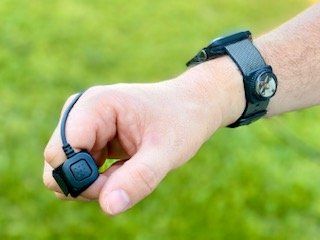
Finger Morse Straight Key

For portable CW opera-ng

Finger Morse is a fun, inexpensive, & ultra lightweight Morse code straight key that allows you to easily stay on the air making CW QSO’s with your QRP rig while you are walking.

It’s a great option for staying on the air while hiking to/from your next SOTA/POTA activation location or while on a backpacking trip.

It’s also nice to have as an inexpensive backup straight key incase you forget your main straight key/paddle, or if your main key/paddle happens to fail while you are in the backcountry.

No more being stuck sitting down while operating. Go for a walk, get some exercise and keep making CW contacts!

With the Finger Morse CW Straight Key by QuirkyQRP Ham Radios, you can finally try operating QRP pedestrian portable.

I have no idea how well this thing actually works, but it’s cute, isn’t it? I also like the company name: QuirkyQRP. :)


If you make or sell ham radio products, please be sure to send me a press release when you introduce new products. If you include a sample, I’ll even do a more in-depth review.

Filed Under: CW Tagged With: portable, POTA, SOTA

Portable antenna book is typical ARRL publication

July 20, 2016 By Dan KB6NU 4 Comments

The ARRL’s Portable Antenna Classics is a typical ARRL antenna book. That is to say, it’s a collection of QST articles, the oldest dating back to the September 1980 (“The Shooter – A 3-Band Portable Antenna” by E.W. “Twisty” Ljonquist, W4WDK/W1CQS). Fortunately, antenna physics hasn’t changed in the last 35 years, so this article is as relevant today as it was in 1980.

Overall, this book reprints 25 HF antenna articles, six VHF and UHF antenna articles, and seven articles on masts and supports. A lot of these articles I remember reading when they were first published, such as “The NJQRP Squirt” by Joe Everhart, N2CX. I was interested in this antenna because it’s only 68-ft. long, but can be tuned on 80m. I never did get around to building this antenna, and now have a homebrew version of the 80m “Cobra” antenna hanging in my backyard.

Another example is “The Miracle Whip: A Multiband QRP Antenna” by Robert Victor, VA2ERY (July 2001). This antenna was actually commercially available for a while, and the URL for the company’s website—www.miracleantenna.com—appears in the article. Unfortunately, the company seems to be out of business. Going to that URL brings up a site that reviews sewing machines.

Some of the antennas are what you might call “novelty” antennas. These include the articles “Build an HF Walking Stick Antenna” by Robert Capon, WA3ULH (December 1994) and “A Paint Pole Antenna” by Anthony J. Salvate, N1TKS (August 1995). While you might get these antennas to work, I’m not sure how useful they’d be for serious portable operations.

In general, though, the articles in the book are pretty good, and even if you don’t make the antennas exactly as described, they will certainly give you some ideas for your own design. For example, “A Simple HF-Portable Antenna” by Phil Salas, AD5X shows how to build a simple, lightweight dipole that can be configured for use on multiple bands. Another article that I liked was “A Portable 2-Element Triband Yagi” by Markus Hansen, VE7CA (November 2001).

Another idea that this book gave me was to publish my own book on portable antennas. One of the shortcomings of this book, imho, is that it doesn’t mention any commercial products at all. Nor does it discuss antennas that can be used with the internal antenna tuners now commonly found in QRP rigs. So, look for KB6NU Goes Portable or KB6NU on Portable Antennas sometime in the future.

Filed Under: Antennas, Books and Magazines, Review Tagged With: portable

Operating from “Up North”

August 14, 2009 By Dan KB6NU 1 Comment

When people in southern Michigan want to get away from it all, they go “up north,” which means the northern part of Michigan’s lower penninsula and Michigan’s upper penninsula. For at least the last ten years, my family—including my brothers and sisters (but mostly my sisters, and their kids and now grandkids)—have been renting a set of cottages on Elk Lake.

For the last three years, I’ve been taking my Elecraft KX-1 and operating from up there. I have a really idyllic operating location. I operate from the screened-in porch of one of the cottages. From my operating position, I have a great view of the lake.

This year was the best in terms of amateur radio, anyway. The first year, I used the 28-ft. random wire vertical antenna described in the Elecraft manual. It loaded up just fine, but I had trouble making contacts with it.

Last year, I used the portable dipole I made with 30-ga. wire and twisted pair feedline. This antenna definitely works better than the 28-ft. vertical, but I still had trouble making solid contacts.

This year, I used the same antenna, and had much better success. For example, where last year, my contacts were mostly short ones with mediocre signal reports, this year’s contacts were much longer with generally good to very good signal reports. For example, the very first contact I made was with W3ANX. He gave me a 579 signal report, and we talked for 40 minutes. One of my other contacts lasted for 30 minutes.

I attribute this mostly to band conditions. When band conditions are poor, low-power signals tend to drift in and out of the noise, making copy rough. When band conditions are good, low-power signals stay above the noise and are easier to copy. When your signal is easier to copy, station you’re in contact with stay with you longer, and longer contacts, in my opinion, are more enjoyable, than short ones.

Another thing I noticed is that I heard stations that I never hear from home. Part of it is the difference in location, but it’s probably also due to the difference in antenna pattern. What I take away from this is that it’s probably a good idea to have more than one antenna per band, if you can swing it. Having two or more antennas with different antenna patters will allow you to talk to more people than if have just one antenna.

I also learned that my iPod earbuds have more output than the earbuds I had been using. While lately I’ve been using an amplified speaker on the output of my KX-1, when I pulled it out of my toolbox, I found that I’d forgotten to turn it off last time and the battery was dead. Not having a ready source of 9-V batteries, I plugged in the earbuds. Then, just for kicks, I decided to try my iPod earbuds. They were noticeably louder, so I used them exclusively.

All in all, it was a great vacation. The scenery was beautiful, weather was mostly nice, the food was great (we take turns preparing dinner), and the company fantastic. Add in the good band conditions, and you have an almost ideal vacation.

Filed Under: Mobile/Portable, QRP Tagged With: portable, QRP

Primary Sidebar

No Nonsense Technician Class License Study Guide (for tests given between July 2026 and June 2030)

New No Nonsense Technican Class Study Guide now available!

The 2026 version of my Tech Class study guide is now available, and as always, the PDF version is FREE!. The ePub version costs $11.97, and a Kindle version and paperback version will be available on Amazon shortly.

Click here to get all of my "No Nonsense" study guides.

Also available: The CW Geek's Guide to Having Fun with Morse Code

W5SWL.Com
Retevis Ailunce H1 DMR Radio
DXpander: Cobweb antennas, Laser Cutting

You’ve got mail!

Enter your email address below and get an email every time I publish a new post.

Email


I frequently teach classes to help newcomers get their licenses. The next class will take place on Saturday, October 10, 2026 on the University of Michigan campus. Click here for more information.

If you can't make the class, subscribe to the mailing list to be notified of when the next class will be held.

You can always download my free study guide, and if you have any questions about the classes, or amateur radio in general, please feel free to email me directly.

Support KB6NU.Com

Donate $7.30 and get two of these cool stickers. Measuring 4.25-in. W by 2.75-in. H, it's perfect for your car, your shack, or wherever!

Contact me

If you have a question or comment about one of my blog posts, or a question about any of the material in my study guides, or just a question about ham radio in general, you can email me at [email protected].

Blogs You Should Also Read

  • AE5X: A CW-centric blog from Kingswood, Texas
  • K0LWC Blog
  • LA3ZA Ham Radio Blog
  • Little Radios, Big Fun – WB3GCK
  • Mr. Vacuum Tube's Blog
  • Radio Artisan – K3NG
  • The K0NR Weblog
  • VE3WDM's QRP Ham Radio Blog
  • W2LJ’s Blog

Ham Radio Websites

  • Dashtoons – The Hammin' Comedy by Jeff K1NSS

Podcasts

  • ICQ Podcast
  • Linux in the Ham Schack
  • No Nonsense Amateur Radio Podcast
  • Resonant Frequency Amateur Radio Podcast

Recent Comments

  • Dan KB6NU on The EMF Explorer: A badge for ham radio?
  • Travis Good on The EMF Explorer: A badge for ham radio?
  • MARTIN ROBERT ROTHFIELD on The EMF Explorer: A badge for ham radio?
  • Mike Chen on Operating Notes, January 5, 2026
  • Rob W4ZNG on The EMF Explorer: A badge for ham radio?

Meta

  • Log in
  • Entries feed
  • Comments feed
  • WordPress.org

Footer

Copyright © 2026 Daniel M. Romanchik, KB6NU · Log in