
• Skip to primary navigation
  • Skip to main content
  • Skip to primary sidebar
  • Skip to footer

KB6NU's Ham Radio Blog

KB6NU's Ham Radio Blog
  • HOME
  • Study Guides
  • Teach a One-Day Tech Class
  • W8SRC Repeater Guide
  • Advertise
  • Hire Me

Ever wonder why transistors have “2N” part numbers?

November 20, 2014 By Dan KB6NU 1 Comment

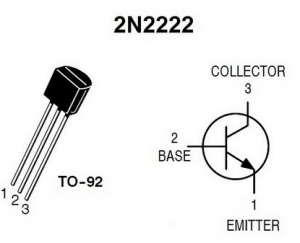
Millions of the venerable 2N2222 are still manufactured every year.

This from Wikipedia:

The JEDEC Solid State Technology Association, formerly known as the Joint Electron Device Engineering Council (JEDEC), is an independent semiconductor engineering trade organization and standardization body.

The early work began as a part numbering system for devices which became popular in the 1960s. The first semiconductor devices, such as the 1N23 silicon point contact diode, were still designated in the old RMA tube designation system, where the “1” stood for “No filament/heater” and the “N” stood for “crystal rectifier”. The first RMA digit thus was re-allocated from “heater power” to “p-n junction count” to form the new EIA/JEDEC EIA-370 standard; for example, the 1N4001 rectifier diode and 2N2222 transistor part numbers came from EIA-370. They are still popular today. In February, 1982, JEDEC issued JESD370B, superseding the original EIA-370 and introducing a new letter symbol “C” that denotes the die version, as opposed to “N”, now meaning the packaged version. The Japanese JIS semiconductor designation system employs a similar pattern. JEDEC later developed a numbering system for integrated circuits, but this did not gain acceptance in the semiconductor industry. The European Pro Electron semiconductor numbering system originated in a similar way from the older Mullard–Philips tube designation.

Earlier in the 20th century, the organization was known as JETEC, the Joint Electron Tube Engineering Council, and was responsible for assigning and coordinating RETMA tube designations to electron tubes (also called valves). The type 6L6, still to be found in electric-guitar amplifiers, typically has a type number that was assigned by JETEC.

JEDEC also developed a number of popular package drawings for semiconductors such as TO-3, TO-5, etc. These are on the web under JEP-95.

Thanks for Karl, W4KRL, via the AMRAD Tacos mailing list for this factoid.

Related posts:

  1. Extra Class question of the day: Semiconductor diodes
  2. 2020 Extra Class study guide: E6A – Semiconductor materials and devices: semiconductor materials; germanium, silicon, P-type, N-type; transistor types: NPN, PNP, junction, field-effect transistors: enhancement mode; depletion mode; MOS; CMOS; N-channel; P-channel
  3. 2015 General Class study guide: G6A: resistors; capacitors; inductors; rectifiers; solid state diodes and transistors; vacuum tubes; batteries
  4. Cleaning out my inbox: Grounding, soldering, transistors

Filed Under: Building/Homebrew, Electronic Components Tagged With: transistor

Reader Interactions

Comments

  1. Art Harrison says

    February 4, 2026 at 12:45 am

    I thought that the number “0,” and not “1,” in the RMA tube designation system was the designator for “no filament/heater,” such as in the “0A2,” voltage regulator.

    Reply

Leave a Reply Cancel reply

Your email address will not be published. Required fields are marked *

This site uses Akismet to reduce spam. Learn how your comment data is processed.

Primary Sidebar

No Nonsense Technician Class License Study Guide (for tests given between July 2026 and June 2030)

New No Nonsense Technican Class Study Guide now available!

The 2026 version of my Tech Class study guide is now available, and as always, the PDF version is FREE!. The ePub version costs $11.97, and a Kindle version and paperback version will be available on Amazon shortly.

Click here to get all of my "No Nonsense" study guides.

Also available: The CW Geek's Guide to Having Fun with Morse Code

W5SWL.Com
Retevis Ailunce H1 DMR Radio
DXpander: Cobweb antennas, Laser Cutting

You’ve got mail!

Enter your email address below and get an email every time I publish a new post.

Email


I frequently teach classes to help newcomers get their licenses. The next class will take place on Saturday, October 10, 2026 on the University of Michigan campus. Click here for more information.

If you can't make the class, subscribe to the mailing list to be notified of when the next class will be held.

You can always download my free study guide, and if you have any questions about the classes, or amateur radio in general, please feel free to email me directly.

Support KB6NU.Com

Donate $7.30 and get two of these cool stickers. Measuring 4.25-in. W by 2.75-in. H, it's perfect for your car, your shack, or wherever!

Contact me

If you have a question or comment about one of my blog posts, or a question about any of the material in my study guides, or just a question about ham radio in general, you can email me at [email protected].

Blogs You Should Also Read

  • AE5X: A CW-centric blog from Kingswood, Texas
  • K0LWC Blog
  • LA3ZA Ham Radio Blog
  • Little Radios, Big Fun – WB3GCK
  • Mr. Vacuum Tube's Blog
  • Radio Artisan – K3NG
  • The K0NR Weblog
  • VE3WDM's QRP Ham Radio Blog
  • W2LJ’s Blog

Ham Radio Websites

  • Dashtoons – The Hammin' Comedy by Jeff K1NSS

Podcasts

  • ICQ Podcast
  • Linux in the Ham Schack
  • No Nonsense Amateur Radio Podcast
  • Resonant Frequency Amateur Radio Podcast

Recent Comments

  • Dan KB6NU on Some Ham-Vention History
  • David Pompea on Some Ham-Vention History
  • Walter Underwood on One lump or two (or three)?
  • Mike, KL7MJ on Question pools should make teaching classes easier
  • Karl Heinz - K5KHK on Question pools should make teaching classes easier

Meta

  • Log in
  • Entries feed
  • Comments feed
  • WordPress.org

Footer

Copyright © 2026 Daniel M. Romanchik, KB6NU · Log in