
A reader writes,
Next Saturday I am going to the Mike & Key Flea Market to buy, among other items, a paddle. What questions should I ask sellers and what should I look for when examining paddles?
This is a great question.
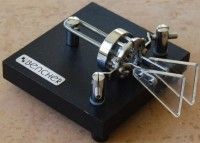
The first thing that I’d say to do is to look for Bencher BY-1s or BY-2s. That’s a Bencher BY-1 at right. The BY-2 is exactly the same paddle, but has a shiny, chrome base.
Thousands of these paddles have been sold over the years, and they’re still in production. At almost any hamfest, you’ll find one or two of them. New, the Bencher BY-1 goes for $135, so you should be able to pick one up for $60-70 at a hamfest.
If you do find one of these paddles, check to see that it’s in good mechanical condition. You want the chrome to be shiny and the contacts to be in good shape. Touch the finger pieces and make sure the action is smooth. This bit of advice really goes for any paddles that you’re thinking of purchasing.
The contacts may be dirty and need to be cleaned, but make sure that no one has taken a file to them. Key contacts are never supposed to be filed. I learned this the hard way, when I bought a bug at Dayton one year. I thought I’d gotten a deal at $50, but I spent more than that replacing the contacts, which someone had taken a file to.
Stay away from brands that you haven’t heard of. If you haven’t heard of them, they may not be in business anymore, and if your paddle ends up needing a replacement part, you may not be able to get one. I wouldn’t, for example, buy any key made by a company called HamKey. They went out of business a long time ago. Not only that, the keys they made weren’t really all that good anyway.
Look for modifications. About a year ago, I purchased a Vibroplex paddle at a hamfest. I could tell that the thing had been modified, but I bought it anyway. One of its previous owners had actually replaced the base with a heavier, round chunk of steel. What I didn’t notice is that the guy hadn’t done a great job of doing this until I got it home.
For example, he lost a small part called a trunion screw. The guy had ingeniously made a replacement from a regular screw, but it really looked kludgey. Fortunately, I was able to get a replacement from Vibroplex (you can still get replacement parts for just about any key that Vibroplex has made in their entire 100+ year history). The key works fine now, and it’s a real conversation piece, but given a choice to do it over again, I think I’d pass.
Don’t spend too much for that first paddle. Some paddles cost $500 or more new, meaning that they’ll cost quite a bit used, too. I don’t see the need for spending that much when a used BY-1 should cost you less than a hundred bucks, and new they are only $135. As you get better, you may want to upgrade to a fancier paddle, but there’s no need to spend that much money when you’re just starting out.
Another consideration is whether you want a single-lever or dual lever paddle. If you’re not sure what these are, read my blog post on choosing a key.
Finally, don’t get upset if what you choose doesn’t really suit you. You can always sell it and buy a different one.
Great article on buying a used paddle. I still have an old J-38 key for my CW work, but find the old wrist gets a bit tired after hitting 20 words per minute for an hour or so. A paddle surely would help me out. I’ve been looking at some products from Bencher. They seem to be well made and sturdy. Aloha from Hawaii Island….Russ (KH6JRM).
If you’re doing 20 wpm on a straight key, I applaud you. I could never get that fast.
As you note, though, working a straight key is just too tiring. That’s why I always advise that beginners start learning to send with a paddle. It’s less tiring, mean that they’ll stick with it longer, and since practice is so important, they’ll get the practice they need.
I have to agree: a straight key is too tiring, particularly if you’re trying to send more than 15 WPM.
I think SKCC is a terrific organization, and a real boon to those trying to improve their CW. I just wish they would drop the straight-key-or-bug requirement.
Consider FISTS. I have to say they are much better under new management, and they don’t care if you use an electronic keyer.
Not only that, I am now the editor of the FISTS newsletter, the KeyNote!
Thanks for the suggestion. I’ll check it out!
What is the difference between BY-2 and MFJ 654?
The MFJ is a knockoff, and is made with cheaper materials than the Bencher. I’d pass on the MFJ personally.
I do not care for bencher paddles. The BY-1 and 2 suffer from broken or stretched spring action. The lexan clear finger pieces are riveted not screwed on and can loosen up over time. Finally the paddle does not travel well. It can easily get bent up and damaged.
Also some history’s: The model number – It was made back when BY (China) was super rare dx with the only active ham station on air being BY1PK. That was a different time. Mid-late 1970’s.
A better choice for similar money is the vibroplex standard iambic. It remains my lower cost choice. Vibroplex invented the iambic paddle and the standard iambic remains a top lower cost choice for around $159 new and less than $100 used. Its base is heavier than the bencher so it doesn’t slide around. The spring action is less likely to stretch and the paddles are built like tanks. The contacts can be changed out ( comes with silver contacts, I like gold contacts).
Finally for For higher end paddles nothing I’ve tried beats a Begali brand paddle. The sculpture is my favorite.
My BY-1 key has the finger pieces attached with tiny phillips round-head screws. No mods that I know of.