• Skip to primary navigation
  • Skip to main content
  • Skip to primary sidebar
  • Skip to footer

KB6NU's Ham Radio Blog

KB6NU's Ham Radio Blog
  • HOME
  • Study Guides
  • Teach a One-Day Tech Class
  • W8SRC Repeater Guide
  • Advertise
  • Hire Me

Electronics Theory

Why Capacitor Polarity is Important

November 6, 2009 By Dan KB6NU 4 Comments

Dave Jones’ latest EEVBlog episode is a graphical demonstration of why it’s important to get the polarity of electrolytics and tantalum capacitors right:


EEVBlog also has some interesting episodes on test equipment, microcontrollers, and product design. Check it out.

Filed Under: Electronics Theory Tagged With: electronics

Learn Digital Logic on the Web

October 20, 2009 By Dan KB6NU Leave a Comment

One topic that a lot of people have some trouble with when taking the Extra Class exam is digital logic. I think one of the reasons for this is that while it is electronics, the logic element is different from the other types of technology we deal with in ham radio.

To help students learn the concepts of digital logic, the Department of Informatics at the University of Hamburg has developed the Hamburg Design System, or HADES for short. HADES is an object-oriented, all-Java, Beans- and Web-based, visual design and simulation environment.

With this system, you can play with digital logic without actually building any circuits or connecting up any test equipment. There are canned demonstrations, such as this digital clock, or you can build your own circuits with HADES’ graphical editor, library of component models, and the discrete-event-based simulation engines.

Filed Under: Electronics Theory, Online Resources Tagged With: Electronics Theory, websites

RF/IF Circuits: Mixers

September 5, 2009 By Dan KB6NU Leave a Comment

RF DesignLine has started serializing Chapter 9 of the book RF Front-End: World Class Designs, edited by Janine Sullivan Love. The first installment (a PDF file) discusses mixer circuits. It’s got a bit of math in it, but if you can get with that, you’ll understand mixers a lot better.

Filed Under: Electronics Theory Tagged With: Electronics Theory

Back to the Future?

August 20, 2009 By Dan KB6NU Leave a Comment

Back in the old days, the really good radios used mechanical filters. Now, according to this item, we could see a whole new type of mechanical filter, this time built with a microelectromechanical (MEMS) device.

Tiny ‘MEMS’ Devices to Filter, Amplify Electronic Signals
Purdue University News (08/10/09) Venere, Emil

Purdue University researchers are developing a new class of microelectromechanical (MEMS) devices called resonators that contain vibrating, hair-thin structures and could be used to filter electronic signals. Resonators vibrate in specific patterns, so they can cancel out signals that contain certain frequencies while allowing others to pass, making these devices useful for applications such as refining cell phone signals. The devices have led to a new type of band-pass filter, which is used in electronics to allow some signals to pass while blocking others, says Purdue professor Jeffrey Rhoads. This new class of resonators represents a potential way to further the miniaturization of band-pass filters while improving their performance and power efficiency. Incoming signals generate voltage that creates an electrostatic force, causing the MEMS filters to vibrate. In addition to their potential use as cell phone filters, resonators also could be used for advanced chemical and biological sensors for medical and homeland security applications, and possibly as a new type of mechanical memory element that uses vibration patterns to store data. “The potential computer-memory application is the most long term and challenging,” Rhoads says. He says the band-pass filter design promises to create better performance than previous MEMS technology because it more strictly defines which frequencies can pass and which are blocked.

View Full Article

Filed Under: Electronics Theory Tagged With: electronics

Free EM Simulator Available As Download

June 4, 2009 By Dan KB6NU Leave a Comment

From Microwaves&RF:

By Jack Browne

Sonnet Lite Release 12 from Sonnet Software is now available for free download. The no-charge three-dimensional (3D) planar electromagnetic (EM) simulator is an excellent training and learning tool for those new to the analysis capabilities of EM simulation software. It is a fully functional software program based on the company’s full-featured Sonnet Professional Suite of EM analysis and simulation software tools. Sonnet Lite can be used as a stand-alone program or within the Advanced Design System (ADS) environment from Agilent Technologies or the Microwave Office environment from Applied Wave Research (AWR).

According to Shawn Carpenter, Vice President of Worldwide Marketing and Sales for Sonnet, “We’re proud to provide a leading-edge ‘virtual prototyping’ tool for the student and experimenter in high-frequency planar circuits, packages, and antennas. Sonnet maintains our commitment to students and learners through free access to top-notch high-frequency electromagnetic software.” The planar EM software is ideal for performing transmission-line or discontinuity analysis and is available for free download from the Sonnet Software web site.

Unfortunately, it won’t run on my Mac.

Filed Under: Electronics Theory, Software Tagged With: Software

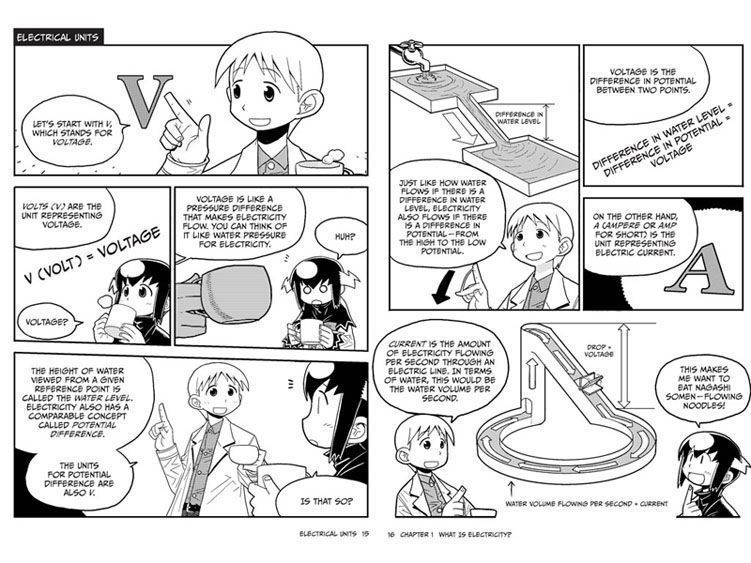
Electricity for the Manga Generation

March 19, 2009 By Dan KB6NU 7 Comments

I just received this press release today, so I haven’t actually seen the book yet, but it looks like it would be fun……Dan

The Manga Guide to Electricity
Learn About Electricity in a Shockingly Fun WaySan Francisco, CA, March 19, 2009—Rereko is just your average high-school girl from Electopia, the land of electricity. Except she’s completely failed her electricity exam! Now she has to go to summer school on Earth—and this time, she has to pass. Luckily, her ever-patient tutor Hikaru is there to help. So begins the The Manga Guide to Electricity (March 2009, 224 pp, ISBN 9781593271978), the charming third volume in a series of technical EduManga titles from San Francisco-based geek book publisher No Starch Press.

The Manga Guide to Electricity combines an entertaining plot with authentic manga comics and lessons that offer readers a unique introduction to the world of electricity. Readers learn alongside Rereko as her tutor explains the basics of electricity by examining everyday devices like flashlights, heaters, and circuit breakers.

“I’m really excited about this latest Manga Guide,” said No Starch Press Founder Bill Pollock. “I can’t even count the number of people who have no clue about how electricity works or what diodes, resistors, and capacitors do. This is a great and painless way to sort through the mumbo jumbo.”

The real-world examples in The Manga Guide to Electricity teach readers:

  • What electricity is, how it works, how it’s created, and how it can be used
  • The relationship between voltage, current, and resistance (Ohm’s law)
  • Key electrical concepts like inductance and capacitance
  • How complicated components like transformers, semiconductors, and transistors work
  • How electricity produces heat and the relationship between current and magnetic fields

As they progress through the book, readers will explore more abstract concepts of electricity like electrostatic force, Ampere’s law, and the Seebeck effect. Co-published with scientific and technical publisher Ohmsha, Ltd. of Tokyo, Japan, The Manga Guide to Electricity will make learning about electricity a shockingly good time for readers of all ages.

About the Author
Kazuhiro Fujitaki is a lecturer at the Tokyo Metropolitan Vocational Skills Development Center. He has written a number of books on electrical engineering and runs a website offering useful information about Japan’s qualifying examinations for electrical technicians.

electricity_sample2

Filed Under: Books and Magazines, Electronics Theory, Kids

NIST Time and Frequency Metrology Seminar to be held June 2-5

March 10, 2009 By Dan KB6NU Leave a Comment

Call me a “time geek,” but I think this would be very interesting to attend……Dan

The National Institute of Standards and Technology (NIST) will host the 34th annual Time and Frequency Metrology Seminar on June 2-5, 2009, in Boulder, Colo.

The four-day seminar provides the most comprehensive course in understanding the characteristics of clocks and oscillators, making precise time and frequency measurements and synchronizing and applying precision time in an array of systems. The seminar is designed for all who are responsible for measurements, analysis, documentation, publications, proposals, calibrations and/or certifications of timing systems. Registrants of all levels of experience are welcome, including scientists, engineers, laboratory technicians, educators, managers, mathematicians and computer programmers.

Notable speakers will include: John (Jan) Hall, who shared the 2005 Nobel Prize in Physics for “contributions to the development of laser-based precision spectroscopy, including the optical frequency comb technique”; David Allan, who has authored more than 100 papers in the field of precise time and frequency, and who led development of the Allan Variance, the recommended statistic for comparing and evaluating clocks and oscillators; and John Vig, current president of IEEE, who holds 55 patents related to quartz crystal resonators and oscillators for high-stability frequency sources, clocks and sensors.

The seminar includes laboratory demonstrations at NIST. For registration information and the full agenda, visit http://tf.nist.gov/timefreq/seminars/T&Foverview.html.

Filed Under: Electronics Theory, Test Equipment

  • « Go to Previous Page
  • Page 1
  • Interim pages omitted …
  • Page 11
  • Page 12
  • Page 13

Primary Sidebar

No Nonsense Technician Class License Study Guide (for tests given between July 2026 and June 2030)

New No Nonsense Technican Class Study Guide now available!

The 2026 version of my Tech Class study guide is now available, and as always, the PDF version is FREE!. The ePub version costs $11.97, and a Kindle version and paperback version will be available on Amazon shortly.

Click here to get all of my "No Nonsense" study guides.

Also available: The CW Geek's Guide to Having Fun with Morse Code

W5SWL.Com
Retevis Ailunce H1 DMR Radio
DXpander: Cobweb antennas, Laser Cutting

You’ve got mail!

Enter your email address below and get an email every time I publish a new post.

Email


I frequently teach classes to help newcomers get their licenses. The next class will take place on Saturday, February 7, 2026 on the University of Michigan campus. Click here for more information.

If you can't make the class, subscribe to the mailing list to be notified of when the next class will be held.

You can always download my free study guide, and if you have any questions about the classes, or amateur radio in general, please feel free to email me directly.

Support KB6NU.Com

Donate $7.30 and get two of these cool stickers. Measuring 4.25-in. W by 2.75-in. H, it's perfect for your car, your shack, or wherever!

Contact me

If you have a question or comment about one of my blog posts, or a question about any of the material in my study guides, or just a question about ham radio in general, you can email me at [email protected].

Blogs You Should Also Read

  • AE5X: A CW-centric blog from Kingswood, Texas
  • K0LWC Blog
  • LA3ZA Ham Radio Blog
  • Little Radios, Big Fun – WB3GCK
  • Mr. Vacuum Tube's Blog
  • Radio Artisan – K3NG
  • The K0NR Weblog
  • VE3WDM's QRP Ham Radio Blog
  • W2LJ’s Blog

Ham Radio Websites

  • Dashtoons – The Hammin' Comedy by Jeff K1NSS

Podcasts

  • ICQ Podcast
  • Linux in the Ham Schack
  • No Nonsense Amateur Radio Podcast
  • Resonant Frequency Amateur Radio Podcast

Recent Comments

  • Michael Burkhardt on One lump or two (or three)?
  • Eric on POTA notes, 7/27/26
  • Steve KB3JC on How to “ragchew” on CW
  • Dan KB6NU on Yaesu FT-710: What’s the big deal?
  • Andrei on Yaesu FT-710: What’s the big deal?

Meta

  • Log in
  • Entries feed
  • Comments feed
  • WordPress.org

Footer

Copyright © 2026 Daniel M. Romanchik, KB6NU · Log in