• Skip to primary navigation
  • Skip to main content
  • Skip to primary sidebar
  • Skip to footer

KB6NU's Ham Radio Blog

KB6NU's Ham Radio Blog
  • HOME
  • Study Guides
  • Teach a One-Day Tech Class
  • W8SRC Repeater Guide
  • Advertise
  • Hire Me

Electronics Theory

Ham Radio on Google +

October 3, 2011 By Dan KB6NU Leave a Comment

Google+ has really caught on with hams. There are quite a few of us on this new social network, and I currently have 330 in my ham radio “circle.”  Here are a few links that those hams have shared:

The KC5FM Daily. Paper.li is a website that lets you turn Twitter, Facebook and RSS feeds into online newspapers in just a few clicks. Here’s KC5FM’s paper.

‘UHF’ Connector Test Results. This blog post by John Huggins (I couldn’t find his callsign anywhere on the website) shows the results of his UHF connector tests. He also compares their characteristics to other types of RF connectors. Huggins says,

The stunning result is all the UHF connectors in the test have worse performance than all the other connectors. One immediate conclusion concerning ‘UHF’ connectors is they will function at these higher frequencies, but one must decide if using the PL259 or SO239 is worth it in an age where its deficiencies have been made moot by ALL connector designs since WWII.

Prywatna Wytwórnia Lamp, where DIY meets vacuum electron devices. This blog post describes another guy–this one in Poland–who makes his own vacuum tubes.

Google+ is a lot better site for ham-radio social networking than Facebook.  Give it a try and join us.
 

Filed Under: Electronics Theory, Emergency Communications / Public Service, On the Internet

Webinar to Cover Basics of Digital Signals

September 2, 2011 By Dan KB6NU Leave a Comment

Normally, these are for subscribers to EETimes, which is targeted at electronics engineers, but I’m sure they wouldn’t mind if a few hams snuck in……..Dan

Webinar:
Fundamentals of the RF Transmission and Reception of Digital Signals

Date:
Wednesday, September 14, 2011; 1600Z

Duration:
60 min

Overview:
Digital Modulation is an important topic forRF designers because most modern day transceivers transmit and receive digitally modulated data. In this webcast, part of ADI’s continuing FUNDAMENTALS OF DESIGN series we will introduce you to the challenges—and solutions—for digital modulation. This webcast is a great way for beginners to get introduced to this vital communications standard or for veteran RF designers learn what’s new in the field. Some of the topics to be discussed will include:

What is the physical transition that happens to digital modulation when it is transmitted into the air?

What RF components are used for transmitting and receiving digital modulation? What are the key parameters in RF parts used in modern day transceivers and why are they important?

What type of digital modulation is there and how does the type of modulation affect the RF components key parameters?

Who should attend?
Students and engineers new to the field of RF Communications, as well as those more experienced engineers looking for a refresher on this topic.

Presenter:
Larry Hawkins, Business Development Manager, RF Group, ADI

Larry Hawkins works at ADI in the RF Group as a Business Development Manager. He has previously worked as an Applications Engineer and in RF Communications Design. Larry has a B.S. in Electrical Engineering, specializing in RF from the University of Utah. He has authored and presented many technical papers and seminars.


Filed Under: Electronics Theory

SimSmith Updated

August 24, 2011 By Dan KB6NU 2 Comments

Ward, AE6TY, writes:

SimSmith is Smith Chart software that was introduced and described in an article in QRP Quarterly earlier in the year.  I recently made some substantial improvements to SimSmith.  These are:

  1. Added a library function to allow you to save and restore tuned circuit elements.
  2. Added some new components including a transformer.
  3. Added a ‘print’ function
  4. Improved the ‘save’ and ‘load’ commands.

If you are interested in getting the newest update or in learning about Smith Charts in general, please visit my page http://www.ae6ty.com/Smith_Charts.html

The newest version in 4.2.  It is written in Java so you need only download “SimSmith-4.2.jar”. There is no installation necessary, only a working Java Runtime Environment.  This code has been tested on Macs, Windows, and Linux.

I haven’t tried it yet, but it sounds pretty cool to me.

Filed Under: Electronics Theory

From the Mailbag

June 2, 2011 By Dan KB6NU 4 Comments

Here are some items of interest that have been discussed on the many ham radio mailing lists I’m on.

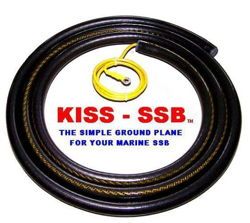
  • KISS-SSBKISS-SSB. The KISS-SSB is a counterpoise designed to be used with a marine SSB transceiver. It’s a nice compact design that claims to operate from 2-30 MHz, when used with an automatic antenna tuner. Basically, it’s a ten-ft. long tube stuffed with bunch of radials. At $145, this seems a bit expensive, but this device, or a homebrew version of it, might be just the ticket for someone operating stealthily.
  • Field Day PR. The June issue of Contact! is loaded with new ideas, links and materials you can use for Field Day.
  • SWR Video. This awesome video from the AT&T archives looks like it was produced in 1959, and explains wave behavior using a mechanical machine. As the presenter, Dr. J. N. Shive, points out, though, electrical waves behave just like mechanical waves. Shive is really having fun presenting this topic. So much so, that it makes me wish I’d had him for my physics professor back at the University of Detroit!
  • Elecraft K3. Wayne Burdick, N6KR, of Elecraft shows the new Elecraft KX3 at the QRP ARCI ‘Four Days In May’at Dayton this year.

I was also going to post a couple of links to YouTube videos showing the sewer line explosion at Hara Arena during the recent Dayton Hamvention, but there’s a little too much profanity in them. If you really want to see them, go to YouTube, search for “2011 Dayton Hamvention,” and you’ll find them. It’s really amazing, and yet another reason that the Dayton Amateur Radio Association should move the Hamvention from Hara. It’s just a terrible facility, and it’s undoubtedly dissuaded many from ever returning to the Hamvention.

Filed Under: Electronics Theory, Gear/Gadgets, Promotion & PR

So, When Can I Get a 100 W HT?

April 6, 2011 By Dan KB6NU 6 Comments

From the 4/1/11 issue of ACM Tech News:

The Incredible Shrinking Circuit
University of Cambridge (03/28/11)

University of Cambridge researchers have developed a technique for producing smaller microchips that can also support extremely high electrical current densities. Led by Cambridge professor John Robertson, the researchers used carbon nanotubes to replace the vertical copper connectors in integrated circuits to build smaller circuits and to reduce the size of electronics even further. They took advantage of the special arrangement of carbon atoms. Normally the atoms are arranged hexagonally and layered in sheets, but in nanotubes the sheets are rolled up to form tiny tubes with diameters equivalent to just a few carbon atoms. To make the approach feasible, the nanotubes would need to be grown in very dense bundles directly onto the substrate. Robertson and colleagues used multiple deposition and the annealing steps to grow nanotube bundles, and the method led to successive increases in nanoparticle density. The researchers say the density of the bundles is five times greater than current technology.

View Full Article

Filed Under: Electronic Components, Electronics Theory

Are Cell Phones Bad for the Brain?

February 24, 2011 By Dan KB6NU 4 Comments

On the IEEE tech talk blog, editor Tekla Perry reports on a new study that shows that holding a cell phone to the ear increases the metabolic activity of nearby brain tissue. She writes:

What this means for long term health is unclear, but it certainly supports the calls of those who want more research, and those who are practicing prudent avoidance by trying to select cell phones with the lowest radiation and limiting their talk time.

I’m not sure how relevant this study is to HT use, but my guess is that the transmit duty cycle is a lot lower for an HT user than a cell phone user. Interesting stuff, nonetheless.

Filed Under: Electronics Theory, Microwaves

Links for the New General Class Study Guide

February 22, 2011 By Dan KB6NU Leave a Comment

For the next version of No-Nonsense, General Class License Study Guide I am going to include links to Web pages that readers can refer to if they really want more information on a topic. I’ve just added some links to the following sections:

  • G5A – Reactance; inductance; capacitance; impedance; impedance matching
    • The Electronics Club on and Impedance and Reactance
    • Impedance Matching: A Primer
  • G5B – The Decibel; current and voltage dividers; electrical power calculations; sine wave root-mean-square (RMS) values; PEP calculations
    • Measurements of AC magnitude?
    • What is RF Peak Envelope Power?
    • Decibel
  • G5C – Resistors, capacitors, and inductors in series and parallel; transformers
    • Passive Electronic Components
    • Transformers – The Basics

If you have other suggestions, I’d love to hear about them. Please send me the URLs and why you happen to like that particular website. Thanks!

Filed Under: Classes/Testing/Licensing, Electronic Components, Electronics Theory

Researchers Develop True Duplex Communications on a Single Channel

February 18, 2011 By Dan KB6NU Leave a Comment

Stanford researchers claim to have invented a new technology that allows wireless signals to be sent and received simultaneously on a single channel. According to an article in the Stanford University News, their research could help build faster, more efficient communication networks, at least doubling the speed of existing networks.

You can also read a more technical explanation in a paper the researchers wrote for some conference.

Filed Under: Electronics Theory

High Frequency Electronics: January 2011

January 21, 2011 By Dan KB6NU 4 Comments

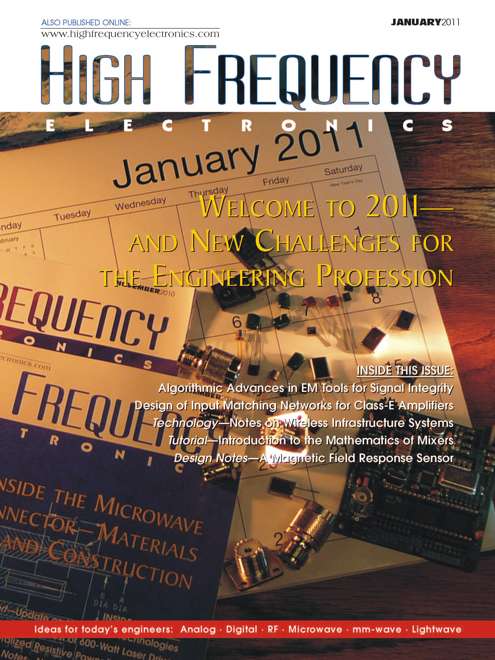
High Frequency Electronics - January 2011There are two articles in the January 2011 issue of High Frequency Electronics that amateur radio operators might find interesting:

  1. The Mathematics of Mixers: Basic Principles. This tutorial walks you through the basics of mixers. Because this article is aimed at engineers, there is math involved, but it’s not overly complicated, and if you stick with it, you’ll gain a better understanding of how the mixer, one of the most basic circuits in amateur radio, works.
  2. Design of Input Matching Networks for Class-E RF Power Amplifiers. The author of this article says, “Little attention is brought to the design of the input matching network and to the device bias conditions, with their effects on the overall circuit performance. This paper attempts to discuss these topics through a systematic design and simulation approach for a typical 5 watt class-E power amplifier operating at 150 MHz.”

Note that the magazine is only available as a single PDF file. To read these articles, you’ll have to download the PDF file first.

Filed Under: Building/Homebrew, Electronics Theory, VHF/FM/Repeaters Tagged With: Electronics Theory, VHF/UHF

Bell Labs Journal Now Online

October 29, 2010 By Dan KB6NU 1 Comment

“Innovation” is a word often thrown around these days. Back in the old days, you couldn’t find an organization more innovative than Bell Labs. They could certainly afford it, though. They had a monopoly on the telephone system!

At any rate, all of the issues of the Bell Labs Journal from 1922 to 1983 are now online. Within the pages of these journals you’ll find papers on:

  • the invention of the transistor in 1947 and subsequent advances in related solid-state device and circuit technology.
  • Shannon’s paper, “A Mathematical Theory of Communication,” that was published over 60 years ago and gave birth to Information Theory.
  • the charge-coupled device (CCD), a technology that transforms patterns of light into useful digital information, is the basis for many forms of modern digital imaging.
  • cellular telephone service, the concept that multiple lower-power transmitters could be spread throughout a region employing automatic call handoff and frequency reuse that changed the face of communications.

Overall, it’s pretty cool stuff.

Filed Under: Electronics Theory, History Tagged With: Electronics Theory, History

  • « Go to Previous Page
  • Page 1
  • Interim pages omitted …
  • Page 9
  • Page 10
  • Page 11
  • Page 12
  • Page 13
  • Go to Next Page »

Primary Sidebar

No Nonsense Technician Class License Study Guide (for tests given between July 2026 and June 2030)

New No Nonsense Technican Class Study Guide now available!

The 2026 version of my Tech Class study guide is now available, and as always, the PDF version is FREE!. The ePub version costs $11.97, and a Kindle version and paperback version will be available on Amazon shortly.

Click here to get all of my "No Nonsense" study guides.

Also available: The CW Geek's Guide to Having Fun with Morse Code

W5SWL.Com
Retevis Ailunce H1 DMR Radio
DXpander: Cobweb antennas, Laser Cutting

You’ve got mail!

Enter your email address below and get an email every time I publish a new post.

Email


I frequently teach classes to help newcomers get their licenses. The next class will take place on Saturday, February 7, 2026 on the University of Michigan campus. Click here for more information.

If you can't make the class, subscribe to the mailing list to be notified of when the next class will be held.

You can always download my free study guide, and if you have any questions about the classes, or amateur radio in general, please feel free to email me directly.

Support KB6NU.Com

Donate $7.30 and get two of these cool stickers. Measuring 4.25-in. W by 2.75-in. H, it's perfect for your car, your shack, or wherever!

Contact me

If you have a question or comment about one of my blog posts, or a question about any of the material in my study guides, or just a question about ham radio in general, you can email me at [email protected].

Blogs You Should Also Read

  • AE5X: A CW-centric blog from Kingswood, Texas
  • K0LWC Blog
  • LA3ZA Ham Radio Blog
  • Little Radios, Big Fun – WB3GCK
  • Mr. Vacuum Tube's Blog
  • Radio Artisan – K3NG
  • The K0NR Weblog
  • VE3WDM's QRP Ham Radio Blog
  • W2LJ’s Blog

Ham Radio Websites

  • Dashtoons – The Hammin' Comedy by Jeff K1NSS

Podcasts

  • ICQ Podcast
  • Linux in the Ham Schack
  • No Nonsense Amateur Radio Podcast
  • Resonant Frequency Amateur Radio Podcast

Recent Comments

  • Michael Burkhardt on One lump or two (or three)?
  • Eric on POTA notes, 7/27/26
  • Steve KB3JC on How to “ragchew” on CW
  • Dan KB6NU on Yaesu FT-710: What’s the big deal?
  • Andrei on Yaesu FT-710: What’s the big deal?

Meta

  • Log in
  • Entries feed
  • Comments feed
  • WordPress.org

Footer

Copyright © 2026 Daniel M. Romanchik, KB6NU · Log in