• Skip to primary navigation
  • Skip to main content
  • Skip to primary sidebar
  • Skip to footer

KB6NU's Ham Radio Blog

KB6NU's Ham Radio Blog
  • HOME
  • Study Guides
  • Teach a One-Day Tech Class
  • W8SRC Repeater Guide
  • Advertise
  • Hire Me

CW

Some Good Advice on Learning Morse Code

November 17, 2006 By Dan KB6NU 3 Comments

Below, find some great advice from Dee N8UZE, who originally posted this to the KochMorse Yahoo Group in response to someone who has been trying for a long time to learn the code. Thanks, Dee!
…Dan

If you can tell a dit from a dah, you can learn it [Morse Code]. You mention having spent “countless dollars on it.” I suspect that you have fallen for the advertising hype “I learned it in days with xxxxx….” and then when that didn’t happen for you (as it doesn’t for most people) you thought that perhaps you couldn’t learn it. This is one area where the amount of money spent has absolutely no bearing on success in learning.

Anyway here are some things for you to mull over that I’ve observed over the course of the years as to why some people pass and some don’t.

Number 1 reason for failure: Unrealistic expectations. Many people believe that they should be able to learn it in a few days or hours. Only the “wunderkind” can do that. The advertising hype encourages that false notion. Most NORMAL people need 30 hours or more to get to 5wpm. At 1/2 hour per day, that’s two months.

Number 2 reason for failure: Incorrect study habits. It is necessary to study every day. If you don’t, you’ll lose a little bit each day you don’t study. Missing an occasional day isn’t bad but missing more than a day a week makes success take even longer as you will have to repeat some material.

Number 3 reason for failure: They don’t really want to take the code test so they fight themselves subconsciously on learning it and find every excuse possible not to put in the time and effort.

MAKE A COMMITMENT TO YOURSELF THAT YOU WILL LEARN AND NOT ALLOW YOUR SUBCONSCIOUS TO RUN THE SHOW AND SABOTAGE YOUR EFFORTS !!

Other reasons/problems in no particular order plus study guidelines:

  • Incorrect choice of training approach. Some people try to memorize the dits and dahs or use words or phrases to help remember. Bad choice. The best method is to learn solely by sound.
  • Additional poor study habits. Skipping days and practicing too long at once are both counterproductive. The most productive approach is to study 1/2 hr per day, every day and break that 1/2 hour into two or more shorter sessions so that the brain doesn’t get fatigued. As I mentioned above the NORMAL person needs 30 hours of practice to get to 5wpm.
  • Pushing too hard. If you add characters too soon, the brain isn’t ready and starts flubbing the ones they know. That is why in G4FON it gives you a specific target in terms of correct copy to go on.
  • Waiting too long to add characters. Again the target is useful here. If you wait until you get 100% copy it takes too long and is discouraging.
  • Setting the character speed too slow. The brain may end up creating a look up table that, while you may pass the test, creates a barrier to higher speeds that you will have to overcome later if you want to get serious about CW. Plus the tests are given using Farnsworth spacing (i.e. character speed around 15wpm and word speed at 5wpm).

I strongly encourage the use of the G4FON program and following its guidelines exactly. Since you are in the US, set the character speed to 15wpm, the word speed to 5wpm, and the tone to 750hz. This is the general standard used in CW tests in this country.

As a VE, if someone fails the CW test, I take them aside afterwards and provide them with guidelines on how to succeed. In addition, I ask those who fail how long they have studied. Invariably their answers have been on the order of one or two weeks and often they have not practiced every day. Some do answer with longer times but even though longer, they often only practiced once or twice per week. None of them have put in 1/2hr per day for 60 days using a method such as G4FON.

I try to encourage people and help them find ways to learn as I want everyone to succeed.

Filed Under: CW

What Should I Have Done?

October 20, 2006 By Dan KB6NU 2 Comments

The other day I was on 40m and heard a signal with very bad key clicks. It was a very strong station, too, from somewhere near Columbus, OH. I listened to the QSO he was having for a while, and heard him say that his transmitter was homebrew. Unfortunately, the other station didn’t report any clicks.

I decided to send him a QSL card, informing him of the problem. Now, I’m kind of wondering if I did the right thing or if I should have left it up to the Official Observers. What do you think?

Filed Under: Building/Homebrew, CW

A CW Presentation for Your Club

October 15, 2006 By Dan KB6NU 2 Comments

Last February, I gave a talk to our club about the basics of operating CW. I thought I’d already posted the slides I used , but I guess not. At any rate, here are the slides I used for the talk. Feel free to use them to give a talk at your club and to modify them as you see fit.

===========================

CW is Fun!
Dan Romanchik, KB6NU, February 8, 2006

Getting Started – Learning the Code

  • G4FON CW Trainer (www.g4fon.co.uk)
  • K7QO (http://www.kc5cqm.org/pmwiki/pmwiki.php?n=Main.K7QOcwCourse) or get a CD from Fists – www.fists.org)
  • Many others, including CodeQuick, Ham Radio University, etc.
  • Tips for Learning the Code – http://www.arrl.org/FandES/ead/learncw/
  • Start! You’ll never learn it if you don’t start.
  • Practice, but don’t overdo it. Too much practice and you’ll burn out.
  • Don’t be discouraged if you don’t copy 100%. You don’t need to copy every single character to pass the test or to take part in a QSO.

Getting Started – Choosing a Key

  • The three basic types are straight key, bug, paddle and keyer.
  • It’s tempting to start out with a straight key because it’s the simplest way to go.
  • I recommend starting with a paddle and keyer, however. It takes a bit more practice to master, but you’ll send better code and sending is much easier on the arm.
  • This means it will be more fun, and you’ll be more likely to stick with it.

Making Contacts – A Basic QSO

  • Calling CQ: CQ CQ CQ DE KB6NU KB6NU KB6NU K
  • Reply to CQ: KB6NU KB6NU DE W8JNZ W8JNZ K
  • The First Exchange
    W8JNZ DE KB6NU TNX FER CALL–UR RST 599 599–NAME IS DAN DAN–QTH ANN ARBOR, MI ANN ARBOR, MI–HW? W8JNZ DE KB6NU

    KB6NU DE W8JNZ R TNX FER RPT–UR RST 599 599–NAME IS CLAY CLAY–QTH DIXBORO, MI DIXBORO, MI–HW NW? KB6NU DE W8JNZ K

Making Contacts – Using Abbreviations

  • CW ops use a whole raft of abbreviations to transfer more information in a short period of time.
  • Can be confusing. Sometimes there are two commonly-used abbreviations for the same word, i.e. TNX and TKS for “thanks.”
  • K3WWP’s Lists – http://home.alltel.net/johnshan/cw_ss_list_abbr.html

Making Contacts – Q Signals

  • Q-signals are also used to speed up a message.
  • Q-signals take the place of entire phrases, not just words. For example, QTH ANN ARBOR, MI means, “My location is Ann Arbor, MI.”
  • When followed by a question mark, the Q-signal is a question. QTH? means, “What is your location?”
  • Other common Q-signals include QRM (You are being interfered with), QSB (Your signals are fading), and QRS (Send slower!).
  • K3WWP’s list of Q-Signals: http://home.alltel.net/johnshan/cw_ss_list_q.html

Making Contacts -Prosigns

  • Prosigns = procedural signals.
  • Similar to abbreviations, but usually call for the other operator to do something.
  • For example, the prosign “K” is used at the end of a transmission to invite the other operator to start sending.
  • Other frequently used prosigns include R (all received correctly), AS (wait), BK (break in immediately).
  • K3WWP’s list of prosigns: http://home.alltel.net/johnshan/cw_ss_list_proc.html

Getting Faster

  • GET ON THE AIR!
  • Copy in your head.
  • GET ON THE AIR!
  • Work contests. Not all contests are 30+ wpm affairs.
  • GET ON THE AIR!

Filed Under: Clubs, CW

Side-swiping With a Cootie Key

October 5, 2006 By Dan KB6NU 2 Comments

Paul WI5F posted the following today to the SolidCpyCW mailing list:

I just recently discovered “cootie” keys. I was about to get active again and on my favorite mode, c.w., after several years of lay off. I had no straight key, haven’t had one in twenty years. What I do have is a dual paddle and keyer, but I also wanted to send code manually. So I was searching the web and discovered “cootie” keys in the article, “The Art of Side-Swipery” by Jerry L. Bartachek KDØCA on the Morse Express web site—and boy am I glad I did. If you send code manually and haven’t tried a “cootie”, you should….it is great!

Start by reading the above article. Any dual paddle can be configured as a “cootie” by shorting together the two posts that are normally used separately for dits and dahs and by using a mono cable direct to your radio c.w. key input instead of using a stereo cable to a keyer. If you are using a dual paddle already this will allow you to try ‘side swipery’ with no investment and using a paddle that you are already accustomed to.

Reading the article was interesting. I always thought that sideswiping meant simply that you connected the two contacts of a single-lever paddle in parallel, and that just like you’d do with a bug, make the dahs with your index finger and the dits with your thumb.

Instead, you make dits or dahs with either finger, depending on the sequence. You always make the odd elements with the index finger and the even elements with the thumb.

For example, “K” is sent: dah (index) di (thumb) dah (index). “R” is sent: di (index) dah (thumb) dit (index).

Interesting, no? I have a Vibroplex single lever paddle, and I might just try this sometime.

Filed Under: CW

Two Resources to Help You Enjoy the Code

October 2, 2006 By Dan KB6NU 5 Comments

I was tempted to title this entry, “Two Resources to Help You Pass the Code Test,” but then I realized this is absolutely the wrong attitude with which to approach learning Morse Code. That’s certainly the opinion put forth in The Art and Skill of Radio-Telegraphy: A Manual For Learning, Using, Mastering And Enjoying
The International Morse Code As A Means Of Communication.
This free download advises,

  • have a “can do” attitude,
  • relax,
  • enjoy the learning process, and
  • picture yourself being successful.

The second resource that I’d like to point you towards is, W5JO’s Tips for Testing. W5JO is a volunteer examiner who has administered hundreds of code tests. His advice includes:

  • Don’t wait for the FCC to remove the requirement.
  • Know the numbers.
  • Learn the names of the more popular radio manufacturers and antenna types.

He notes, however, “All of this is NO substitute for CW skill.” In fact, many more pass the test by copying 25 characters in a row than getting seven out of the 10 questions correct. That’s been my experience, too.

Filed Under: CW

CW T-Shirts

September 7, 2006 By Dan KB6NU 1 Comment

For a while now, I’ve been thinking about opening up a CafePress store to sell stuff with the logo, “REAL Hams Work CW”. (Now, don’t get all bent out of shape. Those of you who know me know that, while I do encourage the use of Morse Code, I don’t look with disdain on those who don’t.)

I thought it might be a fun way to make a couple of bucks. And I do mean a couple of bucks. Unless you sell tons of stuff, CafePress is really making all the money on merchandise sold there.

At any rate, on the Flying Pigs QRP Club mailing list, there was mention of two simliar CafePress stores:

  • CW Lifestyle. This store offers practially the whole range of CafePress merchandise—including shirts, hats, coffee mugs, etc.—with the logo, “CW: Not Just a Mode, It’s a Lifestyle.” The logo includes an image of a straight key.
  • Good Fist T-Shirt. This vendor is less ambitious. He only offers a white t-shirt with an picture of Samuel Morse on the front and the logo, “I like a good fist on a straight key” on the back.

Anyway, what do you think about my slogan? Can you think of any others that might convey the same message?

Filed Under: CW

Something Disturbing

August 13, 2006 By Dan KB6NU Leave a Comment

CW operators pride themselves on being friendly. I attribute that to the fact that it’s harder to be hostile and insult someone on CW than it is on phone. Even so, I had a somewhat disturbing experience last night.

I fired up the rig on 40m, and since the Worked All Europe was still going on, I tuned up the band to the Fists frequency (7058 kHz). After calling QRL? and getting no response, I proceeded to call CQ. I got an immediate response, but instead of a valid callsign, the station signed QLF. I just ignored it, and tuned off the frequency, thinking that I may have inadvertently interfered with a QSO, although I heard no one, and no one had responded to my QRL?

About a half hour or so later, I called CQ on 7047 kHz. This time, a station sent “LID” immediately after my CQ. Not believing what I was hearing, I sent a “?” and the station sent “IDIOT”. Amazing. I called CQ again and had a nice QSO after that.

I hope this was an isolated incident. Maybe it was an OM who had a couple of pops and was feeling frisky. At any rate, there’s really no place on the ham bands for this type of behavior.

Have any of you had a similar experience lately?

Filed Under: CW

Your Novice Accent

July 15, 2006 By Dan KB6NU 18 Comments

This article originally appeared in the November, 1956 issue of QST Magazine with the title “Your Novice Accent–and What to Do About It.” Originally authored by Keith S. Williams W6DTY, it was revised at some point by someone, and then I got my hands on it.

Neither the call sign W6DTY nor the name Keith S. Williams appear in the QRZ.Com database, and my attempts to contact him have been unfruitful. Nevertheless, I thought it would be a good idea to update this venerable article. Most notably, I have changed the word “Novice” to “beginner.” While there are some Novices still on the rolls, their numbers are dwindling, and I’d guess that more Techs and Generals that can use this information than there are Novices. There may soon be no Novices, but the advice in this article is timeless.

A note about prosigns: Normally a prosign that is a combination of two characters, such as AR, is written with a bar over the letters. Instead, I use brackets (for exmaple, [AR]) to denote when to slur the two characters together. When a prosign is sent as two separate characters, such as DE, I don’t use the brackets.

Finally, if you have any comments or suggestions, please feel free to add them below or to e-mail them to me. Thanks, Dan.

Your Beginner’s Accent–and What To Do About it

originally written by Keith S. Williams, W6DTY
updated by Dan Romanchik, KB6NU

A language is means of communication. It is most efficient when all who speak it follow the same grammatical rules and pronounce its words in the same way. Isolated groups of a given linguistic stock tend to develop differences in speech habits. They speak with different accents, follow different rules of grammar, the difference growing with continued isolation until each group finds it difficult to understand others even though all speak the same basic language.

International Morse code is, in a way, a language. We can use it efficiently because we all follow the same procedure and use the same set of abbreviations and Q-signals. Most CW operators learn these procedures, abbreviations, and Q-signals over the years, and it becomes second nature to them.

Now and then, though, you’ll run into an operator who’s new to CW. How can you tell? Well, generally, he will be a bit slower than the average op, but you can also tell by the way he uses Q-signals and abbreviations. He has a “beginner’s accent.” And just like it may be difficult for a native speaker of a language to understand someone who is just learning to speak that language, it may be difficult for experienced CW operators to copy someone with a beginner’s CW accent.

Since most folks learning a new language want to get rid of their beginner’s accent, we’ll assume that most CW newbies want to get rid of their accent too. With that in mind, let’s talk about CW operating procedures.

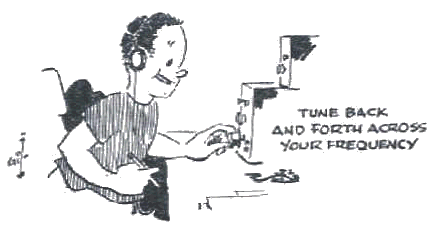
Tune Around
When you flip the switch on your power supply and prepare for a session of brass pounding, don’t be too hasty to call CQ. Check your gear, and when you’re satisfied it’s all ready, listen for a few minutes. Tune around a little and see what’s going on first. More than once I’ve heard some good DX going to waste while the brethren are busy honking out CQ’s without, apparently, having listened more than two seconds after turning on the rig. Listen for stations already calling CQ and answer that call rather than adding to the the bedlam with a CQ of your own. On the remote chance that you hear no CQ’s, go ahead and try one.

Novice Accent Drawing #1
Two things are important:

  1. Your receiver has a tuning dial. Use it. Doing so keeps it from locking up, and you may hear someone calling you off your frequency. Many QRP operators, for example, use crystal-controlled transmitters, and they may not have a crystal for the frequency that you’re calling on. If you don’t tune around, you won’t hear him calling. If a fellow calls CQ, signs and says “K”, then starts another CQ in ten seconds you know he’s not tuning. He just sits there like a lump, expecting a call on his own frequency. He has few QSO’s and he creates beaucoup QRM with his useless calling.
  2. Don’t make your calls too long. Contrary to your first impression, a long call does not attract eager prospects. Rather, just the opposite is more likely–the longer you call the fewer the answers you receive. People are a restless lot. After waiting through ten or twelve CQ’s the average operator will lose patience and start looking for someone else.

Three-by-three-by-three
A CQ pattern that has proved very successful over a long period is the old three-by-three. CQ three times, sign your call three times and repeat the whole thing three times. This is more than sufficient and results have been satisfying.

Today, however, you rarely hear a CQ that long. I generally call CQ four times, followed by my call three times:

CQ CQ CQ CQ de KB6NU KB6NU KB6NU

I then pause and listen for calls, tuning around a bit. Unless band conditions are really bad, I generally get a response by the third call.

When answering a CQ, first make sure that you are on the same frequency as the calling station. YOU do this by tuning your receiver so that the tone of the station calling CQ matches the CW sidetone of your transceiver. Some radios have a special control that makes this even easier to do.

Also, make your call as short as conditions warrant. In general, you only need call about three times and then sign your call three times. For example:

K6DBG K6DBG K6DBG DE KB6NU KB6NU KB6NU

If conditions are good, call twice followed by your call twice. If conditions are poor, or if you’re operating a crystal-controlled transmitter somewhat off the calling frequency, make your call longer.

I’ve noticed recently that some operators–even under marginal conditions–don’t send their calls more than once when responding to my CQ. This is not a good practice. Even if a signal is strong, a static crash can obliterate one of the characters in your callsign. Always send your call at least twice when answering a CQ.

If you’re 25 kilohertz (kHZ) away, call a bit longer, but not too long because it doesn’t take the receiving operator long to tune through the band when activity is light. On the other hand, when QRM is heavy, make your call somewhat longer because it takes a receiving operator longer to comb through the mess. In other words, make the length of your call suit conditions. It is seldom necessary, even under the worst conditions, to call station more than eight or ten times before signing your own call.

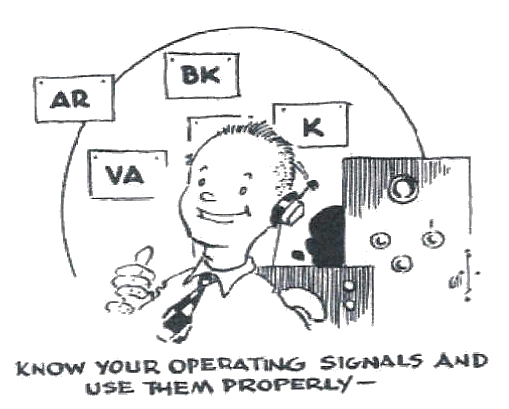
Procedure signals (prosigns)
Prosigns are single characters–or a series of characters–that call for the other operator to do something. For example, the prosign K is used at the end of a transmission to invite the other operator to start sending. Other frequently used prosigns include [AS] (wait), [BK] (break in immediately), and R (all received correctly). K3WWP has a good list of prosigns on his website. You can find it at http://home.alltel.net/johnshan/cw_ss_list_proc.html.

Novice Accent Drawing #2
Some beginners misuse the procedure signal DE. DE means “from” and it is sent only once before each series of a call sign. Do not repeat it before each transmission of your call sign in a series. It is common to hear something like this:

CQ . . . CQ DE KN6ZZZ DE KN6ZZZ DE KN6ZZZ CQ . . . ETC.

This is not good practice. Under poor receiving conditions it is very confusing to the receiving operator who is trying to dope out your call letters. The extra DE throws him every time. (Along the same lines, never sending DE messes up many a receiving station when they are used to listening for it.

When you sign for the last time on a CQ don’t be fancy. Just send the procedure signal K. This invites anyone who heard your CQ to answer. Do not send [AR] either by itself or followed by K:

CQ CQ CQ DE KN6ZZZ KN6ZZZ KN6ZZZ K

When making calls, [AR] is used only when you have contacted another station, but are not yet in contact with him. [AR] is a procedure signal sent as one character, di-dah-di-dah-dit. It is not sent as the two separate letters A and R:

W4YYY W4YYY W4YYY DE K6ZZZ K6ZZZ K6ZZZ [AR]

Once you have established contact there are certain preliminaries you should get squared away. At the beginning of a QSO, it is common practice to exchange three pieces of information: a signal report, station location, and operator name. It used to be standard procedure to send these three pieces of information in exactly that order. Nowadays, however, more operators seem to send their name before their location.

The first two transmissions of a QSO might, therefore, look something like this:

W8JNZ DE KB6NU TNX FER CALL OM [BT] UR RST 599 599 [BT] NAME IS DAN DAN [BT] QTH ANN ARBOR, MI ANN ARBOR, MI [BT] HW? W8JNZ DE KB6NU K

KB6NU DE W8JNZ R TNX FER RPT DAN [BT] UR RST 599 599 [BT] NAME IS CLAY CLAY [BT] QTH DIXBORO, MI DIXBORO, MI [BT] HW NW? KB6NU DE W8JNZ K

Note that both operators repeated each piece of information. This is to ensure that the other operator correctly received the information.

Abbreviations
Ham radio is full of abbreviations. There is good reason for this. It saves time. You can say more in less time and with less wear and tear on the key. A great many abbreviations are standard the world over. You’ll find them listed in handbooks. Don’t go overboard, but learn to use the universally understood shortcuts in operating. A good example is “AND.” Most experienced operators send “ES” instead of “AND.” It’s standard practice, and it’s quicker and easier to send. While you’re at it, learn the proper use of abbreviations.

If in doubt, look them up in the handbooks or on the Web. K3WWP has a good list of prosigns on his website at http://home.alltel.net/johnshan/cw_ss_list_abbr.html.

While there are symbols for the period and the comma, and you need to know them to pass the code test, you rarely hear them sent on the air, except to separate the city and state when sending a station location. The reason for this is that they are awkward to send, and you really don’t need them.

All the punctuation you need is the question mark and the prosign [BT] [dah-di-di-di-dah]. Although it’s become common practice, you don’t really need to send a comma between your city and state, and you certainly don’t need it in any other situation.

Nor do you need to send the lengthy, time-consuming signal for period. Just use the break prosign [BT] between sentences or thoughts. It is much easier to send and sounds smoother. The only time that you really need to send or receive formal punctuation signals is when you are handling traffic or official bulletins.

When you sign over to the other station, make it quick and easy and use on of the standard methods. I have heard some beginners send, “… NOW I AM TURNING IT BACK TO YOU SO HERE IT COMES …” Long winded guff is okay in its place, but it shouldn’t become a habit on CW. Some operators send, “… SO BK TO YOU …” This is an improvement, but may be misunderstood because “BK” is the break prosign as well as the abbreviation for “back.”

All you need to say, really, is “HW?” (short for “how copy?”) or “WATSA?” (short for “what say?”). Either signal indicates to the other fellow that you are through for the moment and are about to sign over to him. Another signal that is becoming popular is “BTU,” which is short for “back to you.”

If it’s also your last transmission it is customary to part with a certain amount of well-wishing. Don’t drag it out too long. You’ve probably sat through a final transmission like the following:

WELL BILL NOW I MUST QRT AND WISH YOU MANY 73S 73S TNX FOR THE SWELL QSO BILL AND 73S BEST OF LUCK AND LOTS OF DX AND BEST WISHES TO YOU AND THE FAMILY SO 73S AND I WILL SEE YOU AGAIN SOON BILL 73S …

All you have to say after you’ve told Bill you must QRT is something like this:

TNX QSO OM 73 GN [SK] W4YYY DE K6ZZZ

Note that it is not necessary to add an “S” to 73. By itself, 73 means “best regards.” If you say 73’s you are, in effect, saying “Best Regardses,” which is just plain silly.

More Procedure
Now a word or two about correct procedure when signing over to the other station or when ending a QSO. It’s all very simple, but many operators seem confused as to how to do it properly.

When you are turning the QSO over to the other operator you proceed as follows:

… SO HW? [AR] W4YYY DE K6ZZZ K

The [AR] indicates that you are through for the time being. The K says, “go ahead and transmit to me.” In practice, most operators omit the [AR] these days.

Incidentally, there is a variation of the K signal. You may have heard it and wondered what it meant and as like as not you have misused it. I am referring to the procedure signal [KN]. This signal indicates that you are engaged in a QSO, that you are inviting the other operator to go ahead with this transmission and you do not wish a third station, the breaking station,” so called to interrupt by calling either of you.

This signal was originated as an aid in DX operating and is not often needed in domestic communications. Therefore I don’t advise its use in ordinary QSO’s. But if you have occasion to use it do it right. It is definitely not a substitute for the plain signal “K”. I have heard novices end a CQ with [KN]. This is obviously simple-minded . Translated to English it means, “I am calling a CQ, a general call, inviting anyone to answer, but please do not call me!”

When ending a QSO use the prosign [SK]. This is easy. [SK] is never the last signal sent. The last item is either your call or the letter K. If you have made your last transmission but will stand by for the other station’s closing remarks you send:

… 73 ES CUL GN [SK] W4YYY DE K6ZZZ K

The [SK] indicates that you have made your last transmission. If you have completely finished the QSO and wish to remain open for business you just naturally don’t put anything at all after your call. If you intend to “close station” and hit the sack you should indicate this fact by adding the CL immediately after your call. Listening operators are thus informed that you will not be in the market for another QSO. It saves them needless calls.

CW operating procedures are fixed by long usage and in part are called for by law. The correct procedure is just as easy to learn and use as the wrong procedure, and if you are a beginner, you might just as well start right. Bad habits are difficult to break. If you find it hard to remember what to send and when to send it make up a sheet with standard forms and keep it on your operating desk. Refer to it when in doubt, and soon, using the correct procedure will be automatic. Once learned, it isn’t forgotten.

R?
Being long winded, I don’t mind adding a few items that are pet peeves of mine. First on the agenda is an ancient complaint about operators who come back with “R” when they have copied only part or perhaps nothing at all of your last transmission. You often hear something like this:

WNYYY DE K6ZZZ R R R OK OK BUT PLEASE REPEAT MY REPORT AND YOUR QTH ALSO MISSED YOUR NAME AND DID NOT COPY YOUR LAST QUESTION IN THE QRM…

If you send “R” you are indicating that you copied solid everything the other operator sent. Do not send a single R if you missed any part of his transmission. Just send a break sign, [BT], after your call when you go back to him, if you missed anything, and tell him what you missed. There is nothing more exasperating than to hear, “R BUT MISSED EVERYTHING OM!”

In connection with this business of receipting, one other point might be mentioned. If you have copied the other fellow’s transmission solid and have so indicated by “R” when you go back to him, he can be expected to have sense enough to know that you got what he sent. Therefore it is needless wear and tear on your key and a waste of your time and his to go through this rigamarole of

OK ON THIS, OK ON THAT, OK ON YOUR RIG, OK ON YOUR WX, OK ON YOUR DOG HAVING JAUNDICE, ETC., ETC.

Just proceed with your remarks and comments. If he asked a question, answer it. If he made a statement that requires no answer, make no answer. It’s really very simple.

Another pet peeve is the guy with long, deathly silences. He sends your call, signs his, then says

R ES TNX FER REPT OM [BT]…

then apparently lapses into a coma.

When you finally decide that the op has suffered a heart attack and departed this vale of tears, he suddenly comes to life and burps out a couple of BT’s and staggers along with

RIG HR 807 WID 50 WATTS [BT]…

and promptly falls asleep again. This makes the receiving operator nervous. If your mind goes temporarily blank when you are on the key, send a series of [BT]. Just don’t sit there leaving the other operator to wonder if you are still alive. There is nothing worse than a lot of clatter on the air except complete silence.

??
A final pet peeve is the misuse of the question mark as a prosign. The question mark does not mean that you made a mistake and that you are going to resend, correcting the mistake. The correct way to note that you made a mistake is to send a series of eight dits, although few operators send all eight these days.

Often, operators will pause and then send three or four widely-spaced dits to note that they made an error. Many high-speed operators don’t even bother sending the dits. They simply pause for a short time after they make a mistake, then start up again, resending the word.

When you send the question mark as a prosign, it means that you are planning to repeat some bit of information so that the receiving station gets it properly. For example, you might send it after you’ve sent your location, especially if it has a tricky spelling. For example,

QTH ANN ARBOR, MI ? ANN ARBOR, MI

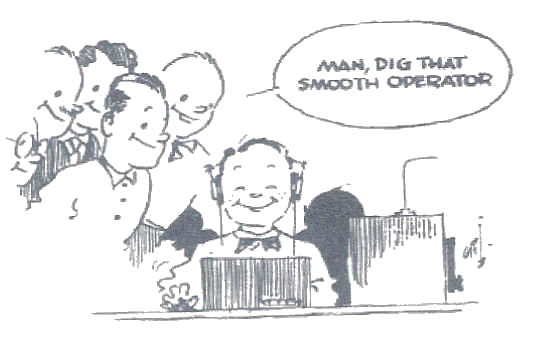
Novice Accent Drawing #3
Sloppy Sending
To get the most out of operating CW, it’s a good idea to practice sending properly. No one enjoys working an operator with a sloppy fist. No one expects you to be perfect, but poorly sent code is a real horror to copy.

Pay special attention to the spacing between characters and between words. I would rather copy code with proper spacing and some errors than code that is error-free, but where the letters and words are all run together.

Some operators go on for years blithely unaware that their fists are bad. In fact, they may even fancy themselves as artists on the key. They get huffy if anyone suggests that they are not 100% readable. They suggest that the receiving operators need a little practice. If you are one of those boys, you are probably a hopeless case. However, if you know that your sending leaves something to be desired, and you are sincerely interested in developing a good readable fist you can stop worrying. It’s simple.

Just practice sending–nut not on the air. Rig yourself a code practice oscillator and send to yourself. Many modern transceivers even have a practice mode that you can use.

The ideal manual fist is one that sounds like a tape transmitter. Don’t laugh! It’s a skill that’s easy to acquire. Of course, to begin with, you must know how good code sounds. The simplest way is to turn on your receiver and tune in a commercial tape circuit and listen. Tune around, find a station sending press or other traffic and just sit and listen. You don’t have to be able to copy it solid. Maybe you can copy only seven words a minute and the commercial is sending at 20 or 25. No matter. Don’t worry about what he’s sending, just pay attention to how it’s sent. Listen to the individual letters; get the feel of his rhythm and spacing. Then adjust your key, get comfortable, and send to yourself. Try to make your hand-keyed letters sound like the tape-sent letters. Send from a newspaper or book and pay attention to spacing between words and letters as well as to the shape of each individual letter. At first it may seem an impossible task but you’ll be surprised how rapidly your sending improves. Sure it’s a lot of work, but you weren’t born with a telegraph key in your hand and you have to learn. You don’t write a letter in such an illegible scrawl that it can’t be read (or do you?), so why transmit a botched-up mess of dots and dashes to some poor wretch on 40 meters who is trying to read it.

It’s Fun!
Perhaps the best reason for using the proper procedures and developing a good fist is that it makes CW operating more fun. Using genuine International Morse and standard procedure will make life a pleasure for both you and your adversaries.

Filed Under: CW, Elmering

CW Ops Needed in Pittsburgh

July 13, 2006 By Dan KB6NU 1 Comment

This came from the Fists mailing list….

CW Operators Needed:
I am a medical student at the University of Pittsburgh, who is currently conducting a summer research project in the laboratory of Dr. Fiez. She is a professor in both the Psychology and Neuroscience departments. A focus of our lab involves gaining a better understanding of language and memory processing. We have recently turned to Morse code as a potential investigating tool due to its unique linguistic properties.

Consequently, our lab is examining the differences between processing Morse code and speech in a simple memory task. As you may already know, it is not easy to find people who are proficient in Morse code. Your involvement would create a unique opportunity to investigate this unexplored area of research.

We would greatly appreciate it if you would circulate this information to all of your members. Participants will be compensated 25 dollars, and will also be refunded for parking. They will be asked to hear and remember letters. The duration of the study is approximately one hour and thirty minutes. If there is interest, we can discuss any further details. Thank you for your time and consideration.

Dalia Balsamo
718 LRDC, 3939 O’Hara Street
Univ. of Pittsburgh
Pittsburgh, PA 15260
412-624-6898 (phone)
[email protected]

Filed Under: CW

“Night of Nights VII” Celebrates Maritime Morse Code Service

July 12, 2006 By Dan KB6NU Leave a Comment

In the seventh annual event that has become known as the “Night of Nights”, historic Morse code radio station KPH will return to the air in commemoration of the last commercial Morse message sent in the United States.

Frequencies and reception report information for all stations appear below.

KPH, the ex-RCA coast station located north of San Francisco, will return to the air for commemorative broadcasts on 12 July at 1701 PDT (13 July at 0001 GMT), 7 years and one minute after the last commercial Morse transmission in the US. These on-the-air events are intended to honor the men and women who followed the radiotelegraph trade on ships and at coast stations around the world and made it one of honor and skill. Transmissions are expected to continue until at least midnight PDT (0700GMT).

Veteran Morse operators, including former KPH staff members, will be on duty at the receiving station at Point Reyes, CA listening for calls from ships and sending messages just as they did for so many years before Morse operations were shut down.

The transmitters are located 18 miles south of Point Reyes in Bolinas, CA at the transmitting station established in 1913 by the American Marconi Co. The original KPH transmitters, receivers and antennas will be used to activate frequencies in all the commercial maritime HF bands and on MF as well.

Many of the KPH transmitters will be 50s vintage RCA sets. KSM will use a 1940s vintage Press Wireless PW-15 transmitter will be on its 12Mc frequency. Power output will be 4 to 5kW. The transmitting antennas include a Marconi T for MF, double extended Zepps for 4, 6 and 8Mc and H over 2s for 12, 16 and 22Mc.

KPH will send traffic lists, weather and press broadcasts as well as special commemorative messages, some of which will be sent by hand. At other times the KPH and KSM “wheel” will be sent to mark the transmitting frequencies.

Members of the public are invited to visit the receiving station for this event. The station will be open to visitors beginning at 1500PDT (3:00pm). The station is located at 17400 Sir Francis Drake Boulevard and is on the route to the Point Reyes lighthouse. Watch for a cypress lined driveway on the right about a mile past the entry to Coast Guard station NMC.

KPH is operated by the Maritime Radio Historical Society in cooperation with the Point Reyes National Seashore, part of the National Park Service.

Further information may be found on the Maritime Radio Historical Society Web site at http://www.radiomarine.org or by contacting Richard Dillman at +1 415-990-7090 (email: [email protected]) or Tom Horsfall at +1 510-237-9535 (email: [email protected]).

KPH
KPH will transmit on 4247.0, 6477.5, 8642.0, 12808.5, 17016.8 and 22477.5kc on HF and 500 and 426kc on MF.

These frequencies have been made available through the generous cooperation of Globe Wireless, the current owner of the KPH and KFS licenses.

KPH operators will listen for calls from ships on ITU Channel 3 in all bands. The Channel 3 frequencies are 4184.0, 6276.0, 8368.0, 12552.0, 16736.0 and 22280.5kc on HF and 500kc on MF.

Reception reports may be sent to: Ms. Denise A. Stoops P. O. Box 381 Bolinas CA 94924-0381 USA. Denice is a former KPH operator and was the first female telegrapher hired at the station.

KSM
KSM will transmit on 426, 500, 6474, 12993 and 16914kc. (Note the addition of a 16Mc channel for KSM this year.) KSM will listen for calls from ships on 500kc and HF Channel 3 (see KPH listing for frequencies).

Reception reports may be sent to:Ms. DA Stoops P. O. Box 381 Bolinas CA 94924-0381 USA

WLO

(This information has not been confirmed by WLO at the time of this announcement.)

WLO will transmit on 438, 500, 8514.0 and 12660.0kc. WLO will listen for calls from ships on 500kc and HF Channel 3 (see KPH listing for frequencies).

Reception reports may be sent to: WLO/KLB 700 RINLA AVENUE MOBILE, ALABAMA 36619 USA or via email to: [email protected]

KLB
KLB will transmit on 488, 500, 2063.0, 6411.0 and 12917.0kc. (Note the expanded frequencies for KLB! This year KLB has added MF, a 2Mc frequency and a 12Mc frequency. A tip of the MRHS earphones to CJ of KLB for all the work he has done to bring this about.). KLB will listen for calls from ships on 500kc and HF Channel 3 (see KPH listing for frequencies).

Reception reports may be sent to: WLO/KLB 700 RINLA AVENUE MOBILE, ALABAMA 36619 USA or via email to: [email protected]

NMC
NMC will transmit on 448, 472, 500, 6383.0, 8574.0 and 17220.5kc

NMC will listen for calls from ships on 500kc and HF Channel 3 (see KPH listing for frequencies).

Reception reports may be sent to:

COMMANDING OFFICER ATTN ITC ERIC SIMMONS COMMUNICATIONS AREA MASTER STATION PACIFIC 17000 SIR FRANCIS DRAKE BLVD POINT REYES STATION, CALIFORNIA 94956-0560 USA

NOJ
NOJ will transmit on 416, 470, 500, 8650.0, 12889.5 and 16909.7kc. (Note that NOJ will be operational on MF this year!)

NOJ will listen for calls from ships on Channel 3 (see KPH listing for frequencies).

Reception reports may be sent to:COMMANDING OFFICER ATTN OSCM WILLIAM KECKLER US COAST GUARD COMMUNICATIONS, STATION KODIAK PO BOX 190017 KODIAK, ALASKA 99619 USA

Filed Under: CW, Everything Else

  • « Go to Previous Page
  • Page 1
  • Interim pages omitted …
  • Page 31
  • Page 32
  • Page 33
  • Page 34
  • Page 35
  • Interim pages omitted …
  • Page 38
  • Go to Next Page »

Primary Sidebar

No Nonsense Technician Class License Study Guide (for tests given between July 2026 and June 2030)

New No Nonsense Technican Class Study Guide now available!

The 2026 version of my Tech Class study guide is now available, and as always, the PDF version is FREE!. The ePub version costs $11.97, and a Kindle version and paperback version will be available on Amazon shortly.

Click here to get all of my "No Nonsense" study guides.

Also available: The CW Geek's Guide to Having Fun with Morse Code

W5SWL.Com
Retevis Ailunce H1 DMR Radio
DXpander: Cobweb antennas, Laser Cutting

You’ve got mail!

Enter your email address below and get an email every time I publish a new post.

Email


I frequently teach classes to help newcomers get their licenses. The next class will take place on Saturday, October 10, 2026 on the University of Michigan campus. Click here for more information.

If you can't make the class, subscribe to the mailing list to be notified of when the next class will be held.

You can always download my free study guide, and if you have any questions about the classes, or amateur radio in general, please feel free to email me directly.

Support KB6NU.Com

Donate $7.30 and get two of these cool stickers. Measuring 4.25-in. W by 2.75-in. H, it's perfect for your car, your shack, or wherever!

Contact me

If you have a question or comment about one of my blog posts, or a question about any of the material in my study guides, or just a question about ham radio in general, you can email me at [email protected].

Blogs You Should Also Read

  • AE5X: A CW-centric blog from Kingswood, Texas
  • K0LWC Blog
  • LA3ZA Ham Radio Blog
  • Little Radios, Big Fun – WB3GCK
  • Mr. Vacuum Tube's Blog
  • Radio Artisan – K3NG
  • The K0NR Weblog
  • VE3WDM's QRP Ham Radio Blog
  • W2LJ’s Blog

Ham Radio Websites

  • Dashtoons – The Hammin' Comedy by Jeff K1NSS

Podcasts

  • ICQ Podcast
  • Linux in the Ham Schack
  • No Nonsense Amateur Radio Podcast
  • Resonant Frequency Amateur Radio Podcast

Recent Comments

  • Dan KB6NU on Some Ham-Vention History
  • David Pompea on Some Ham-Vention History
  • Walter Underwood on One lump or two (or three)?
  • Mike, KL7MJ on Question pools should make teaching classes easier
  • Karl Heinz - K5KHK on Question pools should make teaching classes easier

Meta

  • Log in
  • Entries feed
  • Comments feed
  • WordPress.org

Footer

Copyright © 2026 Daniel M. Romanchik, KB6NU · Log in