• Skip to primary navigation
  • Skip to main content
  • Skip to primary sidebar
  • Skip to footer

KB6NU's Ham Radio Blog

KB6NU's Ham Radio Blog
  • HOME
  • Study Guides
  • Teach a One-Day Tech Class
  • W8SRC Repeater Guide
  • Advertise
  • Hire Me

The Service

ARRL says stats need updating, number of new hams declining in UK, IARU to hold workshop on the future of #hamradio

October 5, 2021 By Dan KB6NU 3 Comments

Over the past couple of days, there has been three news stories related to the future of amateur radio. The first, Data on Number of Radio Amateurs Worldwide Needs Updating, is kind of an odd story, if you ask me. The first paragraph reads:

The oft-cited figure of 3 million radio amateurs worldwide may need updating. That number was what the International Amateur Radio Union (IARU) published in 2000 for the global head count. The IARU once regularly collected amateur radio population statistics, but stopped the practice around the point when the worldwide amateur radio population began to decline.

It then goes on to cite some statistics on the declining number of amateur radio operators around the world. For example, the story says, ” Japan’s ham radio population has dropped by more than 600,000 over the past 2 decades; as of 2015, it was 435,581, according to JARL.” And, the story concludes, “The specific size of the worldwide amateur radio population remains open to speculation, although a 2021 figure of 1.75 million may be closer to the truth.”

My reaction to this is, “OK, so why doesn’t the ARRL get the IARU to start counting again?” The ARRL is, after all, the elephant in the room when it comes to to the IARU, isn’t it?


The next story, Numbers taking up amateur radio in UK declining, reports:

Figures in RSGB Board Proceedings suggest there has been a decline during this year in numbers joining the hobby but numbers are still much better than those before [remote] online exams were introduced.

Unfortunately, the story gives no reasons for the decline.

The third story, “IARU Region 1 prepares for Workshop,” announces the upcoming event, “Shaping the Future.” According to the story, the event is “designed as a highly interactive workshop where small groups of delegates will discuss the goals for amateur radio into the future and how Member Societies and IARU can support progress towards those aims.”

The workshop takes place October 17-21, and is being held virtually. I’ve emailed the IARU to see if this workshop is open to the general public, but I’m guessing that it’s only for invited IARU delegates. If I find out otherwise, I’ll post that information here.

 

Filed Under: The Service Tagged With: ARRL, future, iaru

Another voice for forward thinking in amateur radio

July 9, 2021 By Dan KB6NU Leave a Comment

This evening, while perusing my Twitter feed, I found this tweet by my friend, Jeff, KE9V:

ke9v's avatarJeff Davis @ke9v
Zero Retries Newsletter 0000 zeroretries.substack.com/p/zero-retries…

I clicked on the link and found a thoughtful and inspiring missive by a new acquaintance of mine, Steve, N8GNJ. Steve is a member of the ARDC Grants Advisory Committee, which is how I became acquainted with him.

He is also the author of two amateur radio blogs, www.n8gnj.org and www.superpacket.org and has written about amateur radio data communications over the years, including periods of writing for (and very briefly, editing) the TAPR Packet Status Register (PSR) newsletter and a column in CQ Amateur Radio magazine.

What I liked about this issue of the newsletter is its forward-thinking approach to amateur radio. Of course, you’d expect this from someone who’s been as involved with the ARDC as Steve has been. Here’s hoping that Steve continues to think and write about the amateur radio that can be instead of only the amateur radio that we currently have.

As a final thought, it occurs to me that perhaps what we need is a forum where ideas like the ones Steve and Jeff, KE9V, write about can be shared and discussed. There are many individual voices out there with lots of good ideas. Maybe the next step is to expand the circle and share and develop those ideas. What do you think?

Filed Under: ARDC, Promotion & PR, The Service Tagged With: Zero Retries

IARU R1 addresses strengths, weaknesses, opportunities, and threats to amateur radio

June 13, 2021 By Dan KB6NU 1 Comment

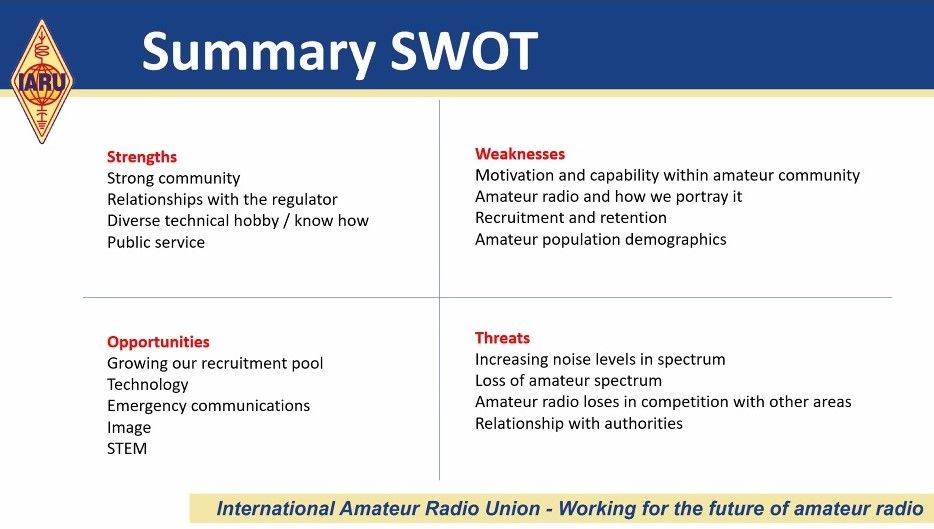
As part of their ongoing Workshop on the Future of Amateur Radio, IARU Region 1 held a session analyzing the strengths, weaknesses, opportunities, and threats (SWOT) of amateur radio. Here’s a summary of their findings:


This type of analysis is a good first step. Knowing our strengths and what opportunities are out there for us will help us foster amateur radio, while knowing our weaknesses and what’s threatening our hobby will help us shore up those areas that could undermine any positive actions we might take.

I wish that they had recorded this session. It would have been very interesting to hear more detail of how the workshop attendees came to these conclusions. I’ve emailed Lisa, PA2LS, to see if I can get more information. I think this is important work and that these ideas should be more widely publicized.

Filed Under: The Service Tagged With: IARU R1

IARU Region 1 to host conference on the future of amateur radio

March 27, 2021 By Dan KB6NU 1 Comment

IARU Region 1 seems be ahead of the pack when it comes to thinking about the future of amateur radio. Here’s a recent example from the IARU Region 1 website…


Facing the future of amateur radio

Mar 24, 2021
Lisa, PA2LS

Tonight IARU Region 1 started preparing together with its Member Societies a Workshop with focus on the future of amateur radio. The message being shared in this session is clear. IARU societies are losing members; loss in members in some societies is remarkable in the last ten years, even with good examination throughput. Next to this, persons in leadership roles in these societies are getting older. Not all Member Societies have top team members under the age of 35 years.

The IARU Region 1 Executive Committee shares that it’s time for change and we need to start moving forward. Working together and changing the current trends. We need to refocus our thinking and way of operating.

Main questions and topics which will be covered in the Workshop are:

  • What is amateur radio today?
  • How is it changing?
  • Where are tomorrow’s radio amateurs?
  • How do others see amateur radio?
  • What do we need to do for the future?

Member societies are called upon to take actively part by nominating people with future oriented mind-set and prepare for this Workshop. Key will be to include new people into the discussion, hoping to reach new ideas and new ways of thinking. The Workshop “Facing the future” is scheduled to be held in October 2021 hopefully in Novi-Sad Serbia, hosted by SRS, the Serbian Amateur Radio Society. A virtual alternative Workshop will be prepared as well.

Filed Under: The Service Tagged With: future

Learn how to get amateur radio grants Saturday February 6!

February 5, 2021 By Dan KB6NU Leave a Comment

Amateur Radio Digital Communications (ARDC) is an organization whose mission is to “support, promote, and enhance digital communication and broader communication science and technology, to promote Amateur Radio, scientific research, experimentation, education, development, open access, and innovation in information and communication technology.” They have a bunch of money that they raised by selling some of the IP addresses that were initially allotted to amateur radio.

TOMORROW, Saturday, February 6, they will be holding a community meeting to inform folks about their activities. Consider attending if you think that you mighth be interested in applying for a grant from ARDC. Here’s the memo:

From: Rosy Wolfe <[email protected]>

Hello, ARDC Grantees!

I hope this new year is off to a good start and that all is well in your
world, or at least as well as it can be given pandemic times.

I’m writing with some invitations – which are both for you and extend to other amateur radio enthusiasts in your communities.

# Invitation 1: Please join us for our next community meeting!

  • Saturday, 06 Feb 2021
  • * 18:00 GMT (10am PT / 1pm ET / 7pm CET)

Join us by signing up here: https://www.ampr.org/feb-6-meeting-sign-up/

In this meeting, we’ll cover:

  • Highlights from 2020
  • Grantmaking goals in 2021
  • Introductions of new Technical Advisory Committee (TAC) and Grants Advisory Committee (GAC) Members
  • Survey results from our latest survey, discussed below
  • Questions from our attendees.

We held a similar meeting on 10 Oct. 2020, which was primarily for
people using 44net addresses.

This one is intended for a much broader audience. So – please tell your
friends! We also plan to record this meeting for those who can’t make it.

# Invitation 2: Please take and share this survey!

Leading up to the meeting, we’re also asking amateur radio enthusiasts to give us their thoughts in this survey. Please share it with other hams you know. As with the last survey, the aim is to get to know the people we aim to support through our grantmaking. And like our upcoming meeting, it too is meant for a broader audience.

That’s all for now! Looking forward to sharing more with everyone soon.

Thank you for all that you do.

All the best,
Rosy
ARDC Executive Director

I plan to attend myself.

Filed Under: The Service Tagged With: ARDC, grants

Amateur radio in the news: Hammarlund, ham radio on the ISS, two kids work the South Pole

December 26, 2020 By Dan KB6NU Leave a Comment

Now, that’s a soldering iron! Worker at the Hammarlund Mars Hill plant assembles a variable capacitor.

Ham radio operators honor legacy of Mars Hill company

During the 1950’s and ’60’s, when the Hammarlund Manufacturing Company had a factory just west of Mars Hill College, the town could have been considered a world center of advanced electronic technology. With a company motto of “Quality Without Compromise,” almost 90% of American WWII wartime military electronic equipment employed Hammarlund capacitors. They also built U.S. Navy search radar installed on aircraft carriers, battleships and cruisers.

Hammarlund was one of the three leading brands of radio communications equipment at the time, along with Hallicrafters and Collins Radio. These three companies dominated in providing state of the art electronics equipment to the U.S. military, large and small corporations, and to private individuals who had the means and taste to own the very best.

….read more


Living in space can get lonely. What helps? Talking to random people over ham radio

The International Space Station cost more than $100 billion. A ham radio set can be had for a few hundred bucks. Perhaps that explains, in part, the appeal of having one of humankind’s greatest scientific inventions communicate with Earth via technology that’s more than 100 years old.

NASA astronaut Doug Wheelock, Expedition 24 flight engineer, used a ham radio system in the Zvezda Service Module of the International Space Station in 2010.(NASA)

…read more


Two Kids, a Ham Radio, and the World at Their Fingertips

CLARK, NJ – A brown house with lots of glass panels, hidden in overgrowth for years, situated across from Manny’s Diner on Raritan Road, was recently demolished and will soon be replaced by apartments. In the 1950s, the house was home to Jules and John Madey, two brothers who grew up spending hours in their basement using a ham radio that one day connected with a navy substation in the South Pole.

…read more

Filed Under: History, Satellites Tagged With: Hammarlund, ISS

FCC proposes new fees for amateur radio licenses

August 27, 2020 By Dan KB6NU 83 Comments

I cadged this off QRZ.Com, but am requesting the permission of the author, Michelle Bradley, KU3N, founder of REC Networks.


On Wednesday, the FCC released a Notice of Proposed Rulemaking (NPRM) in MD Docket 20-270 which implements portions of the Repack Airwaves Yielding Better Access for Users of Modern Services Act of 2018 (or RAY BAUM’S Act), which gives the FCC statutory authority to collect application fees. As a part of the Act, the FCC is required to switch from a fee structure mandated by Congress 20 years ago to a new cost-based system. This change will result in some fees being reduced and in some cases, such as the Amateur Radio Service, new fees are being added.

Proposed new fees for Amateur Radio and reduction in GMRS fees

Section 8 of the RAY BAUM’S Act does not provide any kind of statutory exemption for filing fees in the Amateur Radio Service, which, historically has had no filing fees. Citing the costs involved in the automated processes, routine maintenance of the Commission’s Universal Licensing System (ULS) and limited instances where staff needs to be involved in the application process, the FCC is proposing an across-the-board fee of $50 for new and modified licenses in the personal radio services, which includes Amateur Radio and the General Mobile Radio Service (GMRS). For GMRS, this is a reduction of the current $70 fee. The FCC also proposes these fees for license renewals and requests for vanity call signs, the latter which had its filing fee eliminated several years ago. The FCC is proposing to still not charge for administrative updates, such as mailing address changes on amateur or GMRS applications. Amateur Radio will remain exempt from annual regulatory fees under Section 9 of the RAY BAUM’S Act.

Commenting on the changes

Once the NPRM is published in the Federal Register, filing deadlines for comments and reply comments will be established. Those dates will be announced by the FCC in a separate Public Notice. Comments will be accepted in the FCC’s Electronic Comment Filing System under proceeding 20-270.

A copy of the NPRM, which includes the proposed fee structures, can be found here.

The RAY BAUM’S Act is part of Public Law 115-141 and can be found in this PDF document starting on page 734 (Division P). The relevant part of the law starts on Page 736, under Section 8.

Link to full article at REC Networks, which also discusses fee changes for commercial broadcast radio can be found at https://recnet.com/node/3182

Filed Under: Rules, Regulations, Enforcement, The Service Tagged With: fees

Amateur radio videos: Rob Sherwood on transceiver performance, TH-D74A teardown, what is IARU?

July 17, 2020 By Dan KB6NU Leave a Comment

Rob Sherwood on transceiver performance

Rob Sherwood, NC0B, of Sherwood Engineering, has long been known for his ranking of receiver performance. Well, he also has quite a bit to say about transmitter performance, as you’ll see in this recorded presentation to the Sutton and Cheam Radio Society.

TH-D74A Teardown

Here’s an interesting teardown of the Kenwood TH-D74A. There’s also an interesting Hackaday post explaining how some hams hacked the firmware.

What is IARU?

I couldn’t embed this video, so you’ll have to click here to view it.

Filed Under: Building/Homebrew, The Service, VHF/FM/Repeaters Tagged With: iaru, Rob Sherwood, TH-D74A

A way back to relevance for amateur radio?

April 30, 2020 By Dan KB6NU 8 Comments

Normally, when I post a video, I post several of them. This one, however, I think is important enough to post on its own. Kamal Singh (M0IOV) gave this presentation—The Future and Growth of Amateur Radio—at the RSGB Convention in October 2019. I’ve been meaning to post and comment on it ever since I found out about it several months ago.

His premise is that once amateur radio was relevant, visible, and appealing, but that we are no longer. He blames this, not on the coming of the internet, but instead the third Industrial Revolution. With the coming of the third Industrial Revolution, the complexity of electronics and the electronics industry increased, and that most of amateur radio failed to keep pace with these changes and that we lost our technical edge.

As far as being relevant, he notes that amateur radio used to be a gateway to a technical career, but not so much today. Because amateur radio technology has taken a different path than electronics technology in general, getting an amateur radio license isn’t as advantageous as it used to be.

We also lost our advantage, he says, in being able to provide worldwide communications. He points to the instantaneous communications now provided by the likes of Zoom and Skype. We really have nothing similar to offer.

In addition to losing our technical edge, we’ve also lost visibility. We used to be able to point to a number of leaders and celebrities that were amateur radio enthusiasts. These included Senator Barry Goldwater, TV newscaster Walter Cronkite, and King Hussein of Jordan. Today, however, it’s a real struggle to come up with similar names that might draw people to amateur radio.

Relevance is our Achilles Heel

Relevance, according to Singh, is the biggest issue. Here’s a slide he used to make his point:

Our choice is to continue along the path we’ve been traveling and become even more isolated and detached from the mainstream, or choosing to be more integrated, connected and industry-friendly.

He went on to suggest ways to suggest ways for amateur radio to be more relevant. Singh notes that we are on the verge of the fourth industrial revolution, and that this revolution will be more connected than ever before—and isn’t making connections what radio is all about?

Here’s what he’s talking about:

These applications, he says, are completely dependent on radio and asks, “Aren’t we the radio guys?” Our challenge is to break out of our narrow niche thinking about what amateur radio is and what we do, and to become integrated with the national efforts to develop and integrate these technologies.

He doesn’t pooh-pooh the difficulty of doing this. This is going to be hard, but what choice do we have? One suggestion he has is to launch an innovation challenge, focused on solving a real-world problem. Here’s a slide that talks about some of the things that amateur radio will have to do to make this effort successful:

This is really a great video, and I’m sorry that I didn’t watch it and comment on it sooner. I think he’s spot on with this presentation. I’ve said something similar in the past, when I’ve recommended that the ARRL participate in more professional communications conferences. How can amateur radio keep up if we don’t participate?

As I was watching this video, my wife was at her computer in our shared home office. Towards the end of the video, she said, “This doesn’t sound like amateur radio.” I almost leapt out of my seat. “That’s exactly the point,” I replied. We have to start thinking in new ways and do new things if we’re going to stay relevant. That doesn’t mean we can’t still ragchew on the CW bands, but that we have to start working on the future, too. Let’s start talking about this.

Filed Under: Everything Else, The Service Tagged With: rsgb

Help wanted to remake amateur radio for the 21st century

March 3, 2020 By Dan KB6NU 6 Comments

This appeared today on the IARU Region 2 website….Dan


Are you a “young” ham? Want to help remake Amateur Radio for the 21st century? Frustrated that there are so few of your friends and age group that are interested in ham radio? Frustrated that amateur radio is in a rut, not doing more or different things with technology? Concerned that an aging demographic means ham radio is dying? And that our frequencies will be sold out to the highest bidder because there aren’t enough hams to show that we use them?

So are we. And we want to do more than talk – we want to do something about it.

IARU Region 2 is looking for a few volunteers to work together to brainstorm ideas and possible actions to increase ham radio’s attractiveness. We’re not looking for a single magic approach. After all, amateur radio means many things to many people. Rather we’re looking for possible ways to target specific interests that are either part of ham radio today or could be part of ham radio in the future to recruit and retain new amateurs.

Are you interested? Are you:

  • A radio amateur who has been licensed for more than a year?
  • Between 18 and 35 years of age?
  • Are a self-starter, willing to take initiative?
  • Willing to volunteer your time and exercise creativity?

If so, send an email to [email protected] telling us why you are interested in volunteering to be part of this group, your current interests (in ham radio, what you do: job, student, etc) and your thoughts on what may be done. Ideally we would like to have as many parts of the Americas represented as possible*.

With the exception of a liaison person sitting in, the formalities of committees won’t apply: the group will figure out how it wants to work (Facebook, WhatsApp, video meetings, etc), and develop ideas of what it thinks will be worth trying out.

This is more than a think tank. We’re prepared to provide funding to try out some of the proposed ideas to see how well they work. We expect that some ideas will work, others won’t, and different things will work in different parts of the Americas – one size will not fit all. As part of the work, IARU R2 would propose to send one person to the IARU R1 YOTA youth camp to experience the camp, meet with the R1 youth coordinators to learn about what they are doing in Europe and Africa, to exchange ideas, and explore what joint activities might be done.

Who are we:

IARU Region 2 is the Americas part of the International Amateur Radio Union. Like ITU, IARU has 3 regions: Region 1 Europe/Africa, and Region 3 Asia/Pacific. IARU is best known for being the international representative of ham radio at the ITU, defending our spectrum. IARU does more than that, working through the national societies in each member country, coordinating WINlink networks, band planning, satellite frequency coordination, and training among many others. And of course, IARU is very concerned about the future of amateur radio, especially in attracting new amateurs. R2 has an Executive Committee made up of representatives of each of the 7 areas, a President and a Secretary. All are volunteers, dedicated to seeing that our hobby not only survives but prospers with new ideas and ways to do ham radio.

*IARU Region 2 is divided into 7 areas:
Area “A” — Northern part of North America including Canada and Bermuda.
Area “B” — Central part of North America including the United States of America: also including Puerto Rico and the U. S. Virgin Islands, and also Hawaii and all of the Pacific Ocean islands administered by the United States of America within the boundaries of IARU Region 2.
Area “C” – Mexico and the Caribbean Islands of Antigua-Barbuda, Bahamas, Cayman Islands, Cuba, Dominican Republic, Guadeloupe, Haiti, Jamaica, Martinique, Montserrat, Anguilla, British Virgin Islands, St. Kitts and Nevis, and Turks and Caicos.
Area “D” — Central America including Belize, Guatemala, El Salvador, Honduras, Nicaragua, Costa Rica and Panama.
Area “E” — Northern part of South America including Colombia, Venezuela, Guyana, Suriname, and the Caribbean Islands of Netherlands Antilles, Trinidad and Tobago, Aruba, Barbados, St. Vincent and the Grenadines, St. Lucia, Grenada and Dominica.
Area “F” — Central part of South America including Bolivia, Brazil, Ecuador and Peru.
Area “G” — Southern part of South America including Argentina, Chile, Paraguay and Uruguay.

Tambien disponible en Español (Spanish).

Filed Under: The Service Tagged With: iaru

  • « Go to Previous Page
  • Page 1
  • Page 2
  • Page 3
  • Page 4
  • Interim pages omitted …
  • Page 11
  • Go to Next Page »

Primary Sidebar

No Nonsense Technician Class License Study Guide (for tests given between July 2026 and June 2030)

New No Nonsense Technican Class Study Guide now available!

The 2026 version of my Tech Class study guide is now available, and as always, the PDF version is FREE!. The ePub version costs $11.97, and a Kindle version and paperback version will be available on Amazon shortly.

Click here to get all of my "No Nonsense" study guides.

Also available: The CW Geek's Guide to Having Fun with Morse Code

W5SWL.Com
Retevis Ailunce H1 DMR Radio
DXpander: Cobweb antennas, Laser Cutting

You’ve got mail!

Enter your email address below and get an email every time I publish a new post.

Email


I frequently teach classes to help newcomers get their licenses. The next class will take place on Saturday, October 10, 2026 on the University of Michigan campus. Click here for more information.

If you can't make the class, subscribe to the mailing list to be notified of when the next class will be held.

You can always download my free study guide, and if you have any questions about the classes, or amateur radio in general, please feel free to email me directly.

Support KB6NU.Com

Donate $7.30 and get two of these cool stickers. Measuring 4.25-in. W by 2.75-in. H, it's perfect for your car, your shack, or wherever!

Contact me

If you have a question or comment about one of my blog posts, or a question about any of the material in my study guides, or just a question about ham radio in general, you can email me at [email protected].

Blogs You Should Also Read

  • AE5X: A CW-centric blog from Kingswood, Texas
  • K0LWC Blog
  • LA3ZA Ham Radio Blog
  • Little Radios, Big Fun – WB3GCK
  • Mr. Vacuum Tube's Blog
  • Radio Artisan – K3NG
  • The K0NR Weblog
  • VE3WDM's QRP Ham Radio Blog
  • W2LJ’s Blog

Ham Radio Websites

  • Dashtoons – The Hammin' Comedy by Jeff K1NSS

Podcasts

  • ICQ Podcast
  • Linux in the Ham Schack
  • No Nonsense Amateur Radio Podcast
  • Resonant Frequency Amateur Radio Podcast

Recent Comments

  • Bulin 47 AI on ICQPodcast Episode 485 – World Cup Special Event Station
  • Jesse Alexander on What do you think of this artwork for the ham radio EMF Explorer
  • CADProps on My first go at 3D printing not quite a success
  • Dan KB6NU on A Media Guide to Amateur Radio
  • Steve Stroh N8GNJ on A Media Guide to Amateur Radio

Meta

  • Log in
  • Entries feed
  • Comments feed
  • WordPress.org

Footer

Copyright © 2026 Daniel M. Romanchik, KB6NU · Log in