
• Skip to primary navigation
  • Skip to main content
  • Skip to primary sidebar
  • Skip to footer

KB6NU's Ham Radio Blog

KB6NU's Ham Radio Blog
  • HOME
  • Study Guides
  • Teach a One-Day Tech Class
  • W8SRC Repeater Guide
  • Advertise
  • Hire Me

Kaito Voyager KA500 good in an emergency

January 13, 2013 By Dan KB6NU 5 Comments

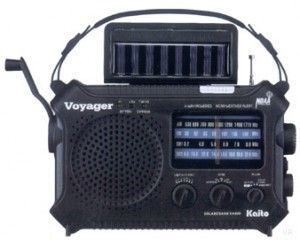
Kaito KA500This Christmas, my sister-in-law gave me a Kaito Voyager KA500 radio. This radio tunes

  • AM,
  • FM,
  • two shortwave bands:  3.2-8 and 9-22 MHz,
  • and the seven weather band frequencies: 162.400, 162.425, 162.450, 162.475, 162.50, 162.525, and 162.55 MHz.
It’s not the most sensitive SW receiver on the market, but it does pick up the big broadcasters, and I’ve had some fun playing around with it. There’s only a short whip antenna, and no external antenna jack, so that might be one reason the sensitivity is lacking. I haven’t yet tried clipping a longer wire onto the whip antenna.
I also wish it had a BFO, so that I could tune CW and SSB signals, but what do you want for $50 (at Amazon). There are several projects out there on the Internet for add-on BFOs, and TenTec even makes a kit, so I might be adding that on later.

One of the cool things about this radio is that there are six ways to power it:

  • dynamo cranking,
  • solar panel power,
  • three AA cells,
  • built-in Ni-MH battery pack,
  • optional AC adaptor, or
  •  from a computer via the USB port.

I played around with the cranking feature, and you get about a half hour of radio operation for each minute you crank. Having said that, you probably don’t want to do this all the time. Not only will your arm get tired, but I don’t think the dynamo was made for heavy-duty use.

Other neat features include a five-LED reading lamp on the rear panel and a LED flashlight on the side. The radio can also charge other electronic items. It has a bi-directional USB jack that can connect with many standard USB enabled items like iPods, cell phones, etc. It comes with six cell phone tips that charge many cell phone models.

Overall, this radio has been fun to play with, and in an emergency, it could prove to be very useful. For more information, there are a couple of YouTube videos showing off the features of the KA500. Here’s one from UltraTechLife.Com.

Related posts:

  1. 2015 General Class study guide: Section G4E – HF mobile installations; emergency and battery-powered operation
  2. My new ICOM IC-7300, part 3
  3. Random stuff: NBC on HI emergency comms, Echolink maker’s net, WebSDR
  4. CW or Voice During an Emergency?

Filed Under: Gear/Gadgets

Reader Interactions

Comments

  1. Don says

    January 13, 2013 at 1:33 pm

    Been looking at getting one of these myself. I like the hand-crank radio idea for power outages. We get at least one outage a year during the winter time, and when that happens we can be cut off from the rest of the world for at least several days.

    Reply
  2. Tom Smerk says

    January 13, 2013 at 6:05 pm

    1/2 hour of radio for every one minute cranking is very good – most I have seen are closer to the opposite – 1 minute of radio for every half-hour cranking!

    Reply
  3. Jim McCulloch says

    January 13, 2013 at 7:13 pm

    I have an old Freeplay Plus emergency radio with essentially the same features and performance. It’s great during our relatively frequent power outages, and is also very useful outdoors on sunny days. It will run all day on solar power. Cranking works fine, too.
    Very handy radios to fall back on when away from commercial power for any reason.

    Reply
  4. David N8SRE says

    January 14, 2013 at 3:35 pm

    My experience with small, whip-antenna shortwave receivers is that connecting a longer antenna usually results in front end overload.

    Reply
    • Dan KB6NU says

      January 14, 2013 at 8:48 pm

      Hmmmm. I hadn’t thought about that, but that’s certainly a possibility. I’m going to give it a go, anyway.

      Reply

Leave a Reply Cancel reply

Your email address will not be published. Required fields are marked *

This site uses Akismet to reduce spam. Learn how your comment data is processed.

Primary Sidebar

No Nonsense Technician Class License Study Guide (for tests given between July 2026 and June 2030)

New No Nonsense Technican Class Study Guide now available!

The 2026 version of my Tech Class study guide is now available, and as always, the PDF version is FREE!. The ePub version costs $9.97, and a Kindle version and paperback version will be available on Amazon shortly.

Click here to get all of my "No Nonsense" study guides.

Also available: The CW Geek's Guide to Having Fun with Morse Code

W5SWL.Com
Retevis Ailunce H1 DMR Radio
DXpander: Cobweb antennas, Laser Cutting

You’ve got mail!

Enter your email address below and get an email every time I publish a new post.

Email


I frequently teach classes to help newcomers get their licenses. The next class will take place on Saturday, February 7, 2026 on the University of Michigan campus. Click here for more information.

If you can't make the class, subscribe to the mailing list to be notified of when the next class will be held.

You can always download my free study guide, and if you have any questions about the classes, or amateur radio in general, please feel free to email me directly.

Support KB6NU.Com

Donate $7.30 and get two of these cool stickers. Measuring 4.25-in. W by 2.75-in. H, it's perfect for your car, your shack, or wherever!

Contact me

If you have a question or comment about one of my blog posts, or a question about any of the material in my study guides, or just a question about ham radio in general, you can email me at [email protected].

Blogs You Should Also Read

  • AE5X: A CW-centric blog from Kingswood, Texas
  • K0LWC Blog
  • LA3ZA Ham Radio Blog
  • Little Radios, Big Fun – WB3GCK
  • Mr. Vacuum Tube's Blog
  • Radio Artisan – K3NG
  • The K0NR Weblog
  • VE3WDM's QRP Ham Radio Blog
  • W2LJ’s Blog

Ham Radio Websites

  • Dashtoons – The Hammin' Comedy by Jeff K1NSS

Podcasts

  • ICQ Podcast
  • Linux in the Ham Schack
  • No Nonsense Amateur Radio Podcast
  • Resonant Frequency Amateur Radio Podcast

Recent Comments

  • Skip K4EAK on Button, button. Who’s got the button?
  • Ed K8MEJ on Is anyone running for the board this year in the Great Lakes Division?
  • Skip Behnke on 2020 Extra Class study guide: E9F – Transmission lines: characteristics of open and shorted feed lines; coax versus open-wire; velocity factor; electrical length; coaxial cable dielectrics
  • Mike on Map your contest QSOs
  • Phillip Cardwell on J-Poles

Meta

  • Log in
  • Entries feed
  • Comments feed
  • WordPress.org

Footer

Copyright © 2026 Daniel M. Romanchik, KB6NU · Log in