
• Skip to primary navigation
  • Skip to main content
  • Skip to primary sidebar
  • Skip to footer

KB6NU's Ham Radio Blog

KB6NU's Ham Radio Blog
  • HOME
  • Study Guides
  • Teach a One-Day Tech Class
  • W8SRC Repeater Guide
  • Advertise
  • Hire Me

building/homebrewing

Two Radios for You to Build

December 5, 2010 By Dan KB6NU 1 Comment

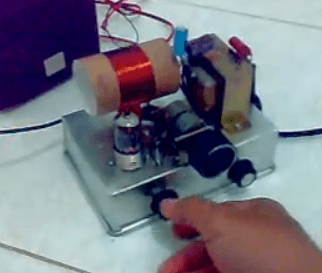
On the AMRAD mailing list, Andre, N4ICK, posted a link to the YouTube video, “12AU7 regenerative radio on a tin bake plate” (see photo at right) It’s a very cool regenerative radio made with a single 12AU7 vacuum tube. The only problem is that there are no links to the schematic for the radio.

So, I Googled a bit, and came up with this circuit. The cool thing about this circuit is that it uses a 12V power supply, not the high voltage power supply normally required for a tube circuit.

Over the weekend, I went to a big rummage sale sponsored by the local Kiwanis club. They had quite a few aluminum baking pans there for very little money. I should have picked up a couple of them. :)

Simliar Radios
VK3YE has also posted a YouTube video
of his experiments with a similar circuit. Unfortunately, he also doesn’t include a link to a schematic.

Another related YouTube video is for a one-transistor radio. This is actually a very well-done video. It shows you step-by-step how to build the radio. This is something that we may actually be able to do down at the museum with some kids.

At the very least, watching the videos is amusing. At best, maybe they’ll inspire you to do a little experimenting.
Filed Under: Building/Homebrew, Receivers, Vintage Radio Tagged With: building/homebrewing, receivers, vacuum tubes

Great Lakes Division Survey A Bust

November 3, 2010 By Dan KB6NU 5 Comments

Jim Weaver, K8JE, the Great Lakes Division Director recently conducted an online survey. He asked a curious combination of questions, and in my opinion, got back a curious combination of answers.

For example, question #2 asked, “What is your favorite Amateur Radio activity?” 27.4% answered “Emergency/Public Service Communications,” while only 8.4% answered “Contesting.” That just doesn’t seem right.

Another example is question #9, “Did you vote in the last election for ARRL Great Lakes Division Director and the last election for the ARRL Section Manager for your Section?” Approximately 70% said that they had voted in the last election.

Well, that is a number that certainly doesn’t make any sense. As some of you may remember, I ran for Vice Director in the last election. 3,578 votes were cast in that election. That’s certainly not 70% of the membership in the GL Division.

Based on these two questions alone, I’d question the usefulness of the numbers produced by this survey. I don’t think that it even reflects how the division’s ARRL members feel about the hobby, much less the amateur population in general. I hope that Weaver isn’t planning to use this survey when deciding how to vote on issues.

Filed Under: ARRL Tagged With: building/homebrewing

Fritzing: The Latest in Electronics from Those Wacky Germans

October 26, 2010 By Dan KB6NU Leave a Comment

According to the website Fritzing.Org:

Fritzing is an open-source initiative to support designers, artists, researchers and hobbyists to take the step from physical prototyping to actual product. We are creating this software in the spirit of Processing and Arduino, developing a tool that allows users to document their Arduino and other electronic-based prototypes, and to create a PCBlayout for manufacturing.

Despite the wacky name, this looks like very cool software. Just avoid using the phrase, “I’m fritzing around with this circuit.” Someone’s going to have to develop a module for Manhattan-style layout, though.

Watch this video:


Filed Under: Building/Homebrew Tagged With: building/homebrewing

Random Links

October 16, 2010 By Dan KB6NU 2 Comments

Here are some more links to websites that ham radio ops will find amusing and/or useful:

  • Climbing a really tall tower. Ever wonder what it’s like to climb a tower nearly 1,800 feet tall? Watch this video.
  • Software for people who build things. Although some of the software on this site is fairly old, it also has an amazingly huge collection of hints and kinks on a wide variety of topics. For example, there is a great tip on how to estimate a tap or drill size.
  • Social networking for hams. Although most hams seem to be anti-social, not all of us are. This is a website for those that aren’t.
  • QRQ CW Info, Ops, and Tips. More social networking, but for hams that like to work CW at high speeds. Most of these guys go a lot faster than I can, but I’m hoping to learn something from them.

Filed Under: Antennas, Building/Homebrew, CW, Online Resources Tagged With: antennas, building/homebrewing, CW, Online Resources

Book Excerpt: Oscillators

September 24, 2010 By Dan KB6NU Leave a Comment

Robert Lacoste writes The Darker Side column in Circuit Cellular, and now he has published a book, Robert Lacoste’s The Darker Side: Practical Applications for Electronic Design Concepts from Circuit Cellar. Topics covered span digital signal design to avoiding interference. EETimes’ RF Designline has published an excerpt from Chapter 4, which covers oscillators. There are five parts:

  1. Introduction to oscillators, including piezoelectricity and how a crystal works.
  2. How to adjust a crystal, depending on whether it is to be used as a parallel resonant frequency element or a series resonant element.
  3. A classic quartz-based CMOS oscillator.
  4. How to accurately determine oscillator start up time and stability.
  5. What happens at higher frequencies (overtone mode)?

Filed Under: Building/Homebrew Tagged With: building/homebrewing

DIY With Perfboard

August 4, 2010 By Dan KB6NU Leave a Comment

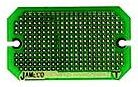
Altoids proto board
This perfboard was designed to fit into an Altoids tin.
Here’s a Make: magazine video on the Jameco Electronics website that shows you how to build circuits on perfboard and talks about the different types of perfboard that are available. Despite the fact that the narrator seems very nervous, it’s a good video explaining how to do this.

Jameco has a lot of different types of perfboard available. At left, you can see a perfboard that measures 1.6-in. x 2.7-in., which will fit nicely into an Altoids tin. It seems a bit expensive at $5.49, but it will make building a circuit easier to do, and if you don’t like what you built, you can always remove (carefully) the components and try something else.

Filed Under: Building/Homebrew Tagged With: building/homebrewing

I Finally Have a Mini Solder Pot

July 27, 2010 By Dan KB6NU 6 Comments

Two years ago—almost to the day—I wrote about making a min-solder pot to tin toroid leads. Well, now I finally have one.

Sunday, at the museum, Jim, K8ELR, brought down all of the soldering irons he’d ever purchased to try them out in building the little QRP transceiver kit he just bought. The results of that may be the topic of another blog post, but one of the irons he had was a 25 W Weller pencil iron.

“Aha,” I thought, “this would be perfect for the mini-solder pot.” I convinced Jim to let me take the iron home with me and convert it by noting that his kit had several toroids whose leads were going to need stripping and tinning.

I  did that tonight. I carefully hacked off the end of the soldering iron tip and filed it down. Then, I carefully drilled a 5/64-in. hole about 3/16-in. deep. I then widened the hole to 3/16-in. The hole in the tip wasn’t exactly centered, but I didn’t break through the sidewall of the tip.

I plugged in the iron, heated up the tip, and filled it with solder. I dipped a short piece of enameled wire, and a couple of minutes later, I had a perfectly tinned lead! It had worked like a charm. In about 15 minutes, I had eliminated one of the most odious tasks associated with kit building. This is going to be well worth the effort.

Filed Under: Building/Homebrew Tagged With: building/homebrewing

Tube Tip

June 23, 2010 By Dan KB6NU Leave a Comment

Here’s a great tip from the 6/23/10 ARRL Contest Update:

Uh-oh! You dutifully cleaned off all of your vacuum tubes to make them shiny and the numbers came off with the dirt! Pat AA6EG saves the day – “Put the tube in the refrigerator, cool it down, then bring it into a warm room temperature environment. There will be moisture condensing on the glass envelope, sometimes leav[ing] a readable outline of the tube numbers.”

If you have any tubes at all in your junkbox (mine’s more like a junk closet), you’ll undoubtedly have some that you can’t identify.

Filed Under: Building/Homebrew Tagged With: building/homebrewing

Good Advice on Toroids

April 20, 2010 By Dan KB6NU 1 Comment

On the QRP-L mailing list, a ham asks:

I know this should be a simple answer, but I’m having a hard time finding it. I am interested in building a EFHW coupler similar to the one on AA5TB’s site. He uses #22 AWG magnet wire.

I’m interested in using something less stout which I have on hand (e.g., #27 AWG magnet wire). Is there a calculator to determine how this would affect the number of turns on the transformer, or am I incorrect in thinking that it would make a difference?

Diz, W8DIZ, replied:

No calculator that I know of.

  1. Smaller wires have less current capacity before heating – bad thing.
  2. Smaller wires have less capacitance between windings (if same # of turns) – good thing.
  3. Wire size (for all practical purposes) does not determine inductance.

Filed Under: Building/Homebrew Tagged With: building/homebrewing

The New ARRL Website

April 16, 2010 By Dan KB6NU 19 Comments

I recently got an e-mail from a reader who wondered why he was the only one to have commented here on the ARRL’s new website. “Alas,” he asked, “Am I the only user left on the ARRL site, or are all of the new hams simply illiterate and just looking at the pictures, or, are they all only hanging around eHam.net these days”?

My reply was, “I don’t think that most hams give a hoot about the new ARRL website.”

My take on it is that it’s a fancier design, but it’s not any easier to use than the old one. In fact, in some important ways, it’s more difficult. For example, there used to be links on the home page to the club search and exam search pages. Now, you have to make two or three clicks to get to those pages.

I cruised around the club section a bit and didn’t note any new content there. My gripe about the old website was that the content really needed some updating. In my short foray onto the new site, I’d have to say the same thing. The only thing that the new site adds is a new wrapper. Of course, I have to admit that my brief bit of web-browsing was not very extensive, so this criticism may be unfair.

What do you think? Do you think it was worth all the time and money they spent on it?

Filed Under: ARRL, Online Resources Tagged With: building/homebrewing, Online Resources

  • Page 1
  • Page 2
  • Page 3
  • Page 4
  • Go to Next Page »

Primary Sidebar

No Nonsense Technician Class License Study Guide (for tests given between July 2026 and June 2030)

New No Nonsense Technican Class Study Guide now available!

The 2026 version of my Tech Class study guide is now available, and as always, the PDF version is FREE!. The ePub version costs $11.97, and a Kindle version and paperback version will be available on Amazon shortly.

Click here to get all of my "No Nonsense" study guides.

Also available: The CW Geek's Guide to Having Fun with Morse Code

W5SWL.Com
Retevis Ailunce H1 DMR Radio
DXpander: Cobweb antennas, Laser Cutting

You’ve got mail!

Enter your email address below and get an email every time I publish a new post.

Email


I frequently teach classes to help newcomers get their licenses. The next class will take place on Saturday, October 10, 2026 on the University of Michigan campus. Click here for more information.

If you can't make the class, subscribe to the mailing list to be notified of when the next class will be held.

You can always download my free study guide, and if you have any questions about the classes, or amateur radio in general, please feel free to email me directly.

Support KB6NU.Com

Donate $7.30 and get two of these cool stickers. Measuring 4.25-in. W by 2.75-in. H, it's perfect for your car, your shack, or wherever!

Contact me

If you have a question or comment about one of my blog posts, or a question about any of the material in my study guides, or just a question about ham radio in general, you can email me at [email protected].

Blogs You Should Also Read

  • AE5X: A CW-centric blog from Kingswood, Texas
  • K0LWC Blog
  • LA3ZA Ham Radio Blog
  • Little Radios, Big Fun – WB3GCK
  • Mr. Vacuum Tube's Blog
  • Radio Artisan – K3NG
  • The K0NR Weblog
  • VE3WDM's QRP Ham Radio Blog
  • W2LJ’s Blog

Ham Radio Websites

  • Dashtoons – The Hammin' Comedy by Jeff K1NSS

Podcasts

  • ICQ Podcast
  • Linux in the Ham Schack
  • No Nonsense Amateur Radio Podcast
  • Resonant Frequency Amateur Radio Podcast

Recent Comments

  • Dan KB6NU on The EMF Explorer: A badge for ham radio?
  • Travis Good on The EMF Explorer: A badge for ham radio?
  • MARTIN ROBERT ROTHFIELD on The EMF Explorer: A badge for ham radio?
  • Mike Chen on Operating Notes, January 5, 2026
  • Rob W4ZNG on The EMF Explorer: A badge for ham radio?

Meta

  • Log in
  • Entries feed
  • Comments feed
  • WordPress.org

Footer

Copyright © 2026 Daniel M. Romanchik, KB6NU · Log in