
A couple of days ago, Thom, W8TAM e-mailed me:
http://www.ad5x.com/images/Articles/FrontEndProt.pdf
That’s pretty compelling, and not a long parts list for the first circuit. Thoughts?
He was looking for a way to protect the front end of his SDR receiver when he was transmitting. I replied:
This circuit was designed to be used in a contest station, and actually switches out the receiver protection while you’re transmitting. Not only that, it seems way too complicated for your application. Here are some other ideas:
AY Technologies RIP-1 Receiver Isolator/Protector. This device simply switches out the antenna and shorts the receiver antenna when you transmit. I don’t know what the price is as the website says, “At this time, we are not manufacturing products on a regular basis, but we continue to provide them according to customer requests and our available time. Please contact me by e-mail to inquire about pricing and availability of our products Our “Products” listing shows what types of products may be available.” AY Technologies is, apparently, a one-man operation run by Gary, K9AY, who I think has some good technical chops.
OK1RR’s Yet Another Front End Saver. This does basically the same thing but uses three relays and a couple of transistors. The extra relays disconnect the antenna and connect the AMP KEY output. (The AY Technologies device uses a DPDT relay to switch the antenna in and out and does not have a relay for the AMP KEY output.) OK1RR also has some good technical chops.
Array Solutions AS-RXFEP Receiver Front End Protector. I kind of like this one, as it doesn’t appear to need any control signal. It costs $55, though. The schematic is at https://www.arraysolutions.com/images/AS-RXFEPdatasheet.pdf. The white packages contain transformers. It looks like they are Mini-Circuits transformers, and you can probably get them for $5 or less.
Thom replied that the AD5X circuit could, of course, be built without the relay, something I hadn’t thought of. That makes the circuit much simpler:
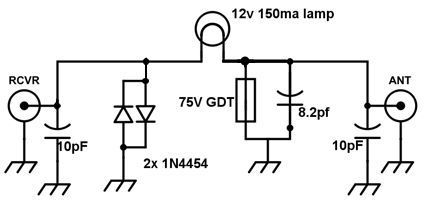
He’s going to go ahead with the AD5X circuit. Anyone else have some other thoughts about this?
In the AD5X circuit, the diodes, lamp and GDT are intended to dissipate any stray RF picked up during transmissions. Your circuit has them inline during transmissions. Unless you’re operating QRP, they won’t last long and your SDR front end will be toast.
Only the lamp is in-line, and the circuit is only used for receiving, not transmitting. In the article describing the circuit, AD5X says, “A receiver protection technique that has been around for years is to use a small incandescent lamp in the receive path followed by shunt back-to-back diodes. The lamp provides minimal mismatch and insertion loss under normal receive conditions, but acts as a current limiter and fuse under high-signal conditions.”
Oops. I assumed it was connected to a tranceiver.
Hey Rick.
Just for clarity, this circuit is to protect the front end of my SDRPlay. A receive only SDR I purchased recently. Prior to upgraded to the SDRPlay, I was using a RTL-SDR blog adapter, with a Nooelec HAM-it-up upconverter, and a 9A4QV LNA4HF pre-amp. The SDRPlay is much more sensitive than my previous setup. I never worried about overloading the old setup.
I use the SDR with HDSDR to cat control my FT-450d. With HDSDR + an SDR I can see an entire band, and tune the FT-450d with a click of my mouse.
My lot is fairly small, and I want a decent length receive antenna on my SDR. Since my lot is much longer than wide (120’x70′), I’m stuck running the long wire receive antenna broadside to my doublet. Even with as much separation as I can get between the two antennas, I overload the SDRPlay with even QRP signals.
I won’t be transmitting out of the SDR, so I believe it’s no problem to have this in the antenna path all the time.
So I just need a Y cable at the ant point to connect both my xcvr and this box?
No. Thom is using a separate receive antenna for his SDR.
I am gong to use a separate dedicated receive only antenna for the Second Receiver in my K3S. I will use AD5X’s control circuit, and use the relay contacts to switch the antenna in and out by PTT. Antenna will be grounded on trasmit. Hope this helps.
SDRs typically cover up to perhaps 2 GHz. Having 10 pF and 8.2 pF and (after the lamp) another 10 pF across the signal path, not to mention the junction capacitance of the diodes, offer a reactance of well below 4 ohms. Not quite a dead short, but this circuit will attenuate the higher frequency bands. Should be fine at HF I suppose.
The purpose of the lamp would be to limit current through the diodes, and its cold resistance will be about 10x lower than its hot resistance.
P.S. The capacitors are drawn upside down (it can matter in some instances which side the outer shield is connected to), and the 8.2 pF has a ‘short’, LOL.