
VK6FLAB (yes, that’s a real callsign, despite the four letters in the suffix) posted this to the amateur radio subreddit about a month ago. He has graciously allowed me to publish it here…..Dan
In my travels around the internet I’ve come across many and varied versions of Morse-code charts. From the incomprehensible through to the impenetrable, through to incorrect, incomplete and more.
-
Here’s one that is mostly right, though incomplete, but refers to the elements as dots and dashes: https://upload.wikimedia.org/wikipedia/commons/thumb/b/b5/International_Morse_Code.svg/315px-International_Morse_Code.svg.png
-
Here’s an example of something that tries, but if you actually attempt to use it, you’ll go insane: http://www.learnmorsecode.com/pix/learn.gif
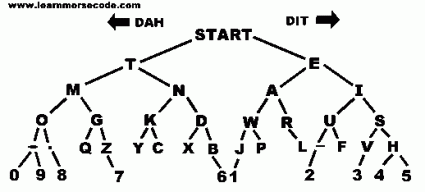
I always found this chart amusing. While it actually does document the correct dits and dahs, as VK6FLAB points out, you’ll go insane trying to use it. -
Here’s one that adds a whole lot of complexity, invents a few new characters – in the form of “Abbreviated Numerals” and refers to Pro-Signs with phrases, “Closing Down” is apparently the same as the Pro-Sign “SK”: https://i0.wp.com/wildernessarena.com/main/wp-content/uploads/2015/06/The-International-Morse-Code.jpg?resize=1024%2C769
-
This one adds the International Phonetic alphabet, but is inconsistent in its use, compare “Niner” and “One”, or “Four”: https://www.otasurvivalschool.com/wp-content/uploads/2016/01/Morse-Code-and-Phonetic-Chart.jpg
-
If you think the representative bodies make it easier for you, nope. The ARRL has this abomination – which you can’t even link to, under “Morse Code Alphabet”: http://www.arrl.org/learning-morse-code
-
The WIA in Australia doesn’t appear to have a reference, referring you to the FISTS Down Under Morse Preservation Society, which also doesn’t actually appear to have a reference. The regulator in Australia, the ACMA has this as a reference, but appears to have invented a few new signals – “End of Transmission”, for example: https://www.acma.gov.au/Industry/Spectrum/Radiocomms-licensing/Apparatus-licences/morse-code-signals
-
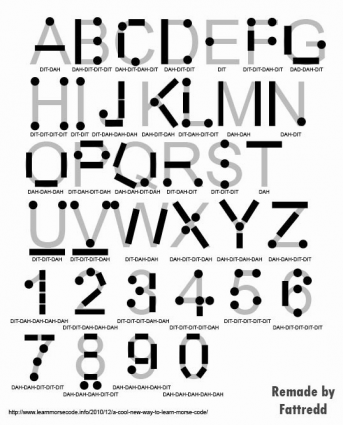
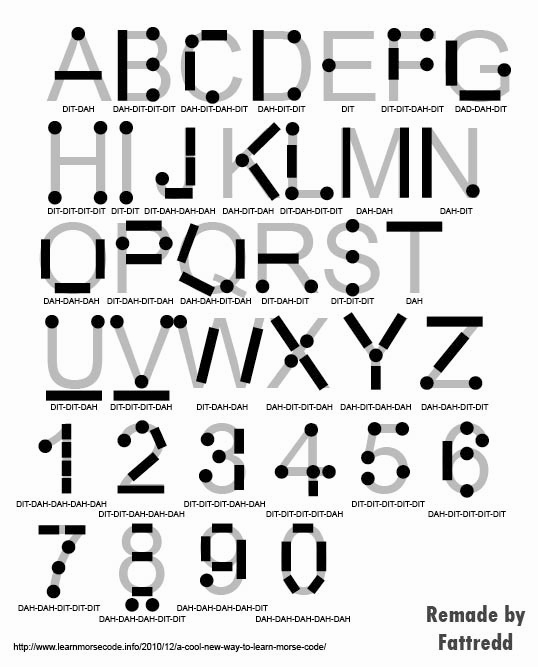
This abomination finds its way onto social media every few weeks: http://www.learnmorsecode.info/wp-content/uploads/2012/05/ditdah.png
-
Here’s a marginally better version, which actually shows the code in order: https://www.vectorstock.com/royalty-free-vector/latin-alphabet-in-international-morse-code-vector-9898048
-
This one is labelled for survival, so you know it’s good: https://survivalized.com/wp-content/uploads/2016/07/MorseCodeAlphabet.jpg
-
This invents the number “10” in the name of poetry: https://thatsmaths.files.wordpress.com/2017/06/morse-code-symbols.jpg?w=553&h=411
-
This appears to be what was state of the art in 1916 to educate the Girl Guides with: https://upload.wikimedia.org/wikipedia/en/6/69/Morse_Code_Mnemonic_chart_from_Girl_Guides_handbook_1916.jpg
-
This one introduces a “fraction bar”, whatever that is, or a “parenthesis”, not sure which one or how to use it, not to mention that the dits are bigger than the dahs: https://www.omniglot.com/images/writing/morsecode.gif
-
This one is from the Encyclopaedia, so you “know” it’s “right”: https://cdn.britannica.com/668×448/87/2787-004-637257B2.jpg
-
This one has lots of pretty colours: https://ece.uwaterloo.ca/~dwharder/Morse_code/images/examples.png
-
This one helps you understand by showing both the UPPER and lower case letters: https://de.tek.com/sites/default/files/media/image/morse%20code.jpg
-
It’s always helpful to refer to symbols by their name, so you know which one it is: http://web.cecs.pdx.edu/~caleb/aa7ou/ham_pages/images/morseb4.gif
-
It’s important to get numbers right if you’re playing Call of Duty, but don’t stress about the letters: https://vignette.wikia.nocookie.net/callofduty/images/f/f0/Morse_Code_Guide_IW.png/revision/latest?cb=20170425145920
-
If you prefer power-point, there’s 16 pages here: https://www.slideshare.net/JosephAmes1/introduction-to-the-international-morse-code
-
Nothing like switching from one type of Morse to another, or introducing new terms: https://st3.depositphotos.com/1032239/16730/v/1600/depositphotos_167302398-stock-illustration-morse-code-letters-and-numbers.jpg
-
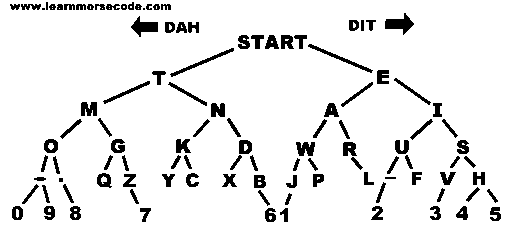
By the time you’ve figured out which letter came past, you’ll have died of old age: https://www.dcode.fr/tools/morse/images/tree-dot.png
-
Apparently if you use dots to make a font, that’s Morse too: https://creativemarket.com/funfontshop/250620-Morse-Code-Font
-
This one was missing some bits, so they were scribbled in: https://s3.amazonaws.com/gs-geo-images/df016c5a-bd7e-4e40-997c-87d853942311.jpg
-
Apparently it’s OK to use the same code for a T and a 0, as well as for a 5 and an S (this is American Morse, historical interest only): https://www.willowbunchtelegraphoffice.ca/media/american_morse_code.png
-
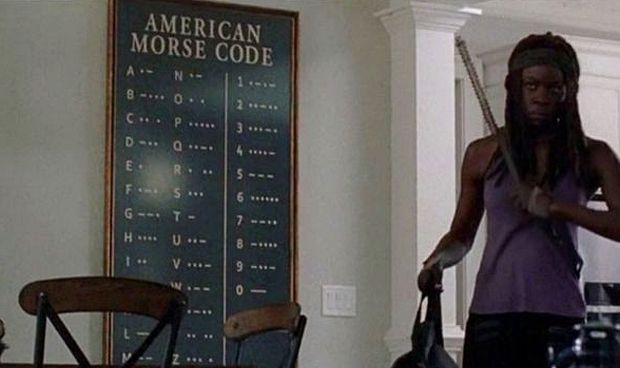
And then there’s this one. Words fail to express (NOT American Morse, check out the A and the N): http://cdn1us.denofgeek.com/sites/denofgeekus/files/2016/11/the-walking-dead-morse-code-michonne.jpg
My point?
Well, it’s hard enough to learn the code, but a definitive reference I have yet to find that shows all the code, with their standard symbols, the pro-signs, their usage and meaning.
Should it really be this hard?
Edit: Added the hilarity that the Walking Dead TV Series contributed to the conversation.
Edit 2: Pointed out that the Walking Dead chart is actually wrong, not just American Morse.
FINAL NOTE: The definitive reference—for the International Morse Code, anyway—is ITU Recommendation M.1677-1 (10/2009) – International Morse Code. Unfortunately, the standard does not have a chart like the ones above.
You should check out the original post. If you’re interested in this kind of thing, the comments are worth reading.
Charts can be a downer. Learning morse code by symbols just slows you down. Morse is best learned by whole letters and numbers, not symbols! HEARING AND WRITING is the key. As you progress you will graduate from paper to hearing whole words at once!
I don’t think the dah-dit tree is meant for learning Morse, but it does show that the code efficiently uses the code space. It is close to optimal. An optimal code would swap some of the numbers with the punctuation codes, but that would be harder to learn.
The Wikipedia entry on Morse has a more thorough tree and properly includes a link to Huffman Coding, a provably optimal code.
https://en.wikipedia.org/wiki/Morse_code#Alternative_display_of_common_characters_in_International_Morse_code
Interestingly, none of these is the chart that I learned from in 1970. That one had the dots and dashes in the letter shapes, with the letters in frequency order: ETAOIN SHRDLU.
If I recall correctly, when I first saw the learnmorsecode.com “tree” chart, it was an illustration how one might design a software algorithm to decode Morse by deciding whether each element in sequence was a dit or dah. It was not intended to illustrate how a person should learn Morse.
73,
Larry K8MU
Found another one. This is the alphabet only, but the few I checked out are correct. Clever, if not generally helpful.
https://www.johndcook.com/blog/2022/02/25/morse-code-in-musical-notation/
All I want is a chart showing both American morse and International mores kTrying to use for a dispalay I don not need all theis kBS kcmparisons onlya a chart. I ahave been a railroad telegrapher since 1956 and in the military for a year or so on international. All I want is a chart comparing the dwo. No other BS needed.