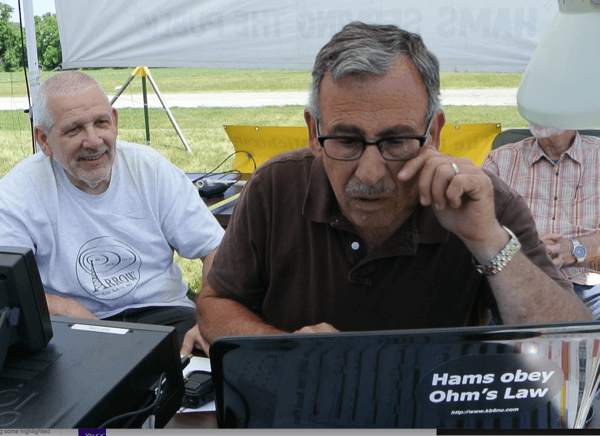
2011: Year of the Elmer?

Here’s another thought-provoking article from Mike, W2JMZ. Think you can find someone to Elmer in 2011? Should we really strive to get to the one million mark, or is quality better than quantity?

Dan KB6NU

===========================================================

2011: Year of the Elmer?

By Mike Zydiak, W2JMZ

If it hasn’t happened already, there will soon be more than 700,000 licensed radio amateurs in the U.S. While that may seem an impressive number, we really need to hit the one million mark to ensure the future of our hobby and to prevent commercial interests from stealing our frequencies. That number will give amateur radio the serious political juice required to impress our elected officials and the agencies which regulate and/or have some effect upon our ham radio activities.

So, how are we going to recruit 300,000 brand new hams? By making the effort to do so. I hereby declare that 2011 be designated the “Year of the Elmer.” Furthermore, I am going to declare that it is the responsibility of each and every able-bodied amateur radio operator to bring at least one new ham into the fold so that the new license statistics for the year 2012 are blown off of the chart.

Unfortunately, we can’t all be Elmers:

  • Silent Keys (SKs). Every month, QST lists between 150 and 250 deceased hams–also known as “Silent Keys”–and unfortunately, not all SKs are listed there. In all, I estimate that 5,000 licensees become SKs each year.
  • Other elderly hams. We also know that there are many elderly hams who are no longer active for one reason or another. I would guess that there may be up to 40,000 hams who are no longer physically able to get on the air or live somewhere where they cannot set up a station or put up an antenna.
  • Those who have lost interest. There are also many hams out there who once embraced the hobby, but who have since lost interest. Their names appear in the FCC database, but they are hams in name only. They will disappear as soon as their license expires. A conservative estimate of the number of hams in this category is 75,000.
  • Hams in name only. There are many hams who renew their licenses whenever they expire, but as a result of circumstance, are not really active at all. There may be up to 100,000 hams who are just too busy taking care of kids, serving in the military, going to school, or simply making ends meet to be active.
  • Newcomers. I would guess that there are perhaps 25,000 hams who need a little more seasoning, i.e. experience, before they can become effective Elmers.
  • Those we don’t want to be Elmers. Here, I’m referring to those nasty, mean, unsociable, and perhaps even criminally-inclined, hams who we don’t want to come anywhere near a newbie. I’ll guess that there are 35,000 in this category.

If you add up those numbers, you get 280,000, and if you subtract that from 700,000, we are left with perhaps 420,000 or so amateur radio operators who are currently active to some degree. Recognizing that not everyone of those 420,000 will want to Elmer someone or be able to Elmer someone, I’m going to be optimistic here and say that out of those 420,000 active hams, we can get 250,000 Elmers, and if each one of those 250,000 Elmers recruits just one new ham in 2011, we’ll be awfully close to the magic number of 1 million.

Now will everybody stop laughing so hard and think about this seriously for just a moment. I’m not kidding here… this is really doable.

It could be one of your friends that sees your shack for the very first time, and is totally mesmerized by the toys and what you can do with them. It could be one of your own kids, or one of their friends, both of whom really really need to be distracted from their Nintendos, the trashier parts of the Web, texting their buds day and night, or hanging out with who knows who at who knows where.

It could be any number of those inquisitive people who wander over at Field Day, or at some public place where you are set up, or who might simply stop by unannounced at your next ham club meeting. These are folks that are easy to entice into the hobby, if only someone remembers to get their name, address, phone number and email address, and then carefully follows up a few days later.

For me, it’s the people I work with that are searching for some serious wholesome activities to do with their children. This month, I am helping one of the men that works for me and his thirteen-year-old son get their Technician licenses. With any luck, I’ll have two new hams to my credit by the end of summer.

There are many opportunities out there. You just have to recognize them. For example, one of my very close friends is a Cub Scout and Boy Scout leader. He occasionally wakes me up way too early on a Saturday morning to participate in some sort of hike in the area. I’ve promised my friend that this season I’m going to put together a few pounds of QRP in a knapsack, and with a lot of very impressionable onlookers, I’m going to make some four watt HF CW contacts out in the middle of nowhere. As I’ll have an eager bunch of strong healthy kids with lots of woodcraft under their belts, I won’t even have to do very much to get things set up, or to work very hard at all to string up the antenna in and over the trees.

Remember, all I’m asking is that each one of you gets just one spouse, friend, neighbor, or colleague interested in ham radio.

If any of you are graphically inclined, perhaps you could design a really slick “Elmer Patch” with a space for a pin that would indicate the number of new hams that the wearer has responsible for. I would be more than glad to arrange to get the patches and pins made, and then distributed at cost through the clubs. Sort of like an Elmer Honor Roll.

This really is doable. WATSA, OMs?

Calling All Rookies – Get on the Air for the Rookie Roundup

From the 2/18/10 ARRL Letter:

The ARRL Rookie Roundup is designed to help newly licensed amateurs build their operating skills on HF. It is a contest specifically for those new to Amateur Radio, similar to the ARRL Novice Roundup that ran from 1952 until 1995. The Rookie Roundup brings the fun and Elmering of the old Novice Roundup into the 21st century. Three Rookie Roundups will be held each calendar year: SSB in April, RTTY in August and CW in December.

The Rookie Roundup will be scored 100 percent in real time through the www.getscores.org scoring system. There are three ways to participate: by using your favorite logging software with the real time scoring support, by downloading a simple logging program from the www.getscores.org Web site or by logging your contacts directly into a www.getscores.org Web page. No separate logs are required — it all happens online in real time and final scores will be available online within hours of the end of the contest! More information is available on all of these options at www.getscores.org. Of course, you can get on the air and make contacts without logging them, but you won’t have as much fun!

Who Can Participate?
Any ham licensed for 3 years or less qualifies as a Rookie. If you were licensed in 2008, 2009 or 2010, you can compete in the 2010 Rookie Roundup. Non-Rookies may only work Rookies, while Rookies may work everybody. A major part of the success of this contest will be non-Rookies getting on the air and working the Rookies, just as in the Novice Roundup. Just like in the Novice Roundups of years past (when Novices could work anyone and non-Novices could only work Novices), Rookies may work anyone, be they Rookie or non-Rookie; however, non-Rookies are limited to only working Rookies.

Entry Categories
Single Operator Rookie, limited to a maximum of 100 W. Spotting assistance or using call sign and frequency alerting systems is allowed, but self-spotting or asking somebody to spot you is not. All Rookies must identify themselves as a rookie. Example: “Kilo Bravo One Quebec Alfa Whiskey, Rookie.” Non-Rookies only need give their call; no designation is needed.

Awards
Certificates will be available for all participants to download. The top five high scores from each US call area, Canadian province and Mexican call area will be recognized on their certificate. No national winners will be recognized.

Go to www.getscores.org for more information on how to participate. Be sure to check out the April 2010 issue of QST for complete rules and other information. The Rookie Roundup — a fun event for all amateurs!

Sounds like fun to me. Every Elmer should get on and participate along with the rookies.

Stuart Gets on the Air

After several months, we finally got Stuart, KD8LWR, on HF from his home. The first hurdle was deciding on what antenna to put up. This choice was complicated by two factors:

  • Stuart’s family lives in a relatively new subdivision carved out from a farm field, with absolutely no trees to hang an antenna from.
  • The homeowner’s association had some antenna restrictions.

Jack, Stuart’s father, met with the homeowner’s association and got them to agree to let him put up a trap vertical, and after some back and forth, we decided to put it towards the back of his lot near some pine trees. In that spot, it’s away from the house, and the pine trees hide it from plain view.

The antenna they purchased was a Hustler 4BTV, and we put it up Sunday afternoon. It took us about two and a half hours to construct the antenna, cut and lay the radials, and run the coax in a shallow trench from the antenna to the house. We started at 3 pm and finished just as it was getting dark. I was hoping that we wouldn’t have to do much in the way of tuning, as this would be pretty much impossible in the dark.

I used the dimensions called out in the instructions, and was kind of surprised to find that the resonant point on 40m was actually around 7150 kHz. The SWR at 7030 kHz was about 1.5:1, meaning that Stuart could work pretty much the entire CW portion of 40m. I didn’t get a chance to check the SWR on any of the other bands.

The rig Stuart’s using is a Kenwood TS-140 that had been donated to the museum. We connected the antenna to the rig, and it came to life. Unfortunately, the band had gone out by this time, and there was very little activity. We did copy a PA5 around 7026, and that was exciting, but there were very few stations on.

Actually, it didn’t matter. We couldn’t transmit anyway. It slipped my mind that the TS-140 didn’t have a built-in keyer, and I didn’t make a cable to connect Stuart’s old MFJ keyer to the rig. Transmitting would have to wait until Monday.

Monday evening, around 7:30, I returned with the cable. We tuned around a bit, but again the band had gone out, and we could hear only a very few weak stations. Stuart called CQ a couple of times, but without any success. I then suggested that I go home and we work a little ground wave.

It took me about twenty minutes to get home, and Stuart was waiting for me. We got coordinated using one of the local repeaters, and soon we were having our first CW QSO. After a nice 20-minute contact, it was time for Stuart to hit the sack, so we said 73.

I’m sure that will be the first of many contacts. I still need to get over there and tune up the antenna a bit more, but I think it’s going to work out very well. So, be listening for him, especially on 40m CW, and when you do contact him, tell him that you read all about it on this blog. :)

Stuart’s First Kit

Many of you are familiar with Stuart, KD8LWR, my newest Elmeree. Since visiting us at Field Day, he’s gotten his ticket and made many contacts on 2m FM and EchoLink, and we’re working on how to get him on HF CW.

Well, yesterday was another milestone. He attended his first ham club meeting and built his first kit. Yesterday, we built things at the ARROW meeting.

We started Stuart out with a Wee Blinky kit from DaleWheat.Com. This is a great little kit for beginners. It consists of 11 components—two LEDs, four resistors, two capacitors, two transistors, and a 9-V battery snap. There are only 24 solder joints to make.

I had to show Stuart how to form the leads and insert the components, and I also showed him how to solder them to the board. These steps were a bit awkward because I didn’t think about providing some kind of fixture for holding the board. That really would have been a help for someone building his first kit.

Even so, Stuart did a great job, and when we connected the battery, it worked! That’s more then I can say about the first kit I built.

Plug for Dale Wheat
Since Dale Wheat donated a bunch of the Wee Blinky kits to the recently-held A2 MiniMaker Faire, and ARROW benefited by getting passed a few of the extra kits, I thought I’d give Dale a plug here. Thanks, Dale!

Dale has another kit that may be of interest to radio amateurs. His Smart Battery Meter “measures the ‘state of charge’ of a 12 volt or 24 volt sealed, lead-acid battery system. It uses a multi-color array of LEDs to give an instant visual indicator of the remaining charge, sort of like a gas gauge.”

Does Your Club Have an Elmers List?

Whilst looking up information on this Sunday’s hamfest in Monroe (http://www.mcrca.org/hamfest.htm), I came across their Elmer page. On it, they list a variety of topics with the name, call, and phone number of someone who can answer questions on that topic.

My club something similar once, but it was less than successful. I think that the problem was that we asked people to fill out a form on our website if they needed any help. That information was e-mailed to one guy, who then forwarded it to the appropriate Elmer. There was just too much time lag between the time someone asked for help and when they got it. Or, it may have been that filling out the form was just too impersonal.

We are going to try it again, though, using the format that the Monroe club uses. I’m also going to give it more billing on our website, and push it more at meetings and other gatherings.

The topics the Monroe club lists on their website are:

  • Antennas
  • Buying First Radio
  • Code Practice
  • Computers
  • Packet
  • County Hunting
  • DXCC Awards
  • Rag Chewers Club
  • Worked All States
  • DX
  • FM
  • Homebrew
  • Testing
  • Public Service
  • Technical Q&A
  • Traffic
  • Tube Radios

We already have Elmers for several of these topics. I, for example, would be more than happy to volunteer to be the Morse Code/CW Practice Elmer. We have one member who is an avid County Hunter, another who restores vintage gear, and yet another who’s been spearheading a statewide effort to set up a packet network throughout Michigan.

In addition, I think we should add or modify several of the categories. For example, Computers might become “Computers/Software” depending on who volunteers to be the Elmer. We should also have Elmers for VHF/UHF, Contesting, and possibly a bunch of other topics.

We’re now in the middle of discussing what topics we should add to the list and recruiting Elmers. I’ll update this topic when we’ve finalized our list.

Does your club have an Elmer list? If so, does it have topics that I haven’t thought of yet? How do you get newcomers to take advantage of the knowledge and experience of your Elmers? And, finally, what topics have you volunteered to be Elmer for?

Last Weekend in Ham Radio at KB6NU

Friday night, I played Elmer. One of the guys who was in my General class last year built a Norcal 40 and needed some help aligning it.

We got the receiver portion going quite nicely, but the final amp didn’t want to work for us. Unfortunately, we ran out of time before we could debug the thing. We did narrow it down, though, to the few components in the final amp circuit, so it shouldn’t be too difficult for my friend to finish the debug.

The Norcal 40, by the way is a nice little rig, if a bit on the pricey side. It costs $140, but the VFO covers a decent range, and that price includes a nice enclosure.

Saturday, I didn’t do any ham radio at all. Instead, my wife and I went down to the Detroit Institute of Arts. They just opened a new wing and have reorganized the exhibits. If you’re in the Detroit are, it’s worth the trip.

Sunday, I spent three hours down at WA2HOM, our museum station. I was joined there by Jim, K8ELR and Ralph, AA8RK.

I made a couple of 40m CW QSOs, and then a few 20m NM QSO party phone QSOs. We also got one U-M EE grad student interested in the station and perhaps getting his amateur radio license.

This Weekend on the Radio at KB6NU

My ham radio weekend started early. Even though we were scheduled to start operating at the museum at 10 am, I thought I’d turn on the rig and see what condition 40m was in. One reason for doing this is that we intended to operate the Jamboree on the Air. I found that the band was in great shape, and I managed to work three stations—one on CW and two on SSB—all getting ready for JOTA.

I got to the museum just before 10 am. Jim, K8ELR, had brought his laptop and a power supply, and we not only set up the IC-746PRO to operate 40m, but we also had 2m and EchoLink setups. Unfortunately, only one Scout showed up, and he didn’t come until 12:30. Even so, he got to make several contacts, and that was a lot of fun.

It was partly our fault; we really didn’t make an effort to get Scouts to the museum. It was partly their fault, too. They didn’t contact us until a week before the event.

Another Ham on the Air
On Saturday afternoon, I went over to help Ian, N8SPE, set up the 40m/20m dipole that I sold him after Field Day. He had gotten it up into the trees, but wasn’t getting the SWR he expected.

Sure enough, when I got over there and put the antenna analyzer on it, the SWR at 7.000 MHz was about 5:1. Going outside to take a look, we found that one of the legs had come loose from its stake (he set it up in an inverted vee configuration) and was just laying on the ground. We got that straightened out, but the SWR was still rather high.

The readings indicated that it was too long. That seems to nearly always be the case when you cut an antenna using the 468/f(MHz) formula. It’s almost as though someone said way back when, “We’ll just tell everybody that the number is 468, and if they use that to calcuate the antenna length, the wires will be too long, and that’s certainly better than being too short.”

We first took a foot off each end. Still too long. Then, we took another three inches off each end. Closer, but still a little too long. Three more inches and we were pretty much right on the money. The SWR was 1:1 at about 7.200 and 1.5:1 at 7.300. We fired up the radio, called CQ, and got an answer to our first call. We even got a 59 report! As W might say, “Mission accomplished.”

I spent the day Sunday with my in-laws, but did get on a bit Sunday evening. I worked 6W/DL4JS, one of the stations preparing for the upcoming DX contest. That was my DX contact for the evening.

Later on, the band was really dead, but I heard K8KS calling CQ over and over. Kaz, K8KS, lives just a couple of miles away from me, but since it seemed that no one else was hearing him, I called him and we had a nice chat. He’s a good operator and a nice guy.

Catching Up

I can’t decide whether I’ve been so busy that I haven’t had time to blog much or whether I’m just slowing down. It’s probably a little of each. And doing so much creates so much blog fodder that it can be overwhelming. There’s so much to write about, you can’t figure out where to start.

So, what I’m going to do here is just report quickly on a bunch of things that I’ve been doing lately. I’ll come back to some and write more about them later. Others, I won’t.

More QSLs from Stations Whose Callsigns Spell Words
Sorry to bother you again with this, but for some reason, this fascinates me. Below, you’ll see the latest three that I’ve added to my collection: K5SEE, N4SHY, and K2DOT.

K5SEE QSLN4SHY QSLK2DOT QSL

I heard K7OIL on PSK the other night, but wasn’t able to work him. :(

Even more Boy Scouts This Year!
Last year, we had about 120 Boy Scouts attend the 2007 Radio Merit Badge Day. Man, that was crazy. This year was even more crazy. This year, more than 150 showed up! I got Michelle, KD8GWX, to capture some of the craziness on video, and I promise to edit that tape real soon now. Stay tuned for that.

This year, I was partnered with Mark, W8MP. Mark is a really great operator, and he’s great with kids. He convinced one guy, Paul, WA9URF, to stay on the air for more than an hour and talk to more than 40 of the Scouts. Thanks, Mark and Paul!

Thanks to all the other hams that helped out (in no particular order): Pat, W8LNO; Dave, KC8TQB; Ralph, AA8RK; Jeff, W8SGZ; George, K8GEO; Don, K0QEA; and, of course, Jack, WT8N, who really organized the whole thing (and paid for breakfast, to boot).

2008 General Class
For the past couple of months, I’ve been teaching a General Class license course. As always, this class was a lot different than the classes I’ve had in the past. For one thing, a lot of them dropped out this time. There were a dozen who started back in January, but by the end we were down to just five or six.

Life intruded for a couple of them—one student’s wife (or daughter) broke her leg, for example. For some, the material was just over their heads at this point. But, a bunch of them just quit coming. I feel kind of bad about that.

Like last year, a couple of them passed the test before the class ended. Congratulations, Arvid, KC8VGO, and Ian, N8SPE! Arvid was in my very first class five years ago, and he passed back then, but just couldn’t get the code. I’m happy that he finally got his General ticket.

One thing I did differently this time is to have a class project. Five or six of the students built the DC40A QRP transceiver. Building them has taken a bit longer than I anticipated. Even though the class is over, we’re still finishing up the kits. Even so, I think it’s been a great experience for the students.

Ham Radio at the Hands-On Museum
We’re still working on setting up a ham radio station at the Ann Arbor Hands-On Museum. One development is that we’re applying for a grant from the IEEE Foundation. We’ll also be applying to the ARRL Foundation.

The IEEE Foundation wants to give money to projects that promote engineering as a career. That’s our slant, anyway. We titled our project, “Kids Connect to Wireless Technology.”

That’s all for now. Gotta go rake the leaves off the lawn and fertilize.

WA2HOM is on the Air

Earlier today, we activated the WA2HOM callsign for the first time at the Ann Arbor Hands-On Museum. WA2HOM is the vanity callsign that I was issued specifically for operations at the Museum.

The first contact occurred at 1510Z with KA3FNH. Overall, we made 14 contacts, including nine SSB contacts and five CW contacts. Four of our contacts were with stations operating from lighthouses that were participating in the International Lighthouse-Lightship Weekend.

More importantly, we were able to give some several adults and kids an introduction to amateur radio. One, Brian, who’s ten years old, says he’s all ready to take the test and can’t wait until the September 8 test session.

For the next four months, we’ll be operating from the museum on two Saturdays each month. The dates are:

  • September 15th, 29th
  • October 20th, 27th
  • November 10th, 24th
  • December 1st, 15th

If you’re in or near Ann Arbor, come on down and operate for a while. If not, listen for us, probably around 7280 (SSB) or 7050 (CW).

A Teacher Institute for the Great Lakes Division?

From the 8/10/07 ARRL Letter:

==> 2007 ARRL Teachers Institutes Reach 45 Schools

Forty-eight teachers representing 45 schools from around the country attended the 2007 ARRL Teachers Institutes, held this summer in Rocklin, California, Spokane, Washington and at ARRL Headquarters in Newington. Each class of 12, ranging from pre-school teachers to college professors, got the opportunity to explore and experience firsthand wireless technology basics, how to teach basic electronics concepts integral to microcontrollers and robots, as well as how to bring space technology into the classroom. The four day course culminated with building and programming a robot.

[lots of stuff deleted]

[Education and Technology Program Coordinator and Director of the ARRL Teachers Institute Mark Spencer, WA8SME] has many long range plans in mind for the Teachers Institute. “In the next 10 years, I would love to see a Teachers Institute in each of the 15 ARRL Divisions. These instructors would work in conjunction with their state’s science museum and run the Institute regionally through the museum. What a great way to bring science to kids,” Spencer said.

I think this is an idea worth pursuing once we get the Ann Arbor Hands-On Museum station up and running.