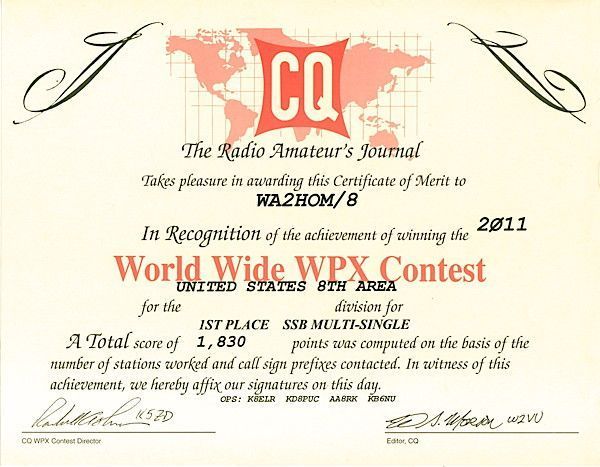
All l Can Say is WOW!!

To break in the new beam yesterday, down at the museum, we participated in a couple of contests: the CQ Manchester Mineira DX Contest (MM) and the Michigan QSO Party (MIQP).  All I can say is, “WOW!!”

I got there just before 11 am. Jim, K8ELR, was already there making out QSL cards. Since the MIQP didn’t start until noon, I thought I’d tune around and see what bands were open. I first tried 15m CW. That’s how I discovered the MM DX contest. The band was very open to Europe, especially with the new beam. In short order, I worked a dozen or more Europeans and Caribbean stations.

What a difference the beam makes! With the 20m inverted vee, nearly every QSO was a challenge, but with the beam, I worked every station I called, usually on the first try. This was so amazing that I was actually getting a little giddy.

About 11:45 am, I decided that I better get set up for the MIQP. I had brought my WinKeyer (since the Omni VII doesn’t have a memory keyer!), and wanted to hook it up to the N1MM program. I had done this quite easily at home, but I could not, unfortunately, get it to work on the computer down at the museum. The computer seemed to be talking to the keyer, but the function keys didn’t work. (If anyone has any ideas on what I’m doing wrong, I’d be happy to hear them.)

A little after noon, I decided to give up on this, and just program the keyer itself and operate stand-alone. About 12:10, we were working the MIQP on 20m using the callsign W8CWN, the callsign of H. Richard Crane, a distinguished professor of physics at the University of Michigan and one of the founders of the Ann Arbor Hands-On Museum.

Again, the performance of the beam was just spectacular, at least compared to our 20m inverted vee. We pointed the beam west and easily worked stations on the West Coast. We pointed the beam east and got calls from Europeans and the East Coast.

Using the beam, our noise level seemed to be lower, too, although not as low as I would like it. We’re going to have to work on that some more.

We worked a lot of 40m, too, using our 40m inverted vee. That antenna has always worked pretty well for us, and the band was in good shape yesterday afternoon. There was a lot of short skip on 40m, allowing us work quite a few Michigan counties.

Overall, we made 195 contacts in nearly five hours. That’s certainly not championship form, but it’s a lot better than we’ve done in the past, and we really had a blast, both operating the contest and explaining what we were doing to the museum visitors. It’s just too bad that the museum closed at 5pm and we had to stop.

WA2HOM: The Tower is Up and We’re Beaming to the World

It’s been one heckuva project, but the tower and beam are now up and running at WA2HOM, our club station at the Ann Arbor Hands-On Museum. See the pictures below.

I’d like to thank everyone involved in this project: Roger, W8OMB, for donating the beam; Jack, WT8N, who really spearheaded the project; Jim, K8ELR; Ovide, K8EV; Rob, KD8PUC; and of course, all the museum people: Mel, the museum director; Dave, the old facilities manager; and Doug, the new facilities director.

As you can see from the photos below, we still have some work left to do. We’re going to be taking down the 30-ft. mast (in the foreground) and moving the dipoles back so that they hand from the tower. And, since we no longer need a 20m inverted vee, we’ll be disconnecting the 20m elements and attaching some 30m elements.

After raising the tower yesterday, Ovide and Jim made a couple of contacts, one on 15m phone and one on 20m phone. They report that both guys gave us 59 signal reports. What a change from the puny signal we used to have on 20m.

Tomorrow, we’re really going to be putting this antenna system to the test as we operate the MI QSO Party. We’ll be using the callsign W8CWN, which used to belong to Dr. Richard Crane, the U-M physicist who was a great science educator and built many of the early displays down at the museum.  Listen for us, and give us a call if you hear us.


The tower is up!

The tower is up! This the view of our tower and beam from the north, facing the main entrance of the museum. In the foreground is our 30' mast, with the 40m and 20m inverted vees.

Doug and Ovide on the Roof

This is Doug (left), the museum's new facilities manager, and Ovide, K8EV (right), discussing how best to raise the tower.

Dan, Jim, and Jack

From left to right: Dan, KB6NU; Jim, K8ELR; and Jack, WT8N in the WA2HOM shack after the tower-raising. We can't believe that the tower is finally up and the beam is working like a charm.


Three Kids Wrangled on Saturday

Ovide, K8EV, our “kid wrangler,” did his thing yesterday and we were able to get three kids on the air. Seven-year-old Jack was our first kid communicator; he spoke to K9IRO. Peter was our second, and Brian our third.  A good time was had by all.

We were very fortunate in that band conditions on 40m were very good. All three stations we talked to were 57 – 59, and no one had to strain to hear one another.

Tower Update
We’re making progress slowly, but surely on the tower project. Over the course of last week, I mounted all the lightning arrestors to the mounting plate that goes in the NEMA box. On Friday, Jack, Dave, and I lowered the tower and mounted the rotor plate and rotor. We mounted the thrust bearing, too, but after inspection, John decided that it needed some kind of cap to prevent water from pooling in it.

New Additions to WA2HOM

We’ve added a couple of new things to WA2HOM, most notably our new QSL display and we’ve finally gotten our maps framed and hung.

The QSL display is shown at right. What they did was to put a plexiglass frame over the railing separating the station from the ramp. This allows museum visitors to get a closer view of our QSL cards. Up near the desk, we have our DX QSL cards; down by the door to the shack, we have the domestic QSLs.

The maps are shown below. They are mounted on the wall opposite the shack door. We haven’t yet done this, but the plan is to put little dots on the maps to mark the locations of stations we’ve contacted. This will give our visitors a very visual indication of what we can do with ham radio. WA2HOM Maps

New Exhibits in Place
There are also a couple of new exhibits in place.  Joining the “see your voice on the oscilloscope” exhibit, is the Morse Code exhibit and the crystal radio exhibit. (I should have also taken pictures of those exhibits, but just didn’t for some strange reason.)

The Morse code exhibit features two ruggedized straight keys, one connected to an audio oscillator, the other connected to a telegraphy sounder. It’s kind of interesting to compare the two different sounds.

The Final Frontier
The last piece of the puzzle is the tower and beam.  I’m told that they’re making progress on this. Permits have been pulled and orders have been placed. I’m hoping that the beam will be up by the end of September.

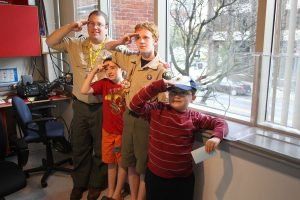
WA2HOM Introduces Cub Scouts to Ham Radio

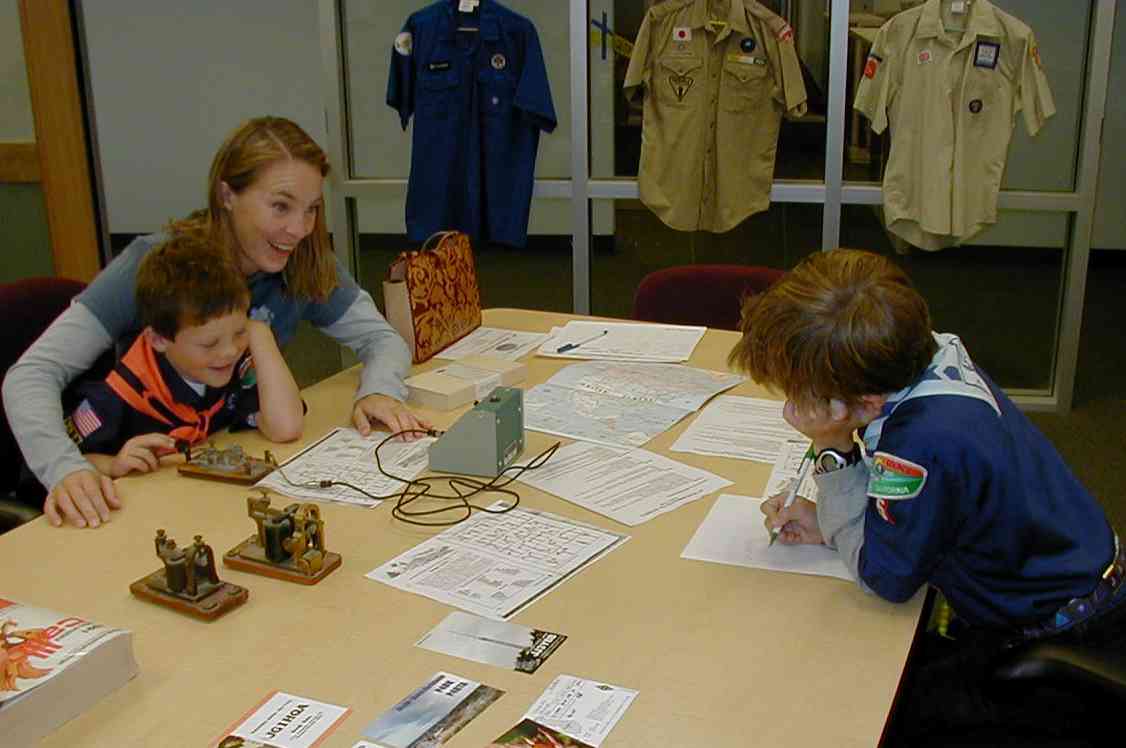
Yesterday, down at the museum, we got a whole pack of Cub Scouts on the air, thanks to Ovide, K8EV, my ever-ambitious “kid wrangler.” No sooner had I managed to make a decent contact than he lassoed a group of five Cub Scouts from Detroit. Fortunately, conditions held out so that I could give them all a turn at the mike.

They must have liked it and told their buddies. About a half hour later, another group showed up. Fortunately, I was already in another QSO (with W3BEE), and he was gracious enough to talk to everyone in the second group.

W3BEE is a very interesting guy. As his vanity call implies, he’s a beekeeper as well as a ham. I’ve often thought about trying beekeeping—especially because of the bee crisis. He encouraged me to look into it further, noting that now is the time to start preparing for next year.

This Weekend on the Air at KB6NU/WA2HOM

This weekend, I got sucked into two contests. The first—the MI QSO Party—I operated on Saturday down at the Hands-On Museum.

I got to the museum around 10 am, and the contest didn’t start until noon, so I fiddled around a bit, trying to figure out how the bands were. I made three contacts on 40m and a couple of contacts on 20m, so it looked like band conditions were going to cooperate.

When noon hit, I was off and running. Switching back and forth between 40m and 20m, I made a total of 90 contacts in the next two hours, including three DX contacts. Not stellar, but not bad, either.

Having my WinKeyer certainly helped. As I’ve mentioned, the Omni VII doesn’t have a built-in memory keyer, meaning that in previous contests, I had to bang out the CQs myself. The WinKeyer improved the process immensely.

When Pigs Fly…
Sunday evening, I participated in the Flying Pigs QRP Club’s monthly “Run for the Bacon.” This is a two-hour “sprint” that takes place on the third Sunday of every month. Since my KX-1 was already set up (my IC-746PRO is still in the shop), it was easy enough to get into this contest.

Band conditions on 40m were great! I was able to camp on a frequency and even run stations for a while. I worked as far west as Nebraska and South Dakota and all up and down the East Coast. In just more than one hour, I made 18 contacts, scoring 616 points.

Scoring is on the honor system and is done online. You enter your data into a Web page on the Flying Pigs website. Contacting members of the FP-QRP Club counts for three points, while contacting non-members counts for one point. After you’ve entered your data, the website automatically calculates your score and ranks you. As of 2 pm this afternoon, I’m still in the top ten, even though I only operated the first hour, and because my KX-1 doesn’t have 80m capability, only 40m.

I really like operating in these smaller contests. They’re way less chaotic and intense than the big contests, and can be just as much fun.

WA2HOM Operating Notes – April 10, 2010

Yesterday, it was just me down at the museum. I made a couple of great contacts, though.

The first was with Fred, KI4XH. Fred was operating his Collins S-Line gear, and keying it with a bug. About halfway through the QSO, he switched over to a VibroKeyer single-lever paddle, keying a Hallicrafters HA-1 keyer.

The HA-1, or T.O. Keyer, was a commercialization of the vaccum-tube keyer designed by W9TO. in the 1950s. It occurred to me that maybe building one of these things is something that I could do with al the tubes that I have. Unfortunately, I can’t seem to find the schematic on the Net. There is an an article in the May 1959 issue of QST by W9TO, but this is for the first transistor keyer. If any of you have a schematic and can scan it for me, or can point me to where I can find it, I would appreciate it.

Titanic Duo
After making a couple of CW contacts, I thought I’d try making a phone contact. Tuning to 7220 kHz, I found our favorite frequency occupied by W0S, a special event station commemorating the sinking of the Titanic. W0S was operating from the Titanic Museum in Branson, MO. According to their website, “This event will commemorate the heroic efforts of Harold McBride and John ‘Jack’ Phillips as they sat at the Marconi radio in the Titanic sending the first ever SOS.” They’ll be on the air until 2200 UTC Sunday, April 11.

My last QSO was with W1T, a station that was also commemorating the sinking of the Titanic. I made the contact on 14.050 MHz. W1T was operating from somewhere in Maine. At first, I thought that perhaps this was a CW operation from W0S, but it was a completely separate operation. I was unable to find any information on the Net about this station, but they did give me QSL info, so I can get a card from them.

In searching the Net, I found a third special event station commemorating the Titanic. This is an operation of the Titanic Historical Society, which is located in the Springfield, MA area. If I’d known about this, I bet that I could have worked them. Maybe next year.

A Man After My Own Heart

In addition to the first packet of QSL cards from the W2 bureau (see previous post), I received a card from Hugh, NT5O. Hugh writes, “Hello, and thank you very much for the ‘wrong number’ QSO in the 2009 Texas QSO Party.” That confused me for a second. I thought, “Did we send him the wrong serial number? And, if we did, why was he thanking me?”

Well, he went on to say,

You are my first 2-call from the 8-state of Michigan. I am trying to work and confirm all the ten numbers from each state—no mobiles or portables. I have 253 of the 500 confirmed so far, and a wrong number from every state except Wyoming. (I guess nobody ever moves there.)

Once I figure out what he meant by “wrong number QSO,” I smiled. I’m not the only one who has a weird QSL collection. In fact, after figuring out what it is that he was trying to do, I asked myself why didn’t I think of that! Hugh is certainly a man after my own heart.

WA2HOM Gets First Pack of QSLs from Buro

WA2HOM, the club station at the Ann Arbor Hands-On Museum, of which I am station manager, received its first pack of DX QSLs from the W2 incoming bureau. There was one card from the Bahamas (C6AGU), one from Spain (EE5E), and two from Germany (DL7ON, DL3YM). EE5E claims to have the “shortest CW callsign in the world!”

By the way, WA2HOM now has its own website. Go to WA2HOM.Org or look in the right-hand column of this blog to see the latest posts there.

Library Patrons to Experience Shortwave Radio

This is an interesting idea. This might be something we could do at the Hands-On Museum when we’re not operating the rig there….Dan

From NorwalkPlus.com, Sep 29, 2009

Experience the adventure of shortwave radio at the Norwalk Public Library

NORWALK, CT – SEPTEMBER 29, 2009 – In the midst of today’s electronic gadgetry and communications innovation little is either known or remembered about shortwave radio – sending and receiving. But the Norwalk Public Library, in partnership with the Greater Norwalk Amateur Radio Club (GNARC) is offering an opportunity to experience the thrill and adventure of “ham” radio.

With a 66 foot-long inverted “Vee” antenna mounted on the Main Library’s roof, radio signals from all over the world can be heard on the shortwave receiver in place on the Main Level. The receiver is available for public use. The headset attachment is located at the Information Desk.

The receiver and antenna was installed by Jay Kolinsky, Gus Hedlund and Curt Seaton of the GNARC and Collin Pratt of the Library staff.

Kolinsky explains “Very few people under 40 have ever seen a shortwave receiver much less heard what the actual signals sound like.”

Interestingly, amateur radio operators, also known as “Hams”, are credited with the discovery of long-distance communication. Radio ‘Hams’ conducted the first successful shortwave transatlantic tests in December 1921. For years, shortwave radio was the only, and a popular method of hearing broadcasts from Europe and most all other parts of the world. It has always played an important part in communicating news, information and helping coordinate emergency efforts – it being a “wireless” way to send and receive spoken words, Morse code, and teletype. “The shortwave signals go through the air,” Kolinsky continues, “and are not dependent on telephone lines, internet and other physical connections.”

If the public begins to show interest, the GNARC will conduct shortwave orientations to explain and demonstrate shortwave radio, foreign broadcasts, and talking to people – other amateur operators – across the globe right from the Library without connecting to any wire communications grid.

The GNARC, founded in the 1930s, has about 100 members from all walks of life and meets monthly.

“Hams” in the United States are licensed by the Federal Communications Commission. They are authorized to use thousands of radio frequencies for transmitting. Besides making friends worldwide, “Hams” continue to handle emergency radio traffic during times of severe disasters when electricity, phone, commercial and government communications systems fail.

For more information about Ham Radio, visit the GNARC website – www.gnarc.org- or contact Jay Kolinsky at ne2q@arrl.net.

For use of the shortwave receiver installed at the Main library inquire at the Information Desk, Norwalk Public Library, 1 Belden Avenue. Corner of Mott Avenue and Belden Avenue.